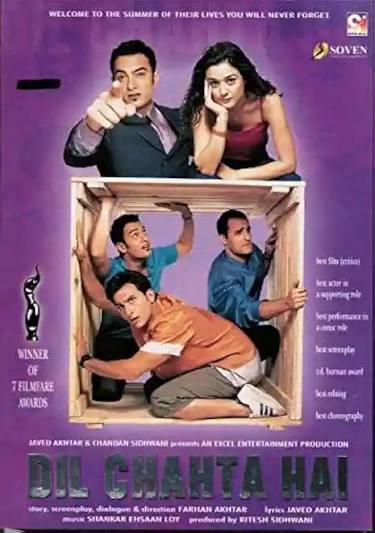
Dil Chahta Hai 2001
Dil Chahta Hai 2001 at Twenty-Five — We Called It a Coming-of-Age Film. We Were Wrong. It Is a Film About the Terror of Becoming.
Twenty-five years later, what looked like a breezy celebration of male friendship reveals itself as one of the most precise and most quietly devastating films ever made about the moment a person understands that who they were is not who they are going to be — and that there is no going back.
When Dil Chahta Hai released in 2001, it was received as a liberation. Here was a Hindi film that did not require its characters to suffer for their joy. Here were three young men — Akash, Sid, Sameer — who dressed well, travelled to Goa, fell in love without the universe punishing them for it. The film felt like a door opening. Indian popular cinema had never looked like this, moved like this, spoken like this.
We loved it for what it freed us from. We did not fully see what it was about.
Watching it again in 2025, what strikes me first is how frightened it is. Not the characters — Farhan Akhtar keeps them performing confidence throughout — but the film itself. Beneath the gorgeous Shankar-Ehsaan-Loy score, beneath the Goa cinematography, beneath the wit of the dialogue, Dil Chahta Hai is a film about three people who are about to lose each other and cannot stop it from happening and do not fully understand that this is what is happening until it has already happened.
The film's real subject is not friendship. It is the end of a specific kind of friendship — the total, unconditional, history-saturated friendship of early adulthood — and what replaces it when the people involved become, inevitably, actual adults with actual lives that do not include each other at their centre.
Consider the structure. The film begins with the three friends as a unit so close they finish each other's sentences, share the same frame, move through the world as a single organism. It ends with each of them alone — alone with a romantic partner, alone with a career, alone with an adult life. The reunion in the final act is joyful. It is also the reunion of three people who will never again be what they were to each other. The film knows this. The final image knows this. We were too happy watching it to notice.
Akash's arc is the cruelest and the most honest. He is the one who defends himself most aggressively against change, who performs the loudest certainty about who he is and what he wants, who ridicules Sid's feelings with a viciousness the film frames as comedy but which is actually terror. When Akash finally falls in love — genuinely, helplessly, against his will — the film's most telling detail is that it happens entirely without his consent. He does not choose to fall in love with Shalini. It happens to him. He resists it. He is changed by it anyway.
Aamir Khan plays this with something I did not appreciate at twenty and cannot stop seeing at forty. Every scene where Akash is most performatively himself — most loud, most certain, most aggressively confident — Khan plays with a barely perceptible register of fear underneath. The performance is a mask that occasionally slips. Not in obvious emotional moments. In the in-between moments. The moments when Akash thinks nobody is watching him.
Sid's storyline, which the original audience largely experienced as the film's emotional centrepiece — his love for Tara, played with extraordinary restraint by Dimple Kapadia — reads differently now. What seemed like a digression from the main story of friendship is actually the film's argument stated plainly. Sid falls in love with someone older, someone damaged, someone who cannot love him back in the way he needs. And in falling in love with her he becomes a different person — a person his friends do not recognise, a person who can no longer fit back into the organism they were. Sid's love for Tara does not complete him. It separates him. That is the film's most honest observation about what adult love actually does.
Sameer is the film's thesis statement told as comic relief. He falls in and out of love constantly, chaotically, without apparent depth. But what Sameer is doing — and what Saif Ali Khan plays with more intelligence than he was given credit for — is practising. He is rehearsing for the permanent commitment he knows is coming and is terrified of. Every failed relationship is a postponement of the self he is about to become.
Shankar-Ehsaan-Loy's score, which we heard in 2001 as celebratory, sounds different in 2025. Woh Ladki Hai Kahan is not a song about finding someone. It is a song about searching — about the specific restlessness of a person who knows their life is about to change and cannot see what it is changing into. Koi Kahe is not a song about confidence. It is a song that performs confidence so insistently it implies its opposite.
Farhan Akhtar's debut film is twenty-five years old and it has aged into something his twenty-five-year-old self could not have intended but which the film earned honestly. It is not a celebration of youth. It is a farewell to a specific kind of selfhood — the selfhood of people who have not yet been required to become someone.
We called it a coming-of-age film. It is actually a film about what age takes from you. The difference matters. Watch it again.
Original verdict: A breezy, joyful liberation. Revised verdict: One of the most precise films ever made about the specific grief of becoming an adult. Rating revised from 8.0 to 9.0 / 10. By Republic of Cinema · Reframe · Republic of Cinema
💬 Discussion
0 comments