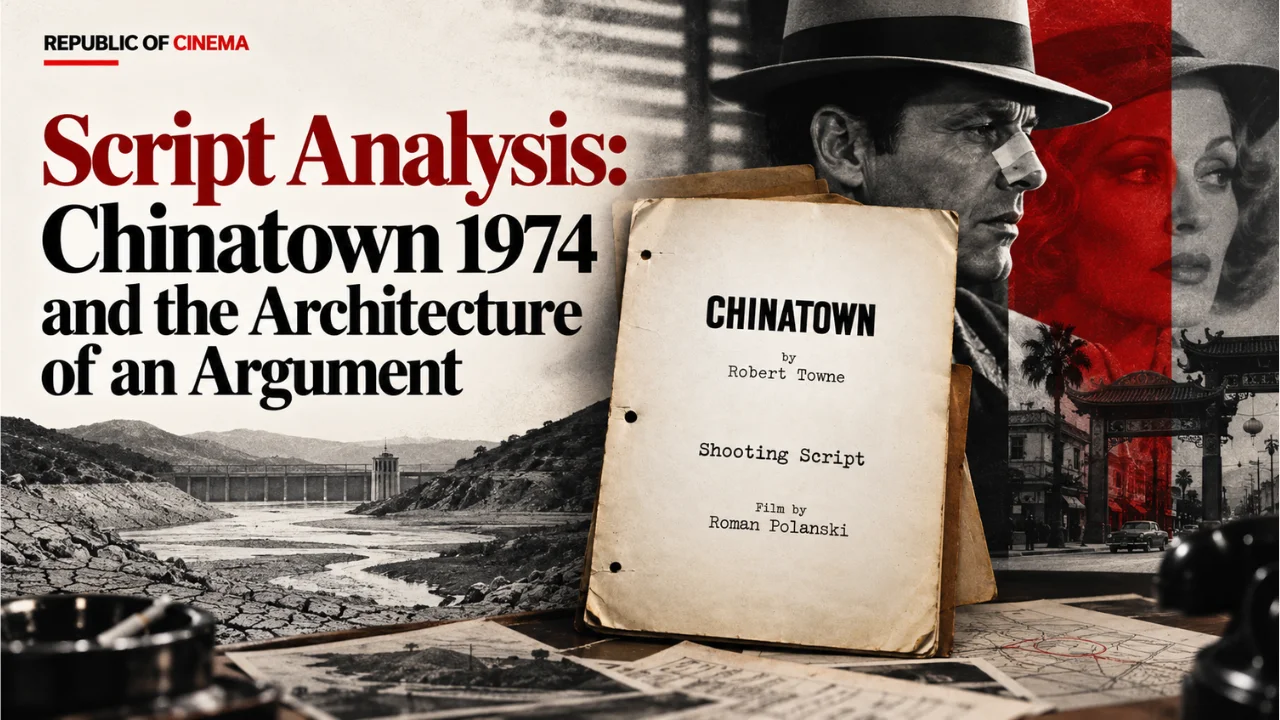
The Chinatown Script Is the Most Studied Screenplay in Film History — Here Is What That Study Almost Always Misses, and What Reading It Correctly Teaches Every Serious Writer About Structure, Moral Complexity, and the Specific Genius of the Last Scene
Robert Towne wrote Chinatown in 1973. He spent two years on it. He was paid $175,000. The script he delivered is the most formally perfect screenplay written in the American cinema of its era and the one that most completely demonstrates the difference between a film that has a plot and a film that has an argument. The argument is in the last scene. Understanding the last scene requires understanding everything that precedes it.
Begin with what is usually said about the Chinatown screenplay, because the usual account misses the most important thing. The usual account is that Chinatown is great because of its structure — the tight, classical three-act architecture, the brilliant use of the detective genre to expose corruption, the way each investigation lead opens into the next. This is all true. The structure is extraordinary. The plotting is among the most elegant in American film history.
But structure is the vehicle. The argument is something else. And the argument — which is what makes Chinatown not simply a great genre film but one of the great films in any genre — lives not in the structure but in what the structure is in service of.
The argument of Chinatown is this: the most powerful systems of corruption are the ones that use the mechanisms of justice against the people seeking justice. The very act of trying to do the right thing — to investigate, to expose, to protect — becomes the mechanism through which the corrupt system destroys its victims and consolidates its power.
Jake Gittes does not fail because he is incompetent. He fails because his competence — his specific ability to find the truth — is used by Noah Cross to locate Evelyn and her daughter. Every discovery Jake makes leads directly to the catastrophe he is trying to prevent. His intelligence is the weapon that kills the woman he is trying to save.
This is not a plot twist. It is a structural argument about power — about the specific way that systemic corruption operates not by defeating the people who fight it but by using the fight against them.
How Towne builds the argument — scene by scene
The script opens with Jake Gittes as a confident, competent, slightly cynical private detective — a man who knows how the world works and has made his peace with that knowledge. He operates in the grey areas of human behaviour without apparent distress. He is funny, observant, professionally competent, and emotionally armoured.
The script's first act uses the conventions of the detective genre to establish this character and to begin the investigation that will destroy his armour. The false Mrs. Mulwray hires him. He follows Hollis Mulwray. He finds apparent evidence of infidelity. He is satisfied with his competence.
Then the real Mrs. Mulwray appears and Jake's confidence — the confidence of a man who believes he understands how the world works — is the first casualty of his encounter with Noah Cross.
Towne builds the second act around a series of investigations each of which reveals something that the previous investigation did not explain — the water theft, the land fraud, the relationship between Cross and the water commission, the specific nature of the Mulwray marriage. Each revelation is satisfying as a plot development and disturbing as a moral revelation. The world being revealed is not simply corrupt in the conventional detective genre sense — it is specifically corrupt in a way that uses the mechanisms of civic life and legal order as instruments of private predation.
The introduction of Evelyn Mulwray and the mystery of her relationship with Catherine changes the register of the script. It introduces a personal stake for Jake — emotional involvement that the detective genre conventionally uses to motivate the protagonist's continued investigation but that Towne uses differently. Jake's growing involvement with Evelyn does not give him additional motivation to expose the corruption. It gives Noah Cross additional leverage over him.
This is the structural genius of the Chinatown script. The conventional detective narrative uses the protagonist's personal investment in the case as a source of strength — the thing that keeps him going when the investigation becomes dangerous. Towne uses Jake's personal investment as a vulnerability — the thing that makes him susceptible to the specific manipulation that Cross exploits.
The last scene — why it is what it is and why Polanski was right
The most discussed fact about the Chinatown screenplay is the ending. Towne wrote an ending in which Evelyn Mulwray survives — in which Jake succeeds, more or less, and the corruption is at least partially exposed. Polanski insisted on the ending in which Evelyn is killed, Catherine is taken by Cross, and Jake is left standing in Chinatown having caused the exact destruction he was trying to prevent.
Towne has said publicly that Polanski was wrong. He is wrong about this. Polanski was right, and understanding why requires understanding what the script's argument is.
If Evelyn survives, the script becomes a story about how a flawed but good man solves a complicated problem against significant odds. The corruption is real but it is not invincible. The system can be beaten by sufficient intelligence and sufficient courage. This is the conventional detective genre's moral position and it is a comfortable one.
If Evelyn is killed and Catherine is taken, the script becomes something completely different. It becomes an argument that the specific kind of corruption that Noah Cross represents — the corruption that is so completely integrated into the structures of civic life that fighting it through those structures only strengthens it — is not simply a problem to be solved. It is a condition to be understood. Jake does not fail because he was insufficiently clever or insufficiently brave. He fails because the system he is fighting has anticipated and incorporated his competence.
The last line — "Forget it, Jake. It's Chinatown" — is the script's thesis statement delivered as resignation. Chinatown is not a place. It is a condition — the condition of trying to do the right thing in a situation where doing the right thing has been made into a mechanism for achieving the wrong outcome. Jake has been in Chinatown before. He failed then. He has failed again. The failure is not accidental. It is structural.
What writers learn from studying this script
The first lesson is the distinction between plot and argument — between the sequence of events that tells you what happened and the structural logic that tells you what those events mean. Every event in the Chinatown script is in service of the argument. Nothing is there simply for entertainment or for interest. Every scene advances the plot and deepens the argument simultaneously.
The second lesson is the use of genre as a critical instrument — the way Towne uses the detective genre's conventions not to satisfy them but to subvert them, using the genre's promise of resolution to make the absence of resolution more complete when it arrives.
The third lesson — the most important — is the function of the ending. The ending of a screenplay is the argument's conclusion. It is not simply how the plot resolves. It is the specific position the film takes on the specific question it has been asking. Towne's original ending resolved the plot but avoided the argument's conclusion. Polanski's ending resolved both.
Every screenwriter who reads the Chinatown script should read it twice — once following the plot and once following the argument. The distance between those two readings is the space where the script's specific genius lives. Finding that space, in your own work, is the most important craft challenge in screenwriting. Chinatown shows you what it looks like when a writer has found it.
💬 Discussion
0 comments