The Ten Books Every Serious Cinephile Must Read — Not the Most Academic, Not the Most Technical, but the Ten That Will Permanently Change How You Watch Films
This is not a comprehensive bibliography. It is a guided reading sequence — ten books in the order that builds each one on the last, from the most accessible to the most demanding, from the practical to the philosophical. Read them in this order. What you understand about cinema when you finish the tenth will be completely different from what you understood before you opened the first.
Before the list, the principle that governs it.
Most recommended reading lists for cinephiles are organised by category — screenwriting books here, cinematography books there, film theory over there. This organisation is useful for reference. It is not useful for building a complete understanding of cinema, because cinema is not a collection of separate disciplines. It is a single practice in which every element affects every other. A book about editing that you read without a foundation in film theory will teach you technique without philosophy. A book about film theory that you read without a foundation in film practice will teach you concepts without application.
The sequence below is built around the principle of progressive depth — each book opens a question that the next book provides the framework to engage with more completely. Begin at the beginning. Do not skip ahead.
Book 1: Hitchcock/Truffaut (1966) · François Truffaut
Begin here because it is the most immediately engaging book about filmmaking ever written and because it opens every subsequent question without requiring any prior knowledge.
Truffaut's book-length interview with Alfred Hitchcock — conducted over eight days in 1962, translated into English, illustrated with frame enlargements from Hitchcock's films — is simultaneously a master class in visual storytelling, a practical education in the craft of directing, and a philosophical conversation about what cinema can do that no other art form can. Hitchcock explains, in plain language, every formal decision in every major film he made. He explains why the camera is here and not there, why this edit and not that one, why this performance note and not another. He explains the mechanism of suspense with a precision and an intelligence that makes every thriller you watch afterwards richer.
Read it slowly. Stop at the frame enlargements. Ask yourself what each one is doing before Hitchcock tells you. You will be wrong often. The wrongness is the education.
Book 2: Adventures in the Screen Trade (1983) · William Goldman
The second book is the most honest account of professional screenwriting ever written — honest in the specific sense that it tells you things about how Hollywood actually works that people who work in Hollywood are not supposed to say publicly.
Goldman wrote Butch Cassidy and the Sundance Kid, All the President's Men, Marathon Man, and dozens of other produced screenplays. He also wrote some of the most commercially successful films of his era that were critical disasters, and he is honest about both. His central thesis — "Nobody knows anything," meaning that nobody in Hollywood can predict with confidence what will succeed and what will fail — is both the most liberating and the most terrifying thing you can understand about the film industry.
The practical chapters on the structure of screenwriting — on what a scene needs to do, on the specific mechanics of a screenplay's opening, on the relationship between what a character says and what they mean — are worth more than most formal screenwriting courses.
Book 3: On Filmmaking (2005) · Alexander Mackendrick
The third book is the most rigorously intelligent book about the craft of directing ever written. Mackendrick directed The Sweet Smell of Success and The Ladykillers and spent twenty years teaching film at CalArts, and this book is the compilation of his teaching notes — a complete, systematic account of how cinema works at the level of scene construction, visual storytelling, and narrative strategy.
What distinguishes Mackendrick from most books about filmmaking is his insistence on the primacy of the image — on the principle that cinema tells its story primarily in pictures and that dialogue is a supplement to the visual story rather than its primary carrier. His analysis of specific sequences in classic films — breaking down exactly what each shot is doing and why the sequence achieves its effect — is the most practically useful close reading of cinema available in print.
Read this alongside specific films. Mackendrick's analysis of a scene from Sunset Boulevard is worth more when you can see the scene he is discussing than when you are reading about it in the abstract.
Book 4: The Conversations: Walter Murch and the Art of Editing Film (2002) · Michael Ondaatje
The fourth book is organised like the first — a conversation, this time between novelist Michael Ondaatje and Walter Murch, the editor of Apocalypse Now, The Godfather Parts II and III, and The English Patient.
Murch is the most philosophically sophisticated thinker about editing in cinema, and this book is the most complete account of how a serious editor thinks — about rhythm, about the relationship between picture and sound, about the specific quality of attention that the editing process requires. His account of editing Apocalypse Now — working from hundreds of hours of footage that Coppola himself described as unusable — is the most extraordinary account of creative problem-solving under pressure in the literature of cinema.
The book also contains Murch's famous "rule of six" — the hierarchy of criteria for evaluating a cut — which is the most useful analytical framework for thinking about editing decisions available anywhere.
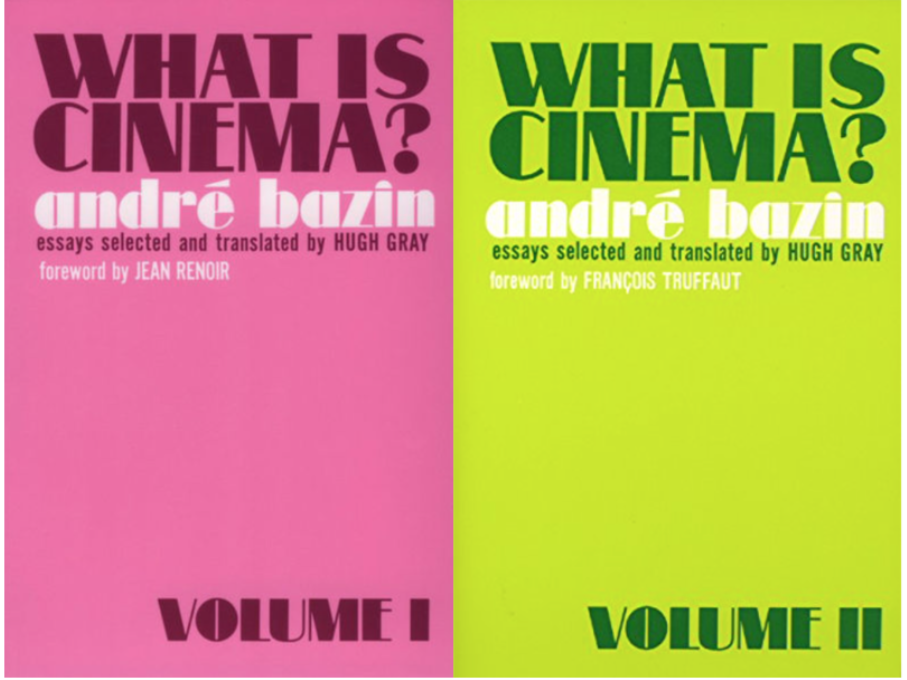
Book 5: What is Cinema? (1958-1962) · André Bazin
The fifth book is the first genuinely theoretical text on this list, and the reason it comes fifth rather than first is that without the foundation of the previous four books — without some understanding of what filmmakers are actually doing — Bazin's philosophical arguments are harder to anchor in the practical reality of cinema.
With that foundation, Bazin's collected essays are the most important theoretical text about cinema ever written. His ontological argument about the photographic image — that a photograph is a trace of reality rather than a representation of it, caused by its subject rather than resembling it — is the foundation of all subsequent serious thinking about what cinema is. His analysis of the long take and deep focus photography as formal expressions of a specific relationship with reality is the most rigorous account of why formal choices in cinema have philosophical implications.
Read the four volumes in order. Volume one, on the ontology of the image and the myth of total cinema, is the most important. Do not stop there.
Book 6: The Poetics of Cinema (2008) · Raúl Ruiz
The sixth book is the most formally radical text on this list and the one that will most completely challenge the understanding of cinema that the first five books have built.
Ruiz was a Chilean filmmaker who made over a hundred films and wrote one of the strangest and most intellectually rich theoretical texts about cinema ever produced. The Poetics of Cinema is not a systematic argument. It is a collection of provocations, hypotheses, and formal experiments that challenge almost every conventional assumption about what cinema is for and how it works.
His central argument — that the dominant form of narrative cinema is built on a principle of central conflict (protagonist wants something, something prevents them from having it) that is not a universal narrative principle but a specific cultural convention — is one of the most interesting attacks on the foundations of mainstream film theory. Read it as a provocation rather than a system. Allow it to make you uncertain about things you thought you understood.
Book 7: Sculpting in Time (1986) · Andrei Tarkovsky
The seventh book is the most completely personal theoretical statement made by any major filmmaker — Tarkovsky's account of his own creative philosophy, written in the last years of his life as he was dying of cancer.
Tarkovsky's argument about time — that cinema is the only art form that can sculpt time directly, that the filmmaker's primary material is not image or sound but time itself, that a shot's duration is as creative a decision as its composition — is the most original contribution to film theory made by a practising filmmaker. His account of the creative process — of how a film image is found rather than constructed, of what it means for an image to be truthful, of the relationship between personal experience and artistic expression — is unlike anything else in the literature of cinema.
Read it as philosophy rather than as technical instruction. Tarkovsky is not explaining how to make films. He is explaining what films are for — what the experience of cinema, at its deepest, offers the person watching it and the person making it.
Book 8: The Cinema of Satyajit Ray (1994) · Chidananda Dasgupta
The eighth book is included not simply because it is the most serious English-language account of Satyajit Ray's work — though it is — but because it is the most complete demonstration of what serious film criticism about Indian cinema looks like when it is done with the depth and intelligence that Indian cinema deserves.
Dasgupta was Ray's contemporary and friend, but the book he wrote about Ray's work is not hagiography. It is rigorous, specific, occasionally critical, and built on a deep understanding of both the films themselves and the cultural and historical context that produced them. Reading it alongside the Ray films creates the kind of critical education that a film school curriculum, at its best, attempts to provide.
The book is also a model of what Republic of Cinema aspires to produce — criticism that treats Indian cinema with the same seriousness that the international critical establishment treats European and American cinema. That seriousness is the standard. This book demonstrates that the standard is achievable.
Book 9: Film Form and The Film Sense (1942, 1943) · Sergei Eisenstein
The ninth book is the most systematic theoretical account of how meaning is created in cinema ever written — Eisenstein's formal theory of montage, developed across two volumes that are most productively read together.
Eisenstein's theory of montage as dialectic — the argument that meaning in cinema is generated through the collision of images rather than through the content of individual images — is the most important counter-position to Bazin's realism, and understanding it fully requires having already worked through Bazin's argument with the depth that the seventh and eighth books should have produced.
The practical chapters on the construction of specific sequences — including the analysis of the Odessa Steps sequence in Battleship Potemkin — are the most rigorous formal analyses of editing in the literature of cinema. Read them with the sequences themselves available for reference. Pause the sequences at the points Eisenstein discusses. See whether you find what he finds.
Book 10: Gilles Deleuze: Cinema 1 — The Movement Image and Cinema 2 — The Time Image (1983, 1985)
The tenth book is the most demanding text on this list and the one that will produce the most complete transformation in how you think about cinema — if you read it after the nine books that precede it, with the foundation they provide.
Deleuze's two-volume philosophical account of cinema — built on his reading of Bergson's philosophy of time and applied to the complete history of cinema from the silent era to the late twentieth century — is the most ambitious theoretical project about cinema ever undertaken. It does not simply describe what cinema does. It argues that cinema, at its greatest, is a form of philosophical thinking — that certain films do not simply represent thought but enact it, do not simply tell stories about time but create specific experiences of time that philosophy in language cannot create.
Cinema 1 covers what Deleuze calls the movement-image — the cinema of the action, the perception, the affection, the classical Hollywood cinema and its European equivalents. Cinema 2 covers the time-image — the cinema that emerged from Neorealism, that creates a different relationship with time, that shows time rather than movement.
The reading is difficult. It requires the foundation that the previous nine books have built. It also requires patience — Deleuze does not explain himself for the reader who is coming cold. He assumes you have watched the films he discusses and thought about them seriously. If you have worked through the previous nine books on this list, you have.
What you will understand when you finish these ten books that you did not understand before you began them: what cinema is — not as an entertainment medium or an industry but as a form of human thought and human experience that has no equivalent in any other art form. That understanding will make you a better viewer, a better writer, a better filmmaker, and a better critic. It will also make every film you watch from that point forward richer — because you will see not just the image but the thinking behind the image, the tradition the image comes from, and the question the image is trying to answer.
💬 Discussion
0 comments