The 25 Films Every Serious Cinephile Must See Before Everything Else — Not the Most Famous, Not the Most Acclaimed, but the 25 That Will Permanently Change How You Watch Every Film That Comes After Them
This is not a greatest films list. Greatest films lists tell you what to admire. This is a list of films that function as perceptual education — films that, once seen, make you a fundamentally different viewer. The order matters. The reasoning matters more than the list.
There are two kinds of canonical film lists. The first kind tells you what the critical establishment considers the greatest achievements in cinema history. The Sight and Sound poll. The They Shoot Pictures list. These are useful. They are also built by consensus, which means they reflect the values of the institutions that produced them as much as they reflect the actual quality of the films.
The second kind — the kind this list attempts to be — tells you which films will most completely change how you see. Not which films are most celebrated but which films, encountered in the right order at the right stage of a cinephile's development, produce the most irreversible transformation in how cinema is experienced.
These are not the same list. Some films on the Sight and Sound top ten belong here. Some do not. Some films that have never appeared on a major canonical list belong here because of what they do to a viewer rather than what the critical establishment has said about them.
The order below is the order of encounter — the sequence in which these films build on each other most productively. Begin at the beginning.
01. Pather Panchali (1955) · Satyajit Ray Why first: Because it teaches you that cinema can look at the world with the same patience and the same compassion that the world requires from us. Nothing is rushed. Nothing is explained. Life happens and you watch it happen. After Pather Panchali you will never again accept a film that tells you how to feel before you have had the chance to feel it.
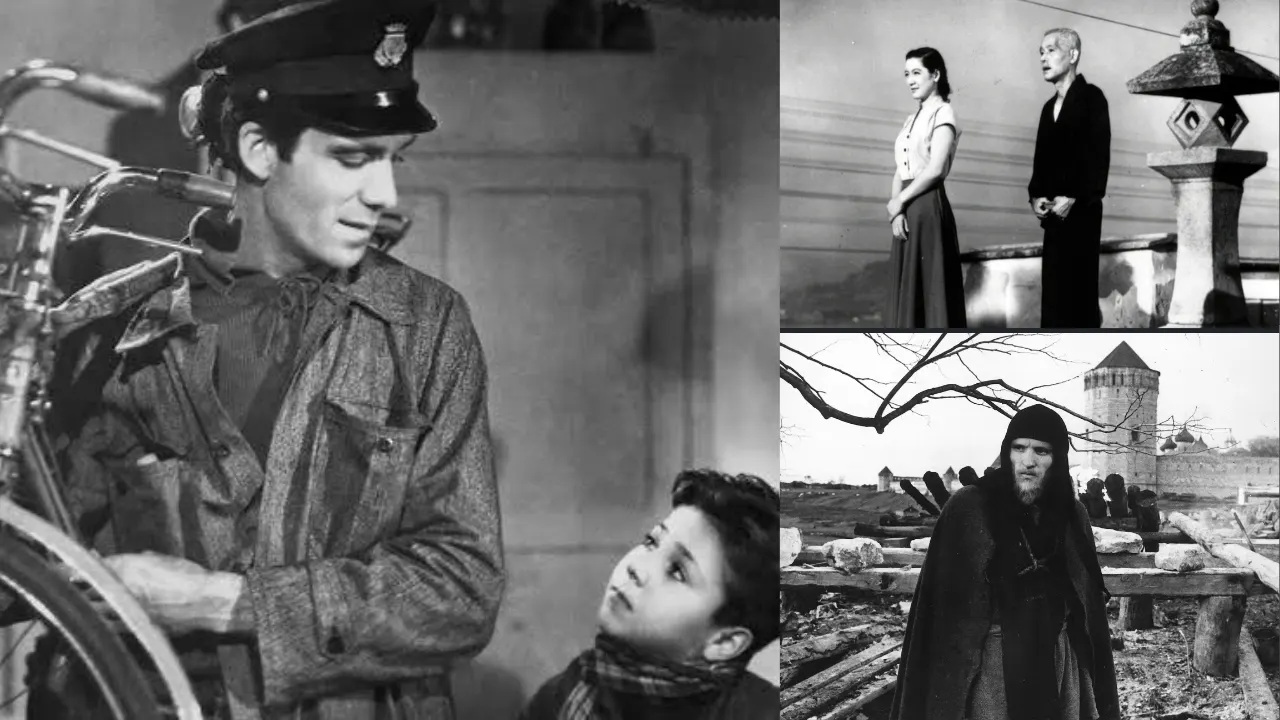
02. Tokyo Story (1953) · Yasujirō Ozu Why second: Because Ozu's camera never moves and his films contain more emotional movement than any film whose camera never stops. Tokyo Story teaches you that the most important things in cinema happen in the spaces between what is said — in the pauses, in the held shots, in the faces of people who are being polite about something that is breaking them.
03. Bicycle Thieves (1948) · Vittorio De Sica Why third: Because it demonstrates that a film with no stars, no studio, no invented drama — only two people looking for a stolen bicycle in a city that does not care — can be among the most gripping experiences cinema offers. It teaches you that specificity is more powerful than spectacle.
04. Breathless (1960) · Jean-Luc Godard Why fourth: Because it breaks every rule you have absorbed from the previous three films and teaches you that rules in cinema are not laws but choices. After Breathless you understand that every formal decision a filmmaker makes is a decision — that continuity editing, the establishing shot, the narrative arc are not natural features of cinema but conventions that can be refused.
05. 8½ (1963) · Federico Fellini Why fifth: Because it is the first film on this list that is entirely about the experience of being a filmmaker — the first film that takes cinema's relationship with its own making as its explicit subject. After 8½ you will never watch a film without being conscious that someone made it, that the making was a specific human experience, and that the film contains traces of that experience whether the filmmaker intended it to or not.
06. Persona (1966) · Ingmar Bergman Why sixth: Because it does something no other film does — it deliberately breaks the illusion of cinema mid-film, showing you the filmstrip burning, reminding you that you are watching a constructed object. And then it continues. And the continuation is more disturbing than the break. After Persona you can never again be entirely unconscious while watching a film.
07. 2001: A Space Odyssey (1968) · Stanley Kubrick Why seventh: Because it teaches you that cinema can be a philosophical instrument rather than a narrative one. The last twenty minutes of 2001 have no conventional meaning. They have only experience. After 2001 you understand that a film does not need to tell you what it means in order to mean something.
08. The Conformist (1970) · Bernardo Bertolucci Why eighth: Because it is the most beautiful film ever made about a man choosing evil, and because its beauty is the argument — the film uses its extraordinary cinematography to ask whether aesthetic pleasure and moral failure can occupy the same space. Vittorio Storaro's colour work here is the most sustained achievement in the history of cinematography.
09. Andrei Rublev (1966) · Andrei Tarkovsky Why ninth: Because it is the film that introduces you to Tarkovsky's world — to the specific experience of time, of silence, of mud and rain and candlelight as spiritual states rather than as atmospheres. After Andrei Rublev you will need to watch everything else Tarkovsky made. That is the correct response.
10. Charulata (1964) · Satyajit Ray Why tenth: Because it is Ray's most perfect film and because perfection in cinema looks like nothing you expect it to look like — not spectacular, not ambitious in any obvious way, simply completely right in every decision. After Charulata you understand what a filmmaker in full command of their medium looks like.
11. Jeanne Dielman (1975) · Chantal Akerman Why eleventh: Because it teaches you that duration is a political instrument. The film's three-hour running time is not a test of your endurance. It is an argument about whose time we are conditioned to find cinematic and whose we are not. After Jeanne Dielman you will never again be comfortable with how quickly most films move past women doing ordinary things.
12. Apocalypse Now (1979) · Francis Ford Coppola Why twelfth: Because it is the most complete demonstration of what cinema can do with sound, with scale, and with the relationship between the two. The Ride of the Valkyries sequence is not simply powerful — it is a lesson in how visual and sonic information combine to create moral vertigo. After Apocalypse Now you understand what a total cinema experience feels like.
13. Sholay (1975) · Ramesh Sippy Why thirteenth: Because it is the most complete demonstration of popular cinema's capacity for formal mastery. Everything Sippy does in Sholay is a conscious craft decision — the widescreen compositions, the use of the landscape, the management of tone across a three-and-a-half-hour film. After Sholay you understand that popular cinema and serious cinema are not different things. They are the same craft applied to different ends.
14. Stalker (1979) · Andrei Tarkovsky Why fourteenth: Because by this point in the list you are ready for a film that operates entirely on the level of experience rather than narrative. Stalker is Tarkovsky's most complete film and the most demanding thing on this list. If it does not work on you the first time, wait a year and try again.
15. Raging Bull (1980) · Martin Scorsese Why fifteenth: Because it is the most technically accomplished American film of its era and because its technical accomplishment is entirely in service of a moral argument — that the same qualities that make a man great can make him monstrous, and that the camera, unlike a biographer, has no obligation to resolve that contradiction.
16. Sans Soleil (1983) · Chris Marker Why sixteenth: Because it is the film that breaks the boundary between documentary and essay and fiction most completely — a film about memory, about Japan and Guinea-Bissau, about what images do to time and what time does to images. After Sans Soleil you understand that cinema's relationship with truth is more complex than any other form's.
17. A City of Sadness (1989) · Hou Hsiao-hsien Why seventeenth: Because it teaches you the long take as an ethical position — that refusing to cut away from a scene as it unfolds is a statement about a filmmaker's relationship with their characters' reality. After Hou you can never again watch a film that cuts away at the moment of maximum emotional intensity without knowing that the cut is a choice and a choice with consequences.
18. Close-Up (1990) · Abbas Kiarostami Why eighteenth: Because it dissolves the boundary between documentary and fiction in a way that permanently alters your relationship with both. A real event, filmed partly before it was complete, partly reconstructed, starring the actual people involved — and the most unsettling thing about it is that you cannot always tell which parts are which.
19. In the Mood for Love (2000) · Wong Kar-wai Why nineteenth: Because it teaches you that cinema can express what cannot be said — the specific texture of desire that has no outlet, of love that is acknowledged only by never being spoken. Every frame is a lesson in how much information a face can carry when a filmmaker trusts it.
20. Mulholland Drive (2001) · David Lynch Why twentieth: Because it is the film that most completely explores the relationship between cinema and dreaming — not as metaphor but as formal strategy. After Mulholland Drive you understand that a film's meaning can be generated by the structure of the viewer's experience rather than by the content of the narrative.
21. Elephant (2003) · Gus Van Sant Why twenty-first: Because it takes the most covered news event of its decade — a school shooting — and refuses every convention of how that event was being narrated, instead building an experience that implicates the viewer's relationship with violence and representation. After Elephant you understand what formal refusal can do that conventional narrative cannot.
22. 4 Months, 3 Weeks and 2 Days (2007) · Cristian Mungiu Why twenty-second: Because it teaches you what a sustained long take in real time does to the experience of moral weight — specifically the dinner table scene, which is among the most unbearable sequences in cinema history, shot in a single unbroken take that refuses to let either the character or the viewer look away.
23. The Tree of Life (2011) · Terrence Malick Why twenty-third: Because it is the film that most completely attempts to use cinema as a theological instrument — to contain within a single film the question of what it means to exist in time, in a family, in a universe that is both beautiful and indifferent. It will not work on every viewer. When it works it works in ways that nothing else does.
24. Leviathan (2012) · Lucien Castaing-Taylor and Véréna Paravel Why twenty-fourth: Because it is the most radical experiment in pure cinema experience on this list — a documentary shot on cameras attached to nets, decks, and the bodies of fishermen, producing images that have no compositional precedent in cinema history. After Leviathan you understand that cinema's visual possibilities have not yet been exhausted.
25. Parasite (2019) · Bong Joon-ho Why last: Because it earns its position at the end of this list by demonstrating that everything the previous twenty-four films taught — formal sophistication, moral complexity, tonal mastery, the capacity to contain a complete social argument within a single story — can be achieved within a film that is also completely, uncompromisingly entertaining. Parasite is the proof that the serious and the popular are not in opposition. It is the best possible conclusion to this education.
This list will be updated annually. Films will be added and removed as our understanding of what constitutes essential cinematic education develops. The current list reflects the editorial position of Republic of Cinema as of May 2025.
💬 Discussion
0 comments