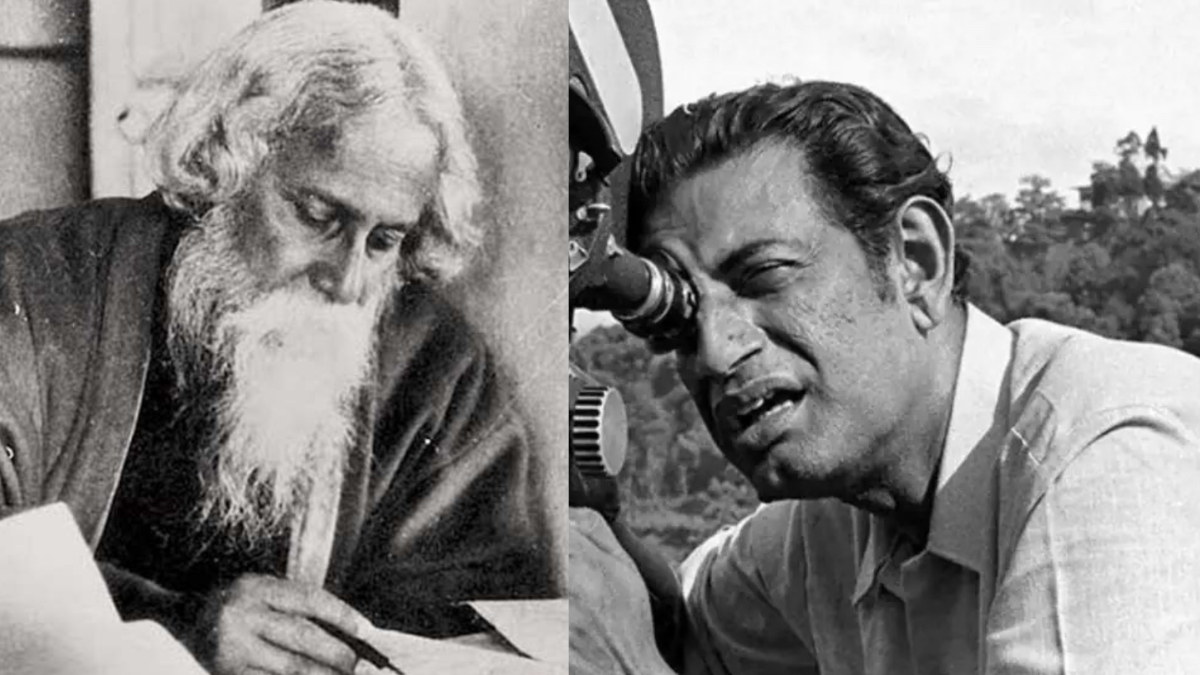
Satyajit Ray Adapted Tagore Seven Times — Here Is the Complete Map of What He Kept, What He Changed, What He Refused to Film, and What the Differences Between the Stories and the Films Tell Us About the Relationship Between Bengali Literature and Bengali Cinema
Literary adaptation is not the transfer of a story from one medium to another. It is the filmmaker's encounter with a literary work — a negotiation between what the work is and what the medium can make of it. Ray's seven Tagore adaptations are the most complete record we have of how a great filmmaker thinks about the specific problems of adaptation — and what the solutions he found reveal about both the filmmaker and the source material.
Rabindranath Tagore is the most complete literary figure in Bengali cultural history — novelist, poet, playwright, short story writer, philosopher, educator, musician, visual artist. His relationship with cinema is paradoxical. He lived until 1941 and saw the medium develop from its earliest period. He was interested in it. He was also profoundly sceptical of it — sceptical of its capacity to represent the internal life of his characters, the specific quality of consciousness that his prose was built to carry.
Satyajit Ray was, as a young man, personally acquainted with Tagore. He designed the cover for the Golden Jubilee edition of Tagore's collected works. He absorbed the Tagore literary tradition as completely as any filmmaker of his generation. And when he made films based on Tagore's work he brought to those adaptations not the fan's desire to reproduce the original but the filmmaker's intelligence about what the original could become in a different medium.
The seven adaptations — Teen Kanya (1961, three short stories), Charulata (1964, Nastanirh), Kapurush (1965, Jyoti O Jyoti), Nayak (elements), Ghare Baire (1984, The Home and the World), and Shakha Proshakha (1990, elements) — span thirty years of Ray's career and together constitute the most sustained engagement by a filmmaker with a single literary figure's work in cinema history.
Teen Kanya — learning the specific problem of Tagore adaptation
Teen Kanya — Three Daughters — adapts three Tagore short stories: Postmaster, Monihara, and Samapti. Ray's approach to each story demonstrates three different solutions to the specific problem that Tagore adaptation presents.
The specific problem is this: Tagore's prose works through interiority. The specific quality of his characters' consciousness — their specific way of experiencing the world, their specific relationship with feeling and thought — is carried by his language rather than by his plots. The plots are often simple. What makes the stories rich is the specific quality of the prose that renders the characters' interior life.
Cinema cannot reproduce interior life directly. It can only find external equivalents for it — images, sounds, performances, formal choices that create, for the viewer, an experience that corresponds to what the prose achieves for the reader. The question in every Tagore adaptation is: what is the cinematic equivalent of this specific interior quality?
In Postmaster Ray solves the problem through performance and restraint. The story is about a city-bred postmaster posted to a remote village who forms a relationship with the orphaned girl who keeps house for him and then leaves abruptly when he is transferred. Tagore's prose renders the girl's grief at the leaving with a specificity that the film cannot match verbally. Ray renders it through Chandana Banerjee's face in the film's final sequence — a face that the camera holds without commentary, allowing the viewer to find in it what Tagore's prose stated.
In Samapti — the film's most complete adaptation — Ray extends the story significantly, adding scenes and dialogue that are not in the original. The extension is not infidelity but recognition — a recognition that the story's material requires more space in the cinematic medium than it occupies in the literary medium, and that fidelity to the source's experience requires, paradoxically, going beyond the source's content.
Charulata — the adaptation that surpasses its source
Charulata, adapted from Tagore's Nastanirh (The Broken Nest), is the film that most completely demonstrates what great literary adaptation can achieve — and makes the most interesting argument about the relationship between the source and the adaptation.
Nastanirh is a novella about a woman's emotional and intellectual awakening and the relationship between that awakening and her growing attraction to her husband's cousin. It is a work of psychological precision and narrative restraint — Tagore's specific quality of showing the internal through the external, of letting the reader understand more than the characters explicitly state.
Ray's adaptation takes this material and makes it more completely itself than the original. Not by adding to it but by finding, in the specific capacities of cinema — the camera's relationship with the face, the capacity of music to carry what dialogue withholds, the specific power of the long take to render consciousness without stating it — equivalents for Tagore's prose that are more fully realised in the cinematic medium than they are in the literary one.
The opera glasses sequence — Charulata watching Amal through her opera glasses before he notices her — has no equivalent in the novella. Ray invented it. The invention is the most complete expression of the novella's central insight: that Charulata's desire is constituted by the specific quality of looking — of seeing clearly while remaining unseen, of the mediated gaze that makes the forbidden possible. The opera glasses are not in Tagore. They are the most complete realisation of what Tagore was reaching for.
Ghare Baire — the adaptation that fails honestly
Ghare Baire (The Home and the World), made in 1984 from Tagore's 1916 novel, is Ray's most ambitious and most compromised Tagore adaptation — a film that is both important and significantly flawed, and whose flaws are more instructive than most films' successes.
The novel is Tagore's most overtly political work — a novel about the Swadeshi movement told through three voices: Nikhilesh, the liberal zamindar; Bimala, his wife; and Sandip, the charismatic nationalist demagogue. The novel uses the love triangle to examine the relationship between political passion and personal desire, between the appeal of the nationalist movement and its specific dangers.
Ray's adaptation is faithful to the novel's structure and to its political argument. Where it is less successful — and where Ray himself acknowledged its limitations — is in the rendering of Sandip's specific quality of dangerous charm. Soumitra Chatterjee, who plays Sandip, is too obviously a good person to fully embody the specific seductive danger that Tagore's Sandip represents. The casting flaw is not a moral failing. It is the recognition of a specific limitation of adaptation — that the interior qualities of literary characters sometimes resist the specific quality of physical presence that specific actors carry.
The lesson of the Ray-Tagore adaptations, taken together, is this: great literary adaptation requires the filmmaker to understand the source material at the level of its deepest qualities — what makes it specifically itself, what it is reaching for that its medium cannot fully achieve, what its material could become in the specific capacities of cinema. Ray understood Tagore at this depth. The seven films he made from Tagore's work are not reproductions of Tagore. They are Ray's encounters with Tagore — encounters that sometimes surpass the source, sometimes fall short of it, and always illuminate both the filmmaker and the writer in ways that neither the films nor the stories alone could produce.
💬 Discussion
0 comments