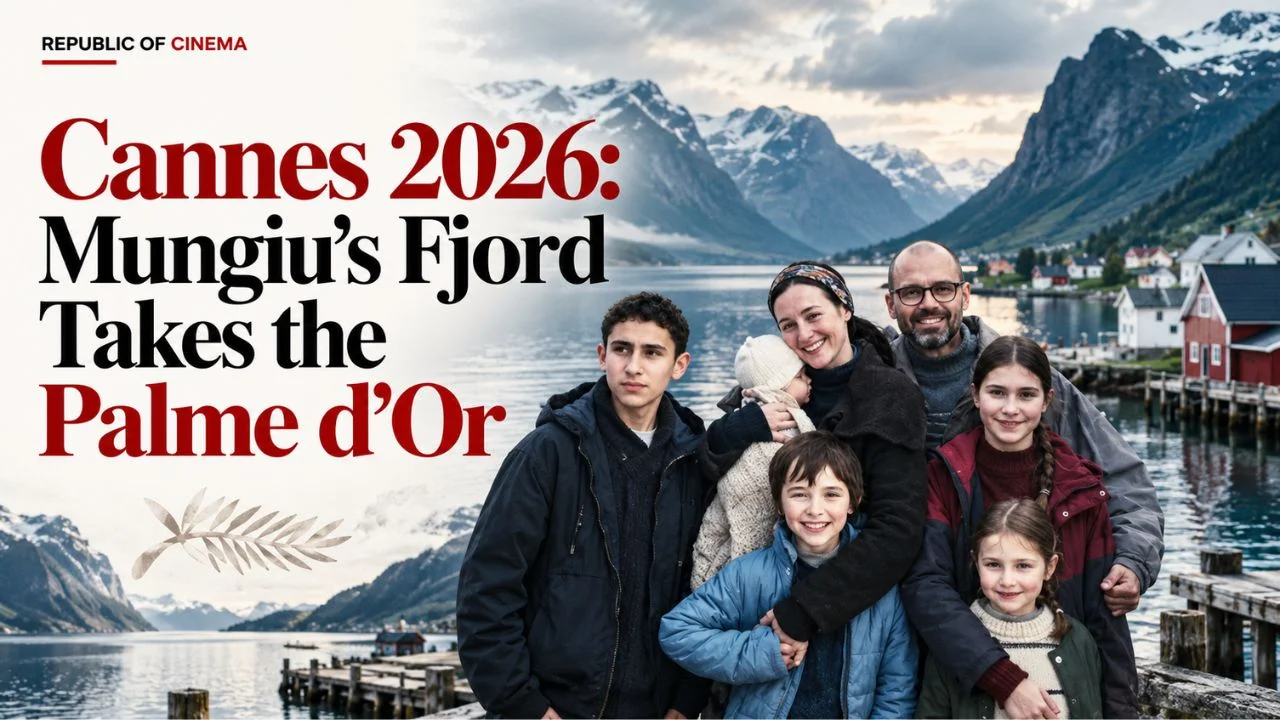
Cannes 2026: Cristian Mungiu's Fjord Takes the Palme d'Or as the 79th Festival Draws to a Close with a Full and Fractious Competition
The Romanian filmmaker wins his second Palme, nineteen years after 4 Months, 3 Weeks and 2 Days, as a richly varied competition sees prizes distributed across seven films — and Neon extends an extraordinary seven-year winning streak.
By Republic of Cinema · May 29, 2026
The 79th Cannes Film Festival closed on Saturday, May 24 with the kind of result that rewards argument. Cristian Mungiu's Fjord — a morally precise, politically resistant drama about a Romanian evangelical family whose lives are upended after Norwegian child services intervene following a disciplining incident — won the Palme d'Or, making Mungiu the tenth filmmaker to win the festival's top prize twice. His first came in 2007 with 4 Months, 3 Weeks and 2 Days, the film that placed Romanian New Wave cinema definitively on the world map. Nineteen years later, he has crossed borders both physically and thematically: Fjord is his first film shot entirely outside Romania, and it arrives as a study of cultural collision, institutional power, and the dangerous proximity between conviction and fundamentalism.
In his acceptance speech, Mungiu was characteristically unsparing: 'We took the risk to speak aloud about things that many of us know and many of us share… but don't dare to say in public. Today, the society is split, it's divided, it's radicalized. This film is a pledge against any kind of fundamentalism.' The film stars Sebastian Stan — the Romanian-American actor Oscar-nominated for The Apprentice — and Renate Reinsve, the Norwegian star of The Worst Person in the World, in what critics described as 'measured, tightly clenched performances' against Mungiu's precise, unnerving mise-en-scène. A ten-minute standing ovation followed the film's premiere. The jury, headed by Park Chan-wook and including Chloé Zhao, Demi Moore, and Stellan Skarsgård, evidently found in its very divisiveness a quality worth rewarding.
FULL COMPETITION AWARDS
Palme d'Or: Fjord — Cristian Mungiu
Grand Prix: Minotaur — Andrey Zvyagintsev
Jury Prize: The Dreamed Adventure — Valeska Grisebach
Best Director (ex-aequo): Javier Calvo & Javier Ambrossi (The Black Ball); Pawel Pawlikowski (Fatherland)
Best Actress: Virginie Efira & Tao Okamoto — All of a Sudden (Ryusuke Hamaguchi)
Best Actor: Valentin Campagne & Emmanuel Macchia — Coward (Lukas Dhont)
Best Screenplay: Emmanuel Marre — A Man of His Time
Camera d'Or (Best First Film): Ben'Imana — Marie-Clementine Dusabejambo (Rwanda)
Short Film Palme d'Or: For the Opponents — Federico Luis
The prizes were distributed across seven films — a breadth that signals a competition of genuine depth rather than a dominant favourite. Andrey Zvyagintsev's Grand Prix for Minotaur was accompanied by an acceptance speech in which the Russian director, in self-imposed exile, called on Vladimir Putin to end 'the butchery.' The moment was one of the festival's defining images. Zvyagintsev's earlier films Leviathan and Loveless established him as Russia's most unflinching moral cartographer; Minotaur, reportedly his most personal work, arrives as a statement of witness.
Elsewhere, the shared Best Director for The Black Ball — a tribute to Federico García Lorca directed by Spanish filmmakers Javier Calvo and Javier Ambrossi — recognised a film that had already been acquired by Netflix after a reported bidding war involving MUBI and A24. Pawel Pawlikowski's Fatherland shared the honour, completing a remarkable decade of Polish cinema's Cannes presence. Valeska Grisebach's Jury Prize for The Dreamed Adventure — acquired by Janus Films for American distribution — confirmed her reputation as one of world cinema's most precisely observational directors.
One institutional subplot requires its own sentence: Neon has now won seven consecutive Palmes d'Or, a streak beginning with Parasite in 2019 and continuing through Titane, Triangle of Sadness, Anatomy of a Fall, Anora, It Was Just an Accident, and now Fjord. The statistical improbability of this run is matched only by its commercial and critical logic — Neon has consistently identified films with the argumentative energy required to sustain a long awards season. With Fjord scheduled for a November theatrical release in the United States, the Oscar race has its first serious contender.
💬 Discussion
0 comments