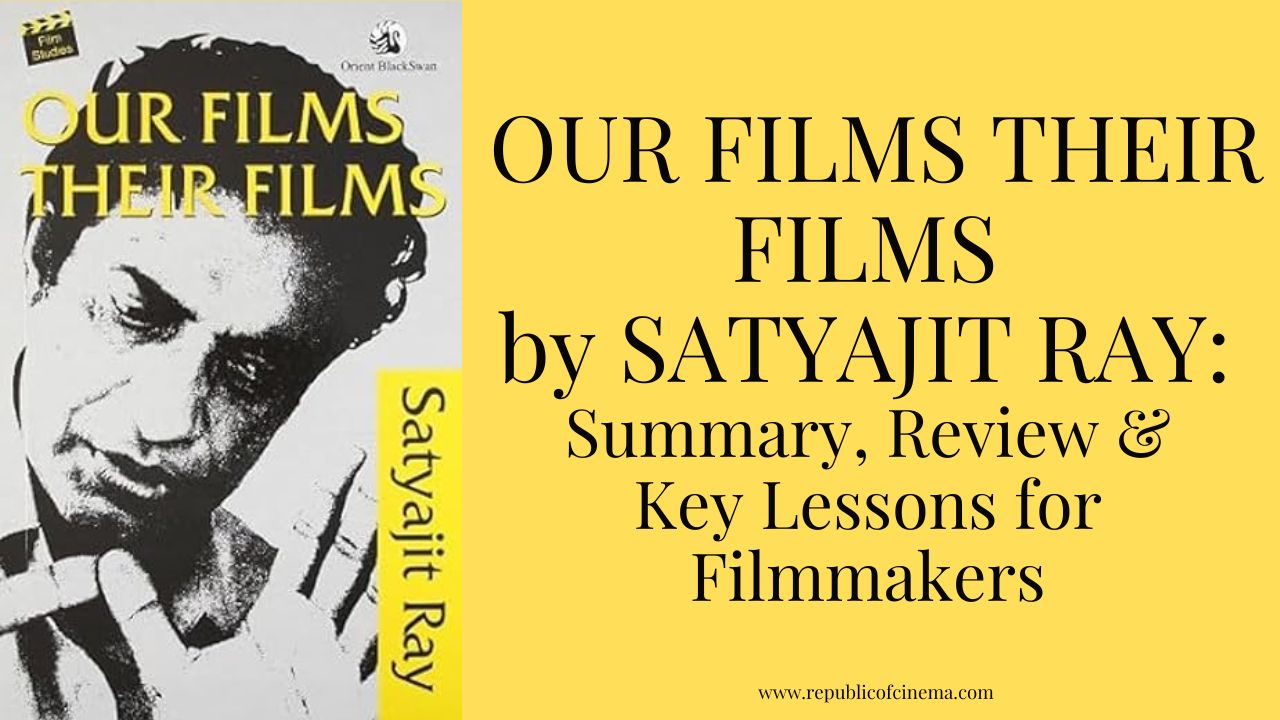
There are very few filmmakers in history who could write about cinema with the same authority with which they made it. Satyajit Ray was one of them. In Our Films, Their Films — a collection of essays, reflections, tributes, and critical observations assembled in 1976 — Ray speaks to us not from behind the camera but from the page, and the voice we hear is unmistakably the voice of someone who has thought about the cinema, its possibilities and its failures, its glories and its disappointments, with the same care and precision that he brought to every frame of every film he made.
This is not a book for the casual reader of film journalism. It is not a collection of on-set anecdotes, promotional interviews, or celebrity reminiscences. It is a serious, searching, and sometimes sobering meditation on what cinema is, what it could be, and what — particularly in the Indian context of Ray's time — it too often failed to become. To read it is to spend time with a mind of rare intelligence and rare honesty, a mind that loved the cinema deeply enough to hold it to the highest possible standard.
That standard was a demanding one. Ray had seen Bicycle Thieves — the great Italian Neorealist film of Vittorio De Sica — while working in London as a young graphic designer, and it had changed his life. The experience of watching that film — its humanism, its simplicity, its absolute faith in the power of the real world to yield cinematic meaning without the mediation of melodrama or spectacle — convinced him that cinema of that quality was possible everywhere, including in India. He returned to Calcutta and made Pather Panchali. The rest is not merely Indian film history. It is world film history.
— ✶ —
About Satyajit Ray — The Complete Filmmaker
To understand what makes Our Films, Their Films so unusual and so valuable, you need to understand the kind of artist Satyajit Ray was — because he was not simply a director. He was one of those rare figures in whom multiple creative gifts coexisted and reinforced each other to produce something greater than any one of them could achieve alone. He was a filmmaker, yes — and one of the greatest who ever lived, the winner of an Honorary Academy Award in 1992, the director of thirty-six films across a career spanning more than four decades. But he was also a graphic designer of distinction, a composer of the music for most of his own films, a writer of celebrated short stories and novels, an illustrator, and a critic of cinema whose judgment was sought and valued by filmmakers and scholars around the world.
This multiplicity matters when reading his essays, because the intelligence at work in them is not the intelligence of the specialist. Ray does not approach cinema from a single angle — the theorist's angle, or the technician's angle, or the nationalist's angle. He approaches it from every angle simultaneously: as a practitioner who knows what it costs to achieve certain effects, as a cultural observer who understands the social context in which films are made and received, as an artist of other disciplines who can illuminate what cinema shares with music, literature, and design, and as a human being who believes profoundly that the cinema's highest calling is the honest representation of human experience.
What gives his prose its distinctive quality is a combination of intellectual rigour and conversational ease that is extremely rare in writing about cinema. He is never pretentious. He never hides behind jargon or theoretical apparatus. He says what he thinks, clearly and directly, and trusts the reader to follow the argument. This clarity is itself a reflection of his filmmaking philosophy: the belief that complexity of feeling and thought can be expressed through simplicity of form, that the most profound things are often best said without ornament.
— ✶ —
What the Book Contains — Two Worlds in Conversation
The title of the book, Our Films, Their Films, announces its structure with elegant simplicity. The collection is divided into two broad movements: the first concerned with Indian cinema, its achievements and its persistent failures, its cultural context and its commercial pressures, its relationship to the society that produced it and the audiences that consumed it. The second half turns outward, toward the global cinema that Ray loved and learned from — toward Chaplin and Keaton, Renoir and Rossellini, Kurosawa and De Sica, toward the traditions of Hollywood and the European art cinema — and engages with them with the informed enthusiasm of a filmmaker who watched everything and remembered everything.
Together, the two halves constitute a vision of what cinema could be if it were practised everywhere with the same seriousness and the same love for the real world. The gap between what Ray observed in Indian commercial cinema and what he had seen in the best films from Europe and Japan was, for him, not primarily a gap of resources or technology — it was a gap of intention, of artistic ambition, of the courage to trust the audience with complexity rather than resorting to the safe reassurances of formula.
The essays were written across many years and for different occasions — some as lectures, some as magazine articles, some as tributes to filmmakers Ray admired — and they retain the quality of occasions. They are not systematic in the way that academic writing is systematic. They circle their subjects with the freedom of a mind that does not need to prove its authority, because the authority is already present in every sentence. The cumulative effect, however, is thoroughly coherent: a unified vision of cinema as a humane art form, practised responsibly in the service of truth.
— ✶ —
Ray on Indian Cinema — Love, Frustration, and a Higher Standard
The essays on Indian cinema are the most challenging in the book, and the most important. Ray loved Indian culture with a depth and a specificity that is evident on every page — he was a product of the Bengali intellectual tradition, shaped by Tagore's humanism, by the richness of classical Indian music, by the density and variety of Indian narrative art. And precisely because of that love, his diagnosis of what was wrong with Indian commercial cinema of his time is delivered without mercy and without sentimentality.
What troubled Ray above all was the Indian film industry's systematic refusal of reality — its insistence on the artificial, the melodramatic, the formulaic, and the spectacular at the expense of the truthful and the human. The songs interpolated into narratives regardless of dramatic logic, the exaggerated performance styles inherited from theatrical convention, the avoidance of social complexity in favour of reassuring moral simplicities, the relentless prioritisation of star power over story, of entertainment over meaning — all of this, Ray argued, was not merely an aesthetic failure but a failure of responsibility. A cinema that consistently misrepresents reality to its audience is a cinema that infantilises them, that withholds from them the respect of honest reflection.
This is a hard argument, and Ray knew it was hard. He was not naive about the economic pressures that shaped the industry, nor about the genuine pleasures that popular Indian cinema offered its audiences. But he believed — and demonstrated in his own practice — that these pressures were not insurmountable, that it was possible to make films of genuine artistic integrity within the constraints of Indian filmmaking, and that the filmmakers who claimed otherwise were, more often than not, making an excuse rather than an argument.
What Ray wanted for Indian cinema was not the prestige of international prizes — though he accumulated those in abundance — but the dignity of artistic seriousness. He wanted Indian filmmakers to believe that their own reality, honestly observed, was sufficient material for great cinema.
This belief — in the sufficiency of the real, in the capacity of ordinary Indian life to yield cinematic meaning without exotic elaboration — is the most important gift that Ray's work, and his writing about his work, offers to the young Indian filmmaker today. It is a belief that has lost none of its relevance in an era when Bollywood formulas have, if anything, grown more elaborate, more expensive, and more detached from the texture of lived Indian experience.
— ✶ —
Ray on World Cinema — A Filmmaker's Education
The second half of the book is, in many ways, a love letter — a series of deeply personal appreciations of the filmmakers and films that shaped Ray's understanding of what cinema could be. Reading these essays, you feel the excitement of a young artist discovering, in the work of masters, the full dimensions of his own chosen medium. The essays on Chaplin and Keaton are particularly beautiful: Ray sees in the great silent comedians not merely entertainers but moral philosophers, artists whose physical comedy was inseparable from a profound understanding of the human condition — of loneliness, of dignity, of the comic heroism of the individual against an indifferent world.
His essay on Jean Renoir — whom Ray knew personally and regarded as perhaps the greatest of all filmmakers — is a model of critical appreciation: precise, warm, intellectually rigorous, and lit throughout by genuine love. Renoir's capacity to observe human beings without judgment, his ability to make every character in a film feel real and complex and worthy of attention regardless of their social position, his understanding that life resists the neat resolutions of dramatic convention — all of this Ray recognised as the highest achievement of the cinematic art, the thing he most aspired to in his own work. When you watch The Apu Trilogy after reading Ray on Renoir, the connection is unmistakable: the same quality of attention, the same refusal to condescend, the same faith in the world as material sufficient for art.
The tribute to Akira Kurosawa — Ray's great contemporary and, in many assessments, his closest equal among the filmmakers who transformed the cinema of the postwar world — is particularly moving. The two men shared a conviction that cinema's greatness lay in its capacity to be specific about the particular culture from which it arose while achieving a universality that transcended cultural boundaries. Rashomon could only have been made by a Japanese director steeped in Japanese aesthetics and Japanese history. And yet it spoke, and continues to speak, to audiences everywhere in the world. This paradox — that the most deeply rooted cinema is often the most universally resonant — is one of Ray's central convictions, and his appreciation of Kurosawa is in part a meditation on why it is true.
— ✶ —
The Philosophy of Making — Ray on Craft and Responsibility
Running through all the essays, whether their ostensible subject is Indian popular cinema or the films of Charlie Chaplin, is a coherent philosophy of filmmaking that is worth examining in its own right — because it is a philosophy that speaks directly to the challenges facing any filmmaker, anywhere, at any time.
On realism: Ray believed, with Bazin and the Neorealists, that the camera's primary gift to cinema is its capacity to record the world with an honesty that no other medium can match. This does not mean that cinema must be a documentary — Ray's own films are full of music, of carefully composed images, of dramatic structure. But it means that the filmmaker's first obligation is to the truth of human experience, and that any formal device — editing, score, performance style, camera movement — must justify itself by serving that truth rather than substituting for it.
On music: Ray composed the scores for most of his own films, and his understanding of the relationship between sound and image is correspondingly precise. He was sharply critical of the Indian commercial cinema's use of song as a structural device that interrupted rather than served the narrative — a convention borrowed from theatrical tradition and sustained by the music industry rather than by any cinematic logic. Music in film, he believed, should arise from and deepen the emotional reality of the scene, not impose upon it an emotion that the images have not earned.
On acting: Ray worked with actors differently from most directors of his era. He cast for presence and authenticity rather than for conventional attractiveness or theatrical technique, and he worked with his cast members over long periods, building the kind of trust and understanding that allowed them to inhabit rather than perform their roles. His observations on acting in the essays are characteristically precise — he understood exactly what the camera could see that the stage could not, and how the performance style appropriate to the intimacy of the lens differed from the style appropriate to the distance of the theatre.
On the filmmaker's responsibility: Perhaps the most important strand in Ray's philosophy is his insistence that the filmmaker has a responsibility to the society in which they work — not a political responsibility in any narrow ideological sense, but a human one. The filmmaker who looks away from poverty, from injustice, from the complexity of social reality, is not exercising artistic freedom. They are practising a form of cowardice. The cinema's ability to show the world honestly is, for Ray, not merely a technical capacity but a moral one. It is the capacity that justifies the art form's existence.
— ✶ —
Why This Book Matters More Than Ever Today
Satyajit Ray published Our Films, Their Films in 1976. The specific films he discusses, the specific industry conditions he describes, the specific cultural debates he engages with — all of these belong to their historical moment. And yet the reading experience is one of extraordinary contemporaneity. Ray's concerns feel not historical but urgent, not archived but alive.
In the age of streaming platforms, the questions he was asking about the relationship between artistic ambition and commercial pressure have become more acute, not less. The streaming era has produced extraordinary volumes of content — and genuinely remarkable individual works — but it has also created new forms of the old pressures Ray diagnosed: the pressure to deliver what the algorithm identifies as popular, to satisfy the genre expectations of a demographically profiled audience, to prioritise the familiar over the challenging. The courage to make films that trust the audience with complexity and silence and ambiguity is no easier to summon in the age of Netflix than it was in the age of the Bombay film studios.
For young Indian filmmakers in particular, the relevance is almost painful. The tensions Ray describes — between a rich, complex, various Indian reality and a cinema industry that has historically preferred to ignore or sentimentalise that reality in favour of elaborately produced fantasy — are still present, still generative, still awaiting the filmmakers bold enough to resolve them. The extraordinary work coming from the margins of Indian cinema in recent decades — the parallel cinema movement, the new wave of regional language filmmaking, the independent documentaries and short films that circulate beyond the studio system — suggests that the tradition Ray embodied is alive and producing remarkable work. But it remains marginal, and the conditions that make it marginal are precisely the conditions Ray spent his career arguing against.
"The day we learn to tell the truth on screen about the way we are and the way we live will be the day Indian cinema comes of age." — Satyajit Ray
Those words were written fifty years ago. They have not yet become unnecessary.
— ✶ —
Strengths of the Book — What Makes It Indispensable
The greatest strength of Our Films, Their Films is the quality of the intelligence behind it. Ray's prose is like his cinema: clean, precise, unpretentious, and suffused with an awareness of the world that is impossible to manufacture. He does not perform depth — he simply has it, and the pages are full of observations that stop you short and make you think again about something you assumed you had understood.
A second strength is the book's range. Moving between Indian popular cinema and Italian Neorealism, between the silent comedy of Buster Keaton and the feudal drama of Kurosawa, between cultural criticism and technical observation, Ray demonstrates that serious thinking about cinema is not the province of any single tradition. He is equally at home in every room of the house of cinema, and his movement between rooms is effortless and illuminating.
A third strength is the book's honesty. Ray is not a self-promoter, and he is not, in these essays, primarily an advocate for his own filmmaking. He can be sharply critical of filmmakers he respects, including himself. He can acknowledge the pleasures of popular cinema even while insisting on its failures. He can celebrate the achievements of Hollywood at the same time as he identifies what Hollywood lacks. This intellectual balance — the ability to hold contradictory truths simultaneously — is rare in film writing, and it gives the book an authority that no amount of one-sided advocacy could achieve.
— ✶ —
Limitations for the Modern Reader — An Honest Note
No book is without its limitations, and honesty requires acknowledging the ways in which Our Films, Their Films shows the marks of its time. The Indian cinema Ray discusses is the cinema of the 1950s, 1960s, and early 1970s — a landscape of studios and stars and production conditions that has been substantially transformed in the decades since. Readers unfamiliar with this historical context may find some references opaque, and the specific industry battles Ray engages with may feel remote from the current landscape of Indian filmmaking.
There is also the question of the book's gender politics, which reflect the moment of its composition more than they reflect Ray's own humanity. Women filmmakers are barely present in the world Ray surveys — not because he was indifferent to women's perspectives, but because the industry as he encountered it was overwhelmingly male-dominated, and his essays do not sufficiently interrogate that fact. The modern reader will feel this absence, and should feel it — it is a real limitation that belongs both to the book and to the era that produced it.
Finally, the book's frame of reference is primarily Euro-American and Asian, with almost nothing from African, Latin American, or Middle Eastern cinema. These were traditions that were, in the 1970s, less visible in the international circuits in which Ray moved, but they are traditions that any complete understanding of world cinema now requires. The reader who uses this book as a starting point rather than a conclusion will need to fill these gaps from other sources.
— ✶ —
Final Verdict — A Book That Stays With You
Our Films, Their Films is one of those books that you do not simply read and put down. You read it, and then you find it working in you — shaping the way you watch, the questions you ask, the standard you hold your own work and the work of others to. It is the book of a man who loved cinema without illusions, who understood its failures clearly enough to believe in its possibilities, and who practised those possibilities in his own work with a discipline and a consistency that no amount of theoretical writing can equal.
For the young filmmaker, it is a manual of values — a reminder of what the cinema is for and what it asks of the person who makes it. For the film student, it is a model of critical thinking: how to engage with cinema seriously without losing contact with the feelings that made you love it in the first place. For the cinephile, it is a companion of rare quality — a book that deepens and enriches every film you will ever see after reading it.
And for anyone who cares about Indian cinema — about what it has achieved, what it has failed to achieve, and what it might yet become — it is simply essential. The conversation Ray was trying to start in 1976 is a conversation that Indian cinema is still having, still needs to have, and has still not fully resolved. To read this book is to find the terms of that conversation stated with a precision and a passion that have not been surpassed in the fifty years since.
Some books about cinema explain the medium. Some celebrate it. Some theorise it, historicise it, or deconstruct it. Ray's book does something rarer and harder: it embodies a way of thinking about cinema that is, in itself, an argument for the art form's seriousness. To read it is to be in the presence of a mind for which cinema was not a career or an industry but a vocation — a life's work of seeing, and of helping others to see.
RATING: 10 / 10 ★★★★★
DIFFICULTY: Accessible — Essential for every serious reader of cinema
ESSENTIAL FOR: Indian Filmmakers, Film Students, World Cinema Lovers, Critics
READ WITH: My Years with Apu — Satyajit Ray
WATCH WITH: Pather Panchali (1955) | Charulata (1964) | The Music Room (1958)
Republic of Cinema
"The only honest cinema is the cinema of the world you actually live in."
💬 Discussion
0 comments