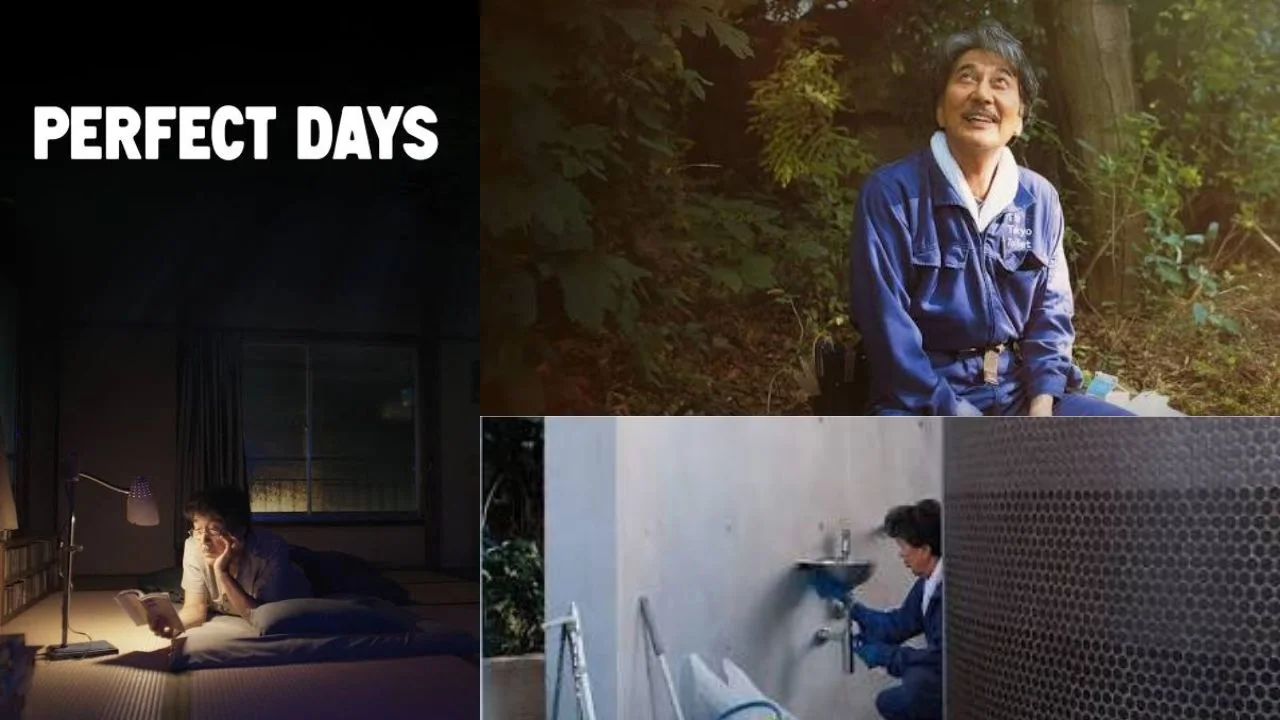
Hirayama wakes before dawn to the sound of an old woman sweeping the street outside his window. He does not need an alarm. He folds his bedding, brushes his teeth, trims his moustache, waters his seedlings, and steps out of his door into the pale Tokyo morning. He looks up at the sky and smiles. Not because anything has happened. Nothing has happened. He smiles because the sky is there and so is he.
We will see him do this again. And again. Wim Wenders' "Perfect Days" (2023) is built on repetition the way a piece of music is built on a theme, and the first thing you must decide, watching it, is whether you are the kind of person who hears variations or the kind who hears the same thing twice. Wenders also understands ma — the expressive interval so central to Japanese art — allowing silence, routine, and empty space to carry emotional weight rather than treating them as narrative absence. The pauses in this film are not waiting for something to happen. They are the something. Hirayama buys a canned coffee from the vending machine outside his building, slides a cassette into the deck of his little van — The Animals, Patti Smith, Lou Reed singing about a perfect day — and drives to work. His work is cleaning public toilets in Shibuya.
I can hear you already. A two-hour film about a man who cleans toilets. But consider what Wenders is actually doing. The toilets themselves, part of a real architectural project that scattered seventeen designer restrooms across one Tokyo ward, are strange and beautiful objects — one has glass walls that turn opaque when you lock the door, a small miracle of engineering that exists for the dignity of strangers. And that phrase is the key, because to a Japanese audience these toilets are not merely architecture. A clean public toilet is part of the invisible social contract by which a city of strangers agrees to trust one another. Hirayama is not just scrubbing porcelain. He is maintaining, every day, one small load-bearing wall of civilization — the shared faith that the next person will find things cared for, left by someone they will never meet.
He cleans them with the concentration of a watchmaker. He carries a small mirror to check beneath the rim of the bowl, where no one will ever look. When a client is waiting, he steps outside and bows. His young colleague Takashi asks him why he bothers; the work will be undone within the hour. Hirayama does not answer, and the film is his answer — but the answer has a name in Japanese. Hirayama is not simply humble. He belongs to the tradition of the shokunin: the artisan who pursues perfection in ordinary work regardless of whether the work is glamorous or invisible, whose obligation is not to the customer or the boss but to the work itself. In this view the dignity lies not in the occupation but in the care brought to it. A toilet cleaned with complete attention is no less worthy than a painting executed with the same devotion — and careless work, not lowly work, is the only real humiliation. The hand mirror under the rim is not eccentricity. It is kodawari, the uncompromising devotion to a detail nobody demanded.
Kōji Yakusho plays Hirayama, and won the Best Actor prize at Cannes for it, and the performance is one of the great feats of screen minimalism. He has perhaps a dozen lines of dialogue in the entire film. Everything else is in the eyes, the posture, the quality of his attention. Yakusho has been a star in Japan since "Shall We Dance?" and "The Eel," but here he empties himself out. He reminds me of what Robert Bresson wanted from his actors and rarely got from professionals — a presence, not a performance — but his truer ancestor is closer to home: Chishū Ryū, the gentle constant of Ozu's cinema, who could hold a whole family's grief in the angle of his shoulders and a murmured "so desu ka." Like Ryū, Yakusho gives us not an ascetic saint but an ordinary man rendered luminous by attention. When Hirayama smiles at the sky, we do not feel an actor indicating contentment. We feel a man who has arrived somewhere, after a long journey the film declines to show us.
That journey is the buried engine of the film, and it is what saves "Perfect Days" from being a greeting card. There are clues. Hirayama reads Faulkner and Patricia Highsmith in paperback, hundred-yen editions bought from a used bookstore. His cassettes are worth serious money now, a collector tells him; he will not sell. And then one day his teenage niece Niko appears at his door, having run away from her mother — Hirayama's estranged sister — and when the sister arrives to collect her, in a chauffeured luxury car, we begin to suspect that Hirayama came from a far more privileged world than the one he now inhabits. The film never confirms it; Wenders guards the ambiguity carefully, and the mystery is part of the design. "Is it true you clean toilets?" the sister asks, and there is horror in the question. He embraces her. She leaves. He stands in the street and weeps, briefly, privately, and the next morning he folds his bedding and looks at the sky.
Notice what he does not do, in that scene or any other. He never explains himself. Never argues his choices, never seeks sympathy, never once performs his pain for another character or for us. Western viewers may read this as repression; Japanese viewers will recognize gaman — the quiet endurance of what is difficult, without complaint, as a form of dignity rather than denial. The tears in the street are not a crack in the composure. They are its price, paid privately, and the composure is resumed not because the grief is buried but because the morning's work is waiting and the work deserves his whole self. The film never explains further, and it is right not to. What matters is not why Hirayama chose this life but what the choice consists of, moment by moment, and this is where the film becomes something rarer than a character study. It becomes a philosophy delivered by other means.
Every day at lunch, Hirayama sits on the same bench in a temple garden, eats a sandwich, and photographs the same tree with an old Olympus film camera. Black and white. He is not photographing the tree. He is photographing komorebi — the Japanese word, untranslatable in a single English term, for sunlight filtering through leaves, the trembling pattern of light and shadow that the wind never repeats. The film ends with a title card defining the word, and telling us that komorebi exists only once, in that moment. The whole project grew from this concept — Yakusho has said the film carried "Komorebi" as a working title alongside "Perfect Days" — and you can feel it: the word is not a motif in the film so much as the film is an essay on the word. At home, Hirayama develops the photos, keeps a few, tears up the rest, and files the keepers in labeled boxes he will likely never open. He is an artist with no audience and no desire for one, which may be the purest kind. The photographs are his practice, in the religious sense of the word.
There are older names for what Hirayama has found. Mono no aware, the gentle sorrow at the passing of things, which has been the deep current of Japanese art since "The Tale of Genji" — the awareness that the cherry blossom is beautiful because it falls. Wabi-sabi, the beauty of the imperfect and the incomplete: his tiny apartment, his analog cassettes, his hundred-yen paperbacks, a life assembled from what the accelerating world has discarded. And ichigo ichie, the tea-ceremony teaching that every encounter happens once and never again, so attend to it fully. Hirayama says it plainly to Niko, riding bicycles over a bridge, in the closest thing the film has to a thesis: "Next time is next time. Now is now." She turns it into a little song, and he — this is the lovely part — starts singing it with her, learning from the child he was teaching.
Wenders has been circling this film for forty years. In 1985 he came to Tokyo to make "Tokyo-Ga," a documentary pilgrimage to the locations of Yasujirō Ozu, the master of the everyday, and confessed he could not find Ozu's Japan in the neon city. "Perfect Days" is his answer to his own younger self: Ozu's Japan was never a place, it was a way of looking. The low camera, the pillow shots of sky and trees, even the hero's name — Hirayama, borne by characters across Ozu's filmography, including the widowed father Chishū Ryū plays in "Tokyo Story" — all of it is homage, but earned homage, absorbed rather than quoted. And there is a historical observation here that Japanese critics made and Western ones largely missed: this is a film that could not have been set in the Japan of the 1980s. The Tokyo of "Perfect Days" is the city after the miracle and after the bubble — mature, aging, polite, and quietly lonely, a society where an old man can be surrounded by people all day and touched by almost none of them, where the bathhouse and the izakaya counter are the last warm rooms of a cooling public life. Hirayama's serenity is real, but it is serenity found inside that loneliness, not in ignorance of it — which is why the film also sits beside Jim Jarmusch's "Paterson," another portrait of a working man who makes art no one will see, though Hirayama is older, more solitary, and carries a wound Paterson does not.
Nights, Hirayama dreams. Wenders' wife Donata created these interludes — flickering black-and-white collages of leaves, shadows, faces from the day — and they divide the film's days like breaths. One evening near the end, Hirayama meets a stranger by the river, the ex-husband of the bar owner Hirayama quietly admires, a man who is dying of cancer and has come to say goodbye. They share cigarettes and beer, and then, because there is nothing left to say, they play shadow tag in the dark, two grown men chasing each other's silhouettes under a streetlight. Do shadows grow darker when they overlap? Hirayama insists they must. It is the film's most mysterious scene and its key: people, too, are komorebi. Light passing through. Here once, in this configuration, never again.
Then the last morning. Hirayama drives into the sunrise with Nina Simone's "Feeling Good" on the cassette deck, and Wenders holds Yakusho's face in an unbroken close-up for the length of the song. He smiles. His eyes fill. He smiles again, and the crying and the smiling stop being separate things. Sun and shadow move across his face like light through leaves. I have thought about this shot for a long time, and I believe it is Wenders' confession that the film's title is not ironic and not sincere but both at once: these days are perfect, and they cost everything, and the man who chose them knows exactly what he gave up. If the film approaches ikigai — that much-abused word — it does so quietly: not as a grand mission discovered, the way the self-help books sell it, but as the daily act of meeting ordinary responsibilities with complete attention. The Instagram philosophers will tell you Hirayama "cracked the code" to inner peace. He did not crack a code. He gets up every morning and earns it again, one folded blanket, one clean bowl, one photograph of light that will never come back.
"Perfect Days" was Japan's entry to the Academy Awards and a nominee for Best International Feature. It is Wenders' finest fiction film since "Wings of Desire," and like that film it is about an angel who watches the city — except this angel already fell, long ago, and decided the ground was where he wanted to live.
★★★★★
Perfect Days (2023). Directed by Wim Wenders. Written by Wenders and Takuma Takasaki. Starring Kōji Yakusho, Tokio Emoto, Arisa Nakano, Yumi Asō. Cinematography by Franz Lustig. 124 minutes.
💬 Discussion
0 comments