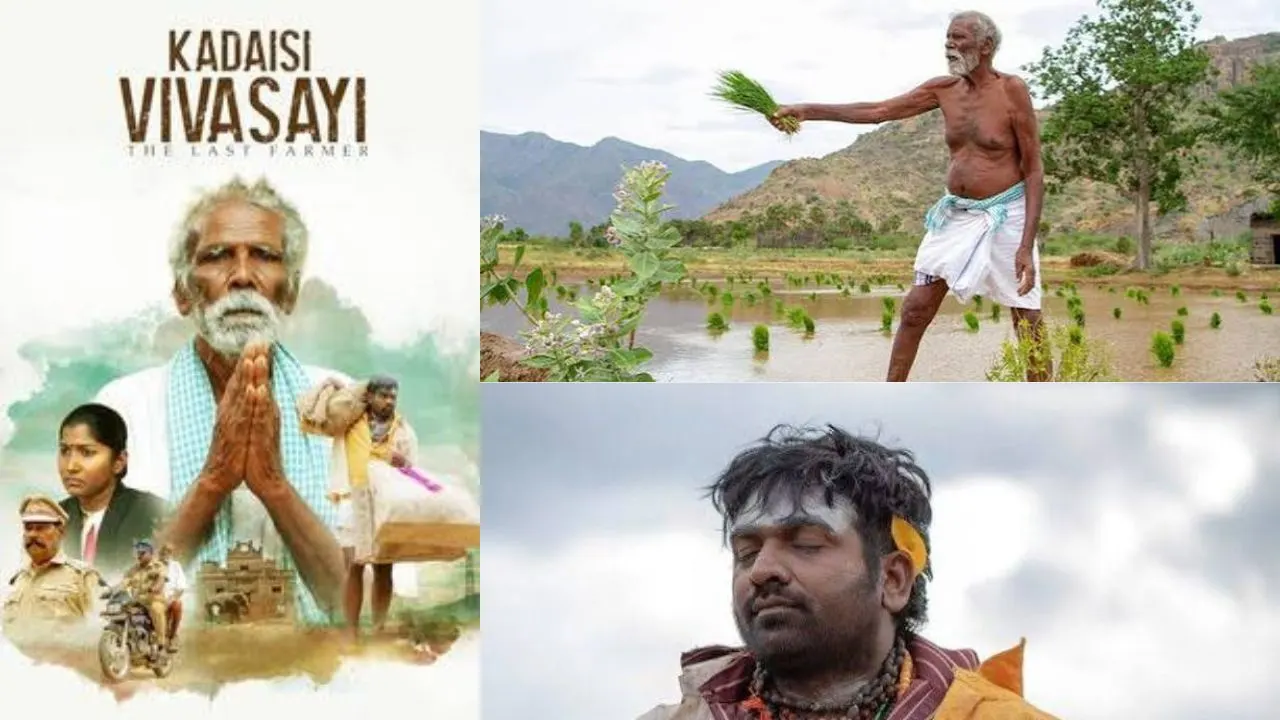
Before we see anything, we hear it. Silence first, then the cry of peacocks filling the dark, and then a devotional song to Murugan as the title appears. M. Manikandan is telling us, in the first thirty seconds of "Kadaisi Vivasayi" (2022), what kind of film this will be — and the song is not establishing mood. It is establishing cosmology. Murugan, in rural Tamil Nadu, is not a mythological reference to be footnoted; he is the hill god, the god of youth and courage, the protector of villages, entwined with Tamil identity itself and with the agriculture that identity grew from. The opening hymn announces, before a single character appears, that this village lives inside Murugan's universe — and that everything which follows, the peacocks and the paddy and the festival and even the courtroom, will happen inside it too.
Then we meet Mayandi. He is somewhere past eighty, lean as a stick of sugarcane, living alone in a village near Usilampatti in a house that is barely more than a roof over a routine. He wakes, tends his cattle, walks his field, eats little, says less. Everyone else in the village has sold their land — to financiers, to brokers, to the future — and the paddy fields around his own have gone to weed and real estate. He is the last farmer. When lightning burns down a sacred tree, the village elders decide the goddess is displeased because there has been no temple festival in years, and a festival needs the first grain of a new harvest, and the only man who can still grow grain is Mayandi. So the old man ploughs his field behind his two bullocks, and the film settles into his rhythm, and we settle with it.
Watch how he ploughs, though, because the film's whole meaning is in the manner of it. Mayandi's relationship with the land is not economic, and that is the distinction modern India keeps forgetting. In the film's moral universe, farming is less a profession than a dharma — a duty carried out without expectation of recognition, entrusted to him by an order larger than any individual life. This is why jail barely disturbs him, why old age barely disturbs him, why poverty does not register as poverty. The harvest matters, and it matters precisely because it is not his. The first grain belongs to the goddess before it is property; the crop is a gift before it is a commodity; the field itself — and here English betrays us with words like "land," "plot," "asset" — is not soil to Mayandi but Bhoomi, the earth as mother, whom Indian agriculture has addressed with reverence since the Vedic hymns asked her forgiveness for the wound of the plough. Notice how gently he works her. Notice that he never behaves like an owner, only like a son with duties. And this, finally, is why the builder's money is not a temptation he heroically resists but a sentence in a language he does not speak. You cannot sell your mother and live on the proceeds. Indic thought has a word for what Mayandi is discharging: ṛṇa, the sacred debts every human is born carrying — to parents, to teachers, to the gods, to the earth that feeds him. His ploughing at ninety is not stubbornness, and it is not even love, exactly. It is repayment, made daily, of a debt he never thinks to resent.
I want to tell you about the man playing Mayandi, because he is the film. His name was Nallandi, and he was not an actor. He was a farmer, found by Manikandan in Perungamanallur, a village near Madurai, after the director had scouted a hundred villages — and after, by Manikandan's own account, he had first pitched the role to Rajinikanth, who didn't show interest. Think of that exchange: the most mythologized superstar in Tamil cinema considered for the part, and a real farmer cast instead, because the director needed someone who, in his words, coexists with nature. It is the best casting decision in recent Indian cinema, and it belongs to a tradition the movies keep rediscovering whenever they want to tell the truth: De Sica pulling a factory worker off the street for "Bicycle Thieves," Satyajit Ray building "Pather Panchali" around faces no camera had bothered with, Kiarostami trusting villagers to carry his Koker films. A trained actor performs an old farmer. Nallandi simply is one, and the difference is visible in how he ploughs, how he squats, how he ties a knot — a lifetime of muscle memory no acting school can issue. Nallandi died shortly before the film's release, and won a Special Mention at the National Film Awards after his death. His first film and his last. The title turned out to be a double elegy.
The plot arrives like trouble usually does in a village — sideways, absurdly, with paperwork. Mayandi finds a peacock and two peahens dead in his cropland. He does what a man of his world does: he buries them with the tenderness owed to a deity, because the peacock is Murugan's own vahana and you do not leave a god's bird to rot. But the peacock is also a protected national symbol, and a neighbour with an eye on the old man's land makes a phone call, and suddenly Mayandi is arrested for killing the birds he mourned. The middle of the film is a comedy of institutions that is also a tragedy of translation. The police need a confession; he has nothing to confess. The magistrate — played with lovely restraint by Raichal Rebecca — can see perfectly well that the man in front of her is innocent, but the law is a machine that cannot process innocence, only procedure. Bail requires documents; documents require a self that exists on paper. And here the film's real collision comes into focus, because this is not, as it first appears, the state versus a farmer. It is the state versus an older civilization. Mayandi is not anti-government; he simply belongs to an older republic — of memory, reciprocity and ritual, where identity lives in relationships rather than documents, where a man is known by his field, his cattle, his conduct at the temple, and the word of his neighbours. The bureaucracy sees an elderly man accused under wildlife law. The village sees the last remaining custodian of a sacred order in which soil, cattle, birds, gods and human labour still exist in reciprocity. That older imagination, more than agriculture itself, is what "Kadaisi Vivasayi" quietly mourns.
What makes the jail scenes remarkable is what Manikandan refuses to do with them. Another film — a hundred other Tamil films about farmers, and there are a hundred — would give us the courtroom speech, the swelling strings, the old man weeping for the camera. Mayandi does not plead. He is not humiliated because he does not accept the premise of humiliation. His worry is not the case. His worry is that his paddy needs water, that his bullocks are unfed, and that the festival is waiting. And the festival, understand, is not waiting for grain the way a kitchen waits for groceries. With the ritual stalled, the village's very order is incomplete — the first offering is the thread that reties people to deity, season to ancestor, field to temple. This is not merely religion; it is social ecology, the annual renewal of a compact between the human and more-than-human members of one shared world. When Mayandi sits in the lockup asking only whether someone has watered the seedlings, he is not being naive. He is the one person in the film who still knows what is actually at stake.
His cattle deserve a sentence of their own, because Western criticism almost never sees them. The two bullocks are not equipment. They are companions, nearly kin — fed before he eats, spoken to more than most humans in the film, worked with rather than used. Mayandi never behaves as though he owns them any more than he owns the field; the relationship is reciprocal, and it is one of the oldest relationships in Indian civilization. The film photographs man and animal at the plough as a single organism, which for three thousand years is roughly what they were.
Around this still centre, Manikandan — who wrote, directed, produced and photographed the film himself, a one-man cottage industry to match his hero's — arranges the village's holy fools and lost sons. Vijay Sethupathi appears in an extended cameo as Ramaiah, whom the director describes simply as a Murugan devotee: a wandering, broken man who talks to the god, grieves a lost love, and drifts through the story like a question the village cannot answer. Sethupathi, a producer on the film, does something rare for a star — he makes himself small, unglamorous, genuinely strange, and in a scene with a sadhu he finds notes I have not seen from him before. Yogi Babu drifts through as well. I should be careful here, because the film is: Ramaiah is not broken because he left farming, and the villagers who sold their land are not villains. He is broken by lost love and lost belonging; they are ordinary people adapting to an economic reality that gave them no better choice. The film's grief is not aimed at them. It is aimed at the world that made their choices inevitable — and Mayandi, who stayed, is less a rebuke to his neighbours than a reminder of what all of them, together, are losing.
If I were to name the film's aesthetic in its own civilization's terms — and we should, since for Japanese films we reach so readily for mono no aware and wabi-sabi — I would say "Kadaisi Vivasayi" is composed in śānta rasa, the rasa of tranquility, the rarest and most difficult of the classical moods, with an undercurrent of karuṇā: not melodrama's sorrow but compassion, extended equally to birds, cattle, madmen and magistrates. And the film's deepest formal choice follows from this: it has no protagonist in the Western sense, no hero with an arc, a want, an obstacle. It has a practitioner. Mayandi does not change, and the film does not want him to. Everyone and everything changes around his stillness, the way a festival revolves around its deity. Readers who know Indian intellectual history will hear one more resonance the film never names: the village, the dignity of manual labour, the local economy, the minimal needs, the self-sufficiency — the whole Gandhian constellation is here, embodied rather than argued, in a man who has never heard the word "swadeshi" and has never needed to. Manikandan's camera loves this landscape without prettifying it — the frames have the composed patience of paintings, but the dirt is real dirt — and Santhosh Narayanan and Richard Harvey's score knows when to disappear, which is most of the time. The true score is the one from the opening: peacocks, wind, cattle bells.
Here I should register my one reservation, which is also, I admit, half a surrender. The final stretch turns toward the miraculous — the wish fulfilled, the festival achieved, a peacock spreading its feathers in full dance — and it plays broader than the flinty film that preceded it. A stricter director might have ended in the paddy, in ambiguity. But I have come to think the ending should be read in the film's own theology rather than ours. The peacock's dance is not a reward, and it is certainly not a plot resolution. It is prasāda — grace, in the precise Indian sense: not earned by the devotee but received by him, given back from the offering, arriving unbidden in the field of the man who kept the compact. Mayandi did his dharma without claiming the fruit; the fruit, in the end, is returned to everyone. That is not sentimentality. That is how miracles have always worked in the Indian imagination.
What Mayandi says, in his handful of words, is the line I carried out of the theatre: the land is his reason to get up in the morning. Without her, why wake? What would he do? It is the same discovery Hirayama makes in Wenders' "Perfect Days," half a world away and in the same season — two men who work for no recognition, no success, no self-expression, who simply do the work placed before them and release the rest, which is the oldest teaching the Gita has to give, though neither film needs to quote it. Both are about the last practitioners of attention in societies that have outsourced it. Both were mistaken by some viewers for slow films about nothing. Both are, in fact, about everything — but Manikandan's film carries the heavier grief, because what is disappearing here is not one man's peace. For nearly three thousand years, village, field, temple, season, festival, cattle, water and family formed a single living ecosystem on this subcontinent, each part unintelligible without the others. That is what is being sold to the financiers, one plot at a time. The film's title names a farmer. Its subject is the last days of an agrarian civilization, mourned without a single raised voice.
"Kadaisi Vivasayi" premiered at Rotterdam, won the National Award for Best Tamil Feature, was praised by every critic who saw it — and failed at the box office, which is the bitterest confirmation of its own thesis: we no longer buy what Mayandi grows. See it anyway. It is one of the great Indian films of its decade, and the last performance of a man who never gave a first one.
★★★★★
Kadaisi Vivasayi / The Last Farmer (2022). Written, directed, produced and photographed by M. Manikandan. Starring Nallandi, Vijay Sethupathi, Yogi Babu, Raichal Rebecca Philip. Music by Santhosh Narayanan and Richard Harvey. 145 minutes. Winner, Best Tamil Feature Film, 69th National Film Awards; Special Mention, Nallandi.
💬 Discussion
0 comments