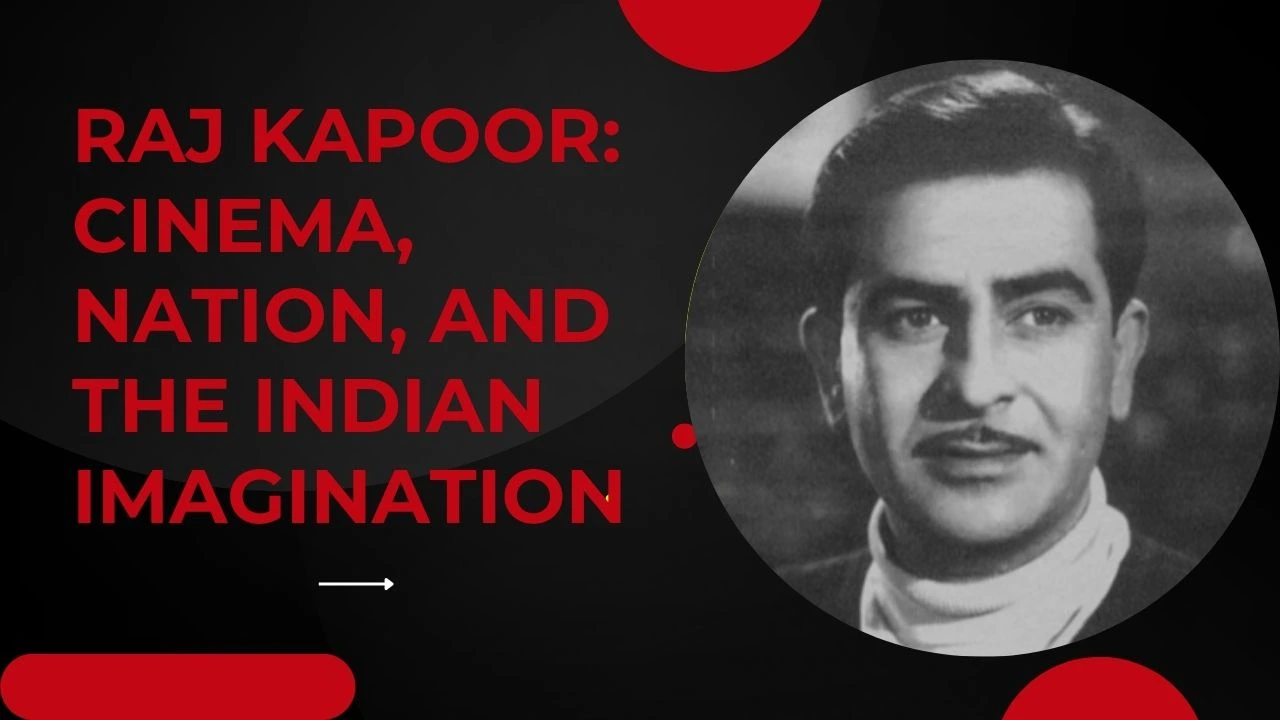
There is a scene in Shree 420 , the 1955 film in which Raj Kapoor's wandering everyman arrives in Bombay carrying nothing but a degree certificate and an enormous appetite for life , where he sings "Mera Joota Hai Japani" while walking down a road that seems to lead toward the city and the future simultaneously. Japanese shoes, English trousers, a Russian cap , yet the heart, he sings, is Hindustani. The song is funny and sad and surprisingly political. It is also, on close attention, a complete theory of Indian modernity: a man made from imported pieces, assembled under colonial pressure, carrying an interior he insists on calling his own. That the song became one of the most beloved in the history of Indian cinema tells you something about how precisely Raj Kapoor understood the emotional condition of his audience , and about the gap between the India that colonialism had left behind and the India that independence was trying to build.
Kapoor died in 1988, but the wanderer he created lives on in Indian cultural memory with a persistence that cannot be entirely explained by nostalgia. The Chaplinesque figure , the oversized shoes, the hesitant walk, the wounded smile, the moral innocence that survives every humiliation the city designs for it , was not simply a borrowed aesthetic from Hollywood. It was Kapoor's most precise social observation, translated into performance. His tramp was not Chaplin's tramp. He was something more specific and more painful: the migrant entering Bombay from the village with impossible dreams, the poor man standing at the edge of the urban economy that would use him without admitting him, the inheritor of independence who discovered that freedom, at the bottom of the economic order, looked remarkably like what had come before.
That figure made Raj Kapoor one of the most globally recognized faces in Indian cinema before globalization existed as a concept. In the Soviet Union, where his films played to massive audiences in the 1950s and 1960s, "Awaara Hoon" was known by people who had never seen India and never would. In the Middle East, in Central Asia, in parts of Africa and Eastern Europe, his wandering dreamer became synonymous with Indian cinema itself. This was not an accident of distribution. It was the consequence of something more essential: Kapoor had found, in the figure of the humane underdog preserving dignity within systems designed to deny it, an archetype that crossed cultures because the systems it was resisting were everywhere.
To write about Raj Kapoor is to write about one of the most complex and productive tensions in the history of Indian popular cinema: the tension between the filmmaker as moral humanist and the showman as emotional manipulator, between the socialist intellectual and the spectacular entertainer, between the artist who understood cinema as a vehicle for social truth and the performer who understood it as a vehicle for myth. Kapoor was all of these things simultaneously, and the films he made are richer and stranger and more contradictory than either his admirers or his critics have usually allowed.
The Inheritance
Raj Kapoor was born on December 14, 1924, into a performance dynasty so formidable that the distinction between art and family was, from the beginning, impossible to maintain. His father, Prithviraj Kapoor, was one of the foundational figures of both early Hindi cinema and modern Indian theatre , a man of enormous physical presence and equally enormous artistic ambition whose itinerant theatre company, Prithvi Theatres, carried Urdu dramatic tradition, nationalist emotional themes, and a rigorous performance culture across the length of the country.
To grow up as Raj Kapoor was to grow up inside a living institution of storytelling. The rhythms of performance, the psychology of audiences, the mechanics of emotional effect , these were household knowledge, as natural and as constant as meals or weather. The theatrical tradition Prithviraj embodied was not the naturalistic tradition of Stanislavski's system, which emphasized the suppression of performance in favor of lived behavior. It was a tradition of heightened emotional expression, of the body as a site of legible feeling, of the audience as a participant in a shared emotional event rather than an observer of a private psychological drama. Characters in this tradition did not merely feel , they declared their feelings, with the fullness and the confidence of people who understood that the emotional truth of a situation was more important than its behavioral surface.
This tradition entered Raj Kapoor's cinema as a structural principle. His characters perform their inner lives , they do not simply have them. The famous Kapoor face, with its enormous eyes and its capacity for displaying vulnerability with a directness that could seem either masterly or excessive depending on your aesthetic assumptions, was shaped in this theatrical workshop. So was his understanding of audience psychology: the knowledge of when to withhold, when to release, when a song could carry an emotion that no amount of dialogue could sustain.
Film scholar Ashish Rajadhyaksha has observed that Kapoor's cinema retained "the emotional grammar of theatre while embracing the possibilities of cinematic modernity" , and this is exactly right, with the important addition that the theatrical grammar Kapoor was working within was specifically the grammar of a popular Indian theatre tradition that had itself absorbed multiple influences: Urdu poetry, Parsi spectacle, nationalist mythology, and a performance culture that understood emotion as fundamentally public rather than private.
RK Films and the Cinematic Republic
When Raj Kapoor founded RK Films in 1948 , he was twenty-four years old, and it was the year after independence , he was not simply starting a production house. He was building an institution with a philosophy. The iconic RK logo, a man holding a violin while a woman reclines in his arms, was not branding in the modern corporate sense. It was a statement of purpose: romance as the medium through which the new nation's emotional life would be explored, the beloved as both the object of desire and the embodiment of the hope that made desire worth having.
What he assembled around that purpose was one of the most remarkable creative ecosystems in the history of Indian cinema. The collaboration with Khwaja Ahmad Abbas gave the films their intellectual backbone , Abbas was a Marxist journalist and novelist who brought to Raj Kapoor's cinema a serious engagement with class inequality, urban poverty, and the ideological dimensions of the Nehruvian moment. The pairing of Abbas's political intelligence with Kapoor's emotional populism produced films that were simultaneously socialist critiques and mass entertainments, which is a combination much harder to achieve than it sounds.
The musical collaborations shaped the films' emotional DNA in ways that are inseparable from their visual or narrative qualities. Shankar-Jaikishan , the composing duo Shankar Singh Raghuvanshi and Jaikishan Dayabhai Panchal , transformed the soundscape of Hindi cinema by fusing folk accessibility with orchestral richness, by understanding that the emotional register of an Indian film song was not the same as a Broadway showstopper or a Hollywood number, that it needed to carry philosophical weight as well as melodic pleasure. Mukesh's voice, which became the aural embodiment of Raj Kapoor's on-screen presence, carried within its specific timbre a quality of melancholic longing that was perfectly calibrated to the emotional world the films inhabited. The lyricists Shailendra and Hasrat Jaipuri achieved something rare: they wrote words that sounded simultaneously like popular poetry and like the natural expression of characters in specific emotional situations.
And Radhu Karmakar, the cinematographer who worked with Kapoor across the most important years of his career, developed a visual language for these films that is as distinctive and as theoretically purposeful as the visual language of any acknowledged master of world cinema. His use of light, shadow, rain-soaked streets, and mirrors; his understanding of how urban space could be transformed into moral geography; his ability to make a wet Bombay pavement carry as much emotional weight as a close-up , these are achievements that deserve the serious formal analysis they have rarely received.
Awaara (1951): The Dream Beneath the City
Awaara is the film on which Raj Kapoor's claim to seriousness as a filmmaker most clearly rests, and it is worth attending to exactly why.
The surface of the film is a melodrama: Raj, the illegitimate son of a judge who has abandoned him, grows up in poverty under the influence of a criminal, falls in love with Rita (played by Nargis), faces trial for attempted murder of his own father, and is ultimately saved by the woman who loves him and by the legal system that had previously failed him. The emotional architecture is operatic , large, declarative, unashamed of its own intensity.
Beneath this surface, however, Abbas and Kapoor were conducting a precise and serious interrogation of post-independence Indian society. The film's central philosophical argument concerns heredity versus environment: the judge believes, with the confidence of a man whose class position has never been genuinely threatened, that character is inherited, that the son of a criminal will become a criminal, that the social order is a reflection of natural order. Raj's life is the evidence against this position. He is not criminal by nature; he is made criminal by a social structure that abandons him, exploits him, and gives him no path toward dignity that doesn't run through crime. The courtroom scenes in the film are not simply dramatic climaxes. They are ideological theatre, making explicit an argument about social determinism that the rest of the film has been building emotionally.
This argument was not accidental. It was central to the Nehruvian project , the idea that India's postcolonial democratic republic had a responsibility to its poorest citizens, that social conditions rather than birth or destiny determined human possibility, that the state owed ordinary people something more than the freedom to fail on their own terms. Awaaratranslated this political position into emotional cinema accessible to audiences who would never read a Five-Year Plan document but who would recognize in Raj's situation something they had lived or seen or feared.
The film's most formally extraordinary achievement is its dream sequence. What Kapoor created , a surrealist landscape of towering staircases, infernal depths, heavenly heights, symbolic choreography, and architectural expression of psychological states , has no obvious precedent in Indian cinema and sits alongside the great oneiric sequences in world film. The influence on the sequence of the German Expressionist tradition, of the nightmare architectures of The Cabinet of Dr. Caligari and Metropolis, is visible. So is the influence of a more specifically Indian symbolic vocabulary: the staircase as a metaphor for social aspiration and spiritual ascent, fire as both destruction and purification, the visual rhetoric of the sacred and the infernal. Kapoor synthesized these into something genuinely his own , a sequence that externalizes the psychological conflict between desire and guilt, between the innocent self and the socially constructed criminal self, with an ambition that Indian cinema would not match for decades.
"Awaara Hoon" , the song that traveled to the Soviet Union and became an anthem for the underdog everywhere , is both the film's emotional center and its most concentrated ideological statement. The word awaara carries a range of meanings in Hindi and Urdu: wanderer, vagrant, the rootless person without a fixed social identity. For Kapoor, it carried also the connotation of the person whom official society had failed to incorporate , the surplus person of modernity, the migrant without a document, the poor man without a patron. To sing awaara hoon was to claim that identity not as a shame but as a condition, to insist on the dignity of the person whom the social order had not managed to place.
That insistence is what crossed languages and cultures. The Soviet audiences who wept at Awaara were not weeping for India specifically. They were weeping for a figure they recognized , the humane person ground down by a system that could not see them , and for the quality of Kapoor's emotional truth, which transcended its specific cultural context precisely because it was so specifically human.
Shree 420 (1955): The City as Moral Laboratory
If Awaara was the film of social determinism and the courtroom, Shree 420 was the film of urban seduction and the conscience. Kapoor moved his wandering protagonist into the heart of Bombay , the real Bombay, the city of electric signs and pavement dwellers, of extraordinary wealth and extraordinary destitution occupying the same streets , and made the city itself into the film's central moral argument.
The section 420 of the Indian Penal Code, which deals with cheating and fraud, gives the film its title and its thematic organizing principle. Bombay, in Kapoor's version, is a city organized around sanctioned fraud: the gap between the glamour of the visible surface and the exploitation of the invisible structure is the city's defining characteristic, the thing that makes it work and makes it corrupt simultaneously. His protagonist, another Raj, arrives carrying innocence , the famous Gandhian-style simplicity that the film contrasts with Bombay's sophistication , and is offered a choice between the moral economy of Vidya (knowledge, truth, the humble schoolteacher played by Nargis) and the false economy of Maya (illusion, the temptress played by Nadira, whose name itself means the very illusion it embodies).
The philosophical vocabulary is explicitly Indian. Vidya and Maya are not simply character names but concepts from Indian philosophical tradition: Vidya as knowledge of the real, Maya as the seductive illusion that conceals the real from those who are taken in by it. Kapoor was working in a tradition that reached back through Vaishnav devotional philosophy to the Vedantic concept of the world as beautiful deception, the surface of appearance concealing a deeper truth. But he translated this into the specific language of postcolonial capitalism: the Maya here is not cosmic illusion but the specific illusion that money and glamour constitute a life worth living.
The rain song "Pyaar Hua Iqraar Hua" is the film's most cinematically sophisticated moment , a sequence in which Karmakar's cinematography achieves something close to perfection. Umbrellas share between two bodies, wet pavements reflect the neon lights of the city above them, moving shadows animate the space around the lovers, and the editing follows the rhythm of the music rather than the logic of the narrative. It is, as pure cinema, one of the great sequences in Hindi film history. It is also, in context, a moment of political poignancy: these two people, sharing an umbrella against the Bombay rain, are the most precarious and the most genuine thing in a film full of false wealth.
Jagte Raho (1956): The Urban Nightmare
Jagte Raho , directed primarily by Sombhu Mitra and Amit Maitra, with Kapoor in the lead , is the most formally radical film in the Kapoor canon, and in certain ways the most formally advanced work that bears his name.
A thirsty villager enters an apartment building looking for water. The building's residents mistake him for a thief. Over one long night, the film exposes the hypocrisy, paranoia, and moral vacuity of Bombay's middle-class residents , each of whom, when their private lives are glimpsed, turns out to be concealing a corruption larger than the non-crime they are pursuing. The apartment building functions as a Kafkaesque surveillance structure: corridors, locked doors, dim staircases, and suspicious windows create an atmosphere in which the visual grammar of bourgeois comfort becomes the grammar of anxiety and guilt.
Dialogue recedes throughout the film. The villager cannot speak the urban language and the urban residents cannot hear his need. What fills the silence is observation , Kapoor's face registering bewilderment, fear, and an increasingly bewildered moral understanding of what kind of world he has wandered into. The apartment building is not simply a Bombay location. It is a diagnosis of what urban modernity does to human solidarity, how the physical architecture of private property creates the psychological architecture of suspicion and self-concealment.
The ending , Nargis appearing as a woman who offers the villager water, transforming suddenly into a figure of almost allegorical compassion , is deliberately otherworldly, as if the only person capable of genuine human gesture in this city has arrived from somewhere else entirely. Water becomes what it has always been in Indian symbolic tradition: the element of grace, the substance of life offered freely to those who need it. In a film about a city that commodifies everything, the free gift of water to a thirsty stranger is the only revolutionary act available.
The Nargis Question
To write about Raj Kapoor's films of the early 1950s without writing about Nargis is to leave out half the architecture of what makes them work. Their screen partnership , one of the great creative and personal partnerships in Indian film history , produced an emotional chemistry that can be analyzed formally but not entirely explained by formal analysis. What happened between them on screen had something to do with the specific quality of their mutual attention, the sense that each was fully present to the other in a way that created a kind of intimacy visible through the camera.
Nargis was not merely Kapoor's leading lady in the conventional sense. She was his emotional counterpart and, frequently, his moral superior within the narrative worlds they inhabited together. In film after film, her character was the person whose moral compass was not shaken by the temptations that undid or threatened to undo his , she was Vidya to his seduced Raj, the ethical anchor who waited for his conscience to find its way back. This is not a flattering role for a woman, exactly, and feminist film criticism has rightly noted that it positions female virtue primarily in relation to male weakness. But Nargis consistently gave these characters an inner life and a dignity that exceeded their narrative function, and the films are richer for it.
When she left , when their relationship ended and she married Sunil Dutt and effectively departed from Kapoor's cinematic world , something changed in the emotional register of his films. He continued to make great work, but the quality of mutual attention that had animated the early films was replaced by something more solitary, more self-regarding. The mirror, which had always been an important motif in Kapoor's visual vocabulary, became more central , as if, without the genuine other of Nargis across from him, he was increasingly forced to find his emotional counterpart in his own reflection.
Mera Naam Joker (1970): The Clown's Confession
Mera Naam Joker is the film in which everything Raj Kapoor was trying to say caught up with him at once, in a form too honest and too personally vulnerable for its original audiences to receive it without discomfort. Released in 1970 after years of production and enormous financial investment, it failed at the box office and devastated Kapoor both financially and emotionally. Its rehabilitation , the gradual recognition, across the following decades, that it was one of the great self-reflexive films in world cinema , is one of the more instructive stories in Indian film history.
The film is structured as three episodes, each representing a stage of the clown-protagonist's life, and each turning on an incomplete love , a love that begins, deepens, and is then lost, leaving the clown to continue performing. The circus is the film's organizing metaphor, and Kapoor understood exactly what he was doing with it. The circus performer who maintains his professional smile while privately suffering , who transforms personal pain into entertainment, whose tears become performance before they can be private grief , is the most honest self-portrait an Indian film star of Kapoor's generation ever offered.
"Jeena Yahan Marna Yahan" , the song that closes the film and that functions as its philosophical statement , is among the most extraordinary moments in Indian popular cinema. It does not console. It does not resolve. It accepts, with a quality of philosophical resignation that is not the same as despair, the proposition that life is exactly this: a performance that continues whether or not the performer's private grief has been acknowledged. The show must go on is not a bromide here. It is a tragic recognition.
The film's commercial failure was partly a consequence of its emotional honesty. Indian audiences in 1970 were not prepared for the degree of autobiographical self-exposure that Kapoor was offering , for a film in which the showman removed his greasepaint, or rather revealed that the greasepaint was the only face he had. History, which has a way of eventually compensating for these failures of immediate recognition, has placed the film where it belongs: among the handful of Indian films that genuinely changed what the medium understood about itself.
Sangam (1964): The Grammar of Spectacle
Between Jagte Raho and Mera Naam Joker, Kapoor made Sangam , and in doing so, effectively invented a new register for mainstream Hindi cinema. Shot partly across Europe in the lavish color cinematography that Karmakar and later cinematographers would develop through this period, Sangam announced that the Hindi film could operate at a scale of visual grandeur previously associated only with Hollywood epics.
The word sangam means confluence , the meeting of rivers, but also the meeting of desires and relationships. The triangular love story at the film's center is less interesting, finally, than the emotional structure it supports: a meditation on male possessiveness, on the specific pathology of a certain kind of romantic love that cannot distinguish between devotion and ownership, that mistakes jealousy for depth and emotional control for care.
Raj Kapoor's character in Sangam is not simply a lover. He is a man whose love is structured around a terror of abandonment so profound that it deforms his relationship with everyone it touches. The film shows this without quite endorsing it , it is too honest about the damage wrought by this kind of love to be entirely complicit , but it also aestheticizes it, surrounds it with enough beauty that the critique exists alongside the seduction rather than replacing it. This ambivalence is characteristic of Kapoor's mature work. He rarely offered simple moral positions on his protagonists' failures. He showed them, with all their attractiveness intact, and trusted the audience to do their own moral arithmetic.
The color in Sangam functions thematically in a way that Karmakar had been developing throughout the black-and-white period. Red returns consistently during moments of emotional crisis and romantic extremity , it is the color of the blood that jealousy draws, and of the passion that makes jealousy feel like love. The European locations provide a visual counterpoint that does not simply signify glamour: they represent the world outside India, the modernity that is available to wealth, the distance from village morality that money purchases. When the characters return to India in the film's final movement, the visual grammar shifts , the landscapes become simultaneously more beautiful and more morally serious.
Bobby (1973): The Reinvention
After the commercial catastrophe of Mera Naam Joker, Raj Kapoor did what the great showmen always do when the form that has served them stops serving them: he reinvented. Bobby shifted everything , the generation at the center of the story, the register of the romance, the music, the pacing, the visual grammar , and produced one of the most commercially successful films in Indian cinema history.
But the reinvention was not purely cosmetic. By introducing Rishi Kapoor and Dimple Kapadia as his new protagonists, Raj Kapoor was acknowledging something about generational succession and about the changing nature of aspiration in Indian society. The young people in Bobby do not carry the ideological weight of the Nehruvian moment , they are not wandering dreamers confronting the moral corruption of capitalism, they are teenagers in love who want their love acknowledged and their freedom respected. The class politics have not disappeared , the film is still about the obstacles that wealth and family erect against genuine human connection , but they have been translated into a more personal, less ideologically structured register.
The music of Bobby represents another shift. Where Shankar-Jaikishan had created orchestral grandeur, the Bobby songs have a lighter, more contemporary texture. The emotional vocabulary is still recognizably Kapoor's , longing, innocence, the tenderness of first love , but the idiom has updated. This was Raj Kapoor demonstrating, once again, his fundamental understanding of the relationship between cinema and its audience: that the audience changes, and the cinema that serves it must change with it, but that the emotional truths beneath the surface remain constant.
Satyam Shivam Sundaram (1978): The Unresolved Contradiction
The most honestly complicated film Raj Kapoor ever made may be the one that is most often discussed in terms of its controversy. Satyam Shivam Sundaram , Truth, Divinity, Beauty: the Sanskrit triad that posits these as aspects of the same ultimate reality , attempted something philosophically ambitious and cinematically achieved a result that is simultaneously profound and troubling.
The film's argument is about the relationship between physical beauty and spiritual truth. Its protagonist is a woman who is, by conventional standards, scarred and therefore visually imperfect. The man who loves her loves the voice of her devotional singing , which reaches him as pure spiritual beauty , before he sees her face. The spiritual argument is that divine beauty exists independently of physical beauty, that the soul speaks through the voice and the song in ways that the body cannot match or contain.
This is a serious argument. It has deep roots in Indian devotional aesthetics , in the Vaishnav tradition's understanding of the divine beloved as apprehended through sound before sight, in the philosophical concept of nada brahma (the universe as sound). Kapoor intended it as a spiritual film. And in certain sequences , particularly those involving the devotional music itself , the spiritual intention is genuinely achieved. The singing sequences have a quality of transcendence that is real, not manufactured.
But the feminist critique of the film, articulated with particular clarity by scholars working in the tradition Laura Mulvey established, cannot be dismissed or softened. The camera's relationship to Zeenat Aman's body throughout the film is voyeuristic in ways that contradict the spiritual framework the film explicitly endorses. The eye of the camera repeatedly positions the female body as an object of the male gaze at the same moments that the male protagonist is supposedly transcending the physical. Spirituality and voyeurism do not cancel each other in Satyam Shivam Sundaram. They coexist, unresolved, each undermining the other's claim to sincerity.
This unresolved tension is, finally, the most revealing thing about the film , and perhaps about Raj Kapoor's entire relationship with the women in his cinema. He genuinely believed in the spiritual seriousness of what he was doing. He also genuinely aestheticized the female body in ways that served purposes other than spiritual seriousness. Both things were simultaneously true, and the failure to resolve them was not hypocrisy but contradiction , the contradiction of a man deeply shaped by a culture that simultaneously venerated and objectified feminine beauty, and who could not locate, in his filmmaking practice, the point at which veneration ended and objectification began.
Ram Teri Ganga Maili (1985): The Final Allegory
Raj Kapoor's final major film carries the weight of a coda. The Ganga , the river as sacred geography, as the symbolic embodiment of Indian civilization's spiritual life, as the national symbol of purity , descends from the Himalayas into the plains and is progressively contaminated by the corruption, greed, and exploitation that await it. The protagonist, Mandakini's character, enacts this descent in human terms: she comes from the purity of the mountains and is progressively subjected to the defilements of a society that cannot protect what is most precious in it.
The film's allegorical structure is explicit , more explicit, and less comfortable to contemporary audiences, than Kapoor's earlier allegories , because the vehicle of the allegory is once again the female body and its violation. The nationalist tradition of imagining the nation as a woman whose purity must be defended against violation was well established long before Kapoor returned to it here, and the problems with that tradition , the way it transforms women from subjects into symbols, from people into the property that the national conscience is defined by defending , are real and serious. The feminist critique of Ram Teri Ganga Maili is essentially the feminist critique of a certain strand of Indian nationalist cinema, and it is a critique that must be acknowledged rather than argued away.
And yet the film also carries a genuine grief. Whatever the limitations of its symbolic vocabulary, it was made by a man in his sixties who had been watching India change throughout his adult life, who had made film after film about the moral cost of what he called modernity, and who found, in this final major statement, a form , the violated sacred river , for the sadness of watching a civilization's spiritual inheritance be sold.
The film's faults and its genuine feeling are inseparable from each other. That is true of Raj Kapoor more broadly.
The Collaborators and Their Legacy
No serious account of Raj Kapoor can avoid returning, repeatedly, to the people who made the films with him , because no serious account of Indian popular cinema can afford to treat the director as the sole author of a form that is as fundamentally collaborative as Hindi commercial cinema.
Shailendra, the lyricist, deserves particular attention. He was a socialist trade union worker before he became the poet whose words gave Raj Kapoor's films their philosophical texture. His lyrics for "Awaara Hoon," "Mera Joota Hai Japani," "Sab Kuch Seekha Humne," and dozens of other songs in the Kapoor canon were not simply popular verse , they were philosophy in the vernacular, ethical statements compressed into images accessible to everyone. The particular achievement was to make the political feel personal and the personal feel universal: to write a song about a man's wandering and make it sound simultaneously like a specific life and like the condition of an entire generation.
Shankar-Jaikishan understood that the function of film music in the Indian emotional economy was categorically different from the function of film music in Hollywood or Europe. It was not background. It was foreground , sometimes the primary site of the film's emotional action, the place where the narrative's deepest feeling was expressed when dialogue was inadequate and image alone was insufficient. Their orchestrations gave Mukesh's voice an environment that amplified rather than supported what that voice did naturally: the quality of longing it carried, the slight roughness that kept it from being merely beautiful, the sense that sorrow and tenderness were present simultaneously.
Radhu Karmakar's contributions to this cinema remain systematically underanalyzed. His visual grammar , the rain-soaked streets as moral geography, the play of light on wet surfaces, the use of mirrors to suggest the fracture between the self that performs and the self that suffers, the way he framed Kapoor's body within urban spaces so that the physical scale of the city was always legible as a social relationship , deserves the kind of extended formal analysis that the field of Indian cinema studies has largely reserved for directors rather than cinematographers.
The Global Phenomenon
The international reception of Raj Kapoor's films , particularly in the Soviet Union but also across the Middle East, Central Asia, parts of Africa, and the non-aligned world , is one of the most significant and least studied phenomena in the history of world cinema. At the height of his popularity in the Soviet Union, Kapoor was recognized on the street in Moscow. Soviet film critics wrote seriously about his work. "Awaara Hoon" was sung by people who spoke no Hindi, in contexts that had nothing specifically to do with India.
This reception was not purely the result of state cultural policy, though Cold War cultural politics played a role in enabling the circulation of Indian films in Soviet and Eastern European markets. It was a genuine audience response to something in the films themselves that crossed cultures. The figure of the humane underdog, the wandering dreamer who preserves emotional dignity within systems designed to deny it, was recognizable everywhere that such systems operated , which was, in the 1950s and 1960s, nearly everywhere. The specific Indianness of Kapoor's tramp , the particular moral vocabulary, the specific relationship to Gandhian ethics and Nehruvian socialism , was legible even to audiences who could not decode its cultural references, because the emotional situation it enacted was universal.
This suggests something important about the relationship between cultural specificity and universal resonance in cinema. The films did not become globally powerful by becoming generic or culturally neutral. They became globally powerful by being deeply, specifically rooted in a particular time and place and emotional vocabulary , and finding that this rootedness, rather than limiting their reach, was precisely what made them accessible to people whose lives were superficially very different.
The Contradictions, Held Without Resolution
To write about Raj Kapoor without writing about his contradictions is to write a hagiography rather than a critical essay, and hagiographies, however reverential, tell us less than the complications do.
His films oscillate, sometimes within a single sequence, between socialist humanism and emotional manipulation, between genuine compassion for the poor and a romanticization of poverty that serves the emotional needs of his narratives more than it serves the actual needs of the poor. The beautiful pavement dwellers in Shree 420, the singing migrants in Awaara , they are moving and real, but they are also aestheticized in ways that make their poverty a backdrop for Kapoor's emotional architecture rather than a social reality demanding structural change. This is not a minor criticism. It is a criticism of the entire tradition of what M. Madhava Prasad has called the "feudal-family romance" in Hindi popular cinema , the mode in which social inequality is made emotionally available without being politically challenged.
His films' relationship to women is similarly unresolved. Nargis, Vyjayanthimala, Dimple Kapadia, Zeenat Aman, Mandakini , the women in Raj Kapoor's films are among the most memorable figures in Indian popular cinema. They are also, with notable exceptions, primarily legible in relation to his protagonists' emotional needs. They represent purity, temptation, sacrifice, or regeneration within a moral economy whose center is consistently male. This was not unusual for the Hindi commercial cinema of his era, but it is a limitation that needs to be named, particularly in the context of films like Satyam Shivam Sundaram and Ram Teri Ganga Maili, where the gap between the film's spiritual ambitions and its camera's voyeuristic behavior becomes a genuine contradiction rather than simply a period convention.
Ravi Vasudevan's work on the melodramatic public in Indian cinema has helped clarify why these contradictions were not aberrations but structural features of the commercial Hindi film form as it developed through this period. The form required the simultaneous mobilization of emotion and the management of social anxiety, which meant it regularly produced texts in which progressive political content and conservative emotional structures coexisted without resolution. Raj Kapoor did not invent this tension. He inhabited it with more self-awareness than most, and his best films are those in which the tension generates genuine complexity rather than simply muddiness.
The Dreamer Who Built a Republic
Raj Kapoor died on June 2, 1988, from complications of asthma, at a film function in Delhi , at a ceremony honoring him with the Dadasaheb Phalke Award, cinema's highest national recognition. The manner of his death felt almost scripted: the showman, being honored at last in the full public sense, collapsing in the middle of the ceremony. The show, in the most literal possible way, could not go on.
He was sixty-three years old. He had been making films for forty years. He had built, in that time, not merely a body of work but an emotional world , a world populated by wanderers and dreamers and women who waited and cities that seduced and rain that fell as if it knew what the people beneath it were feeling. That world was populated, in the first instance, by the specific anxieties and aspirations of newly independent India in the Nehruvian moment. But it was also populated by something more durable than a moment: the condition of the person who wants a better life than the one they have been given, who carries that want into a world organized to frustrate it, and who keeps singing anyway.
Ashis Nandy, writing about the secret politics of Indian popular cinema, has suggested that Hindi film operates as a kind of dream work for Indian society , a space in which desires that cannot be openly expressed in the social world find symbolic expression. Raj Kapoor understood this not as a theoretical proposition but as a practical one, as the foundation of his entire artistic project. He made films that were dream work in Nandy's sense: that allowed their audiences to experience, in safety and in darkness, the longings and the griefs and the possibilities that daily life contained but could not accommodate.
That is what the wanderer walking down the road at the beginning of Shree 420, singing about Japanese shoes and an Indian heart, was doing. He was giving the audience back a version of themselves that was both more innocent and more truthful than the version they had to present to the world each morning. He was insisting, in the face of everything the modern world did to ordinary people, that the heart remained Hindustani , that something essential and irreducible persisted beneath the borrowed pieces of an identity assembled under pressure.
India was wandering beside him. In some sense, it still is.
Further Reading
Prasad, M. Madhava. Ideology of the Hindi Film: A Historical Construction. Oxford University Press, 1998.
Vasudevan, Ravi. The Melodramatic Public: Film Form and Spectatorship in Indian Cinema. Palgrave Macmillan, 2011.
Dwyer, Rachel. Raj Kapoor: The Fabulous Showman. Lustre Press, 1994.
Mazumdar, Ranjani. Bombay Cinema: An Archive of the City. University of Minnesota Press, 2007.
Rajadhyaksha, Ashish and Paul Willemen. Encyclopaedia of Indian Cinema. BFI and Oxford University Press, 1994.
Nandy, Ashis, ed. The Secret Politics of Our Desires: Innocence, Culpability and Indian Popular Cinema. Zed Books, 1998.
Mulvey, Laura. "Visual Pleasure and Narrative Cinema." Screen 16, no. 3 (Autumn 1975).
Chatterjee, Partha. The Nation and Its Fragments: Colonial and Postcolonial Histories. Princeton University Press, 1993.
Republic of Cinema publishes long essays on cinema history, theory, and filmmakers for readers who believe film is one of the most powerful tools we have for understanding the world we live in.
💬 Discussion
0 comments