Read a script the way it's meant to be read, and it goes from page one to "fade out" without a single jump. Scene follows scene. Day follows night follows day. A character leaves a room in scene forty and walks into the next room in scene forty-one, and on the page, that's seamless — one breath, one continuous world.
No film is ever shot that way. Not one. Not ever.
This is the gap this department exists to close — the gap between a script, which is an experience designed for a reader moving in one direction, and a shoot, which is a machine designed to move people, equipment, and money through space and time as efficiently as possible. A script has a story order. A shoot has almost nothing to do with story order. And the entire craft of planning is the craft of taking something written to be read in sequence and turning it into something that can be executed out of sequence — without losing the sequence at all, because the sequence is the only thing that actually matters in the end.
Here's a detail that sounds small but tells you everything: in most scripts, the first scene and the final scene often happen in the same location. Beginning and end, bookended in the same room, the same street, the same house. On the page, those two scenes are separated by ninety pages and, often, months or years of story time. On a schedule, there's a good chance they get shot on the same day, an hour apart, because nobody is going to pay to rent that location twice. That's not a compromise the planning process makes reluctantly. That's the planning process working exactly as it should.
So if a film can't shoot in script order, what does it shoot in? The answer starts with a document that, if you've never seen one, looks almost comically unglamorous: the script breakdown sheet.
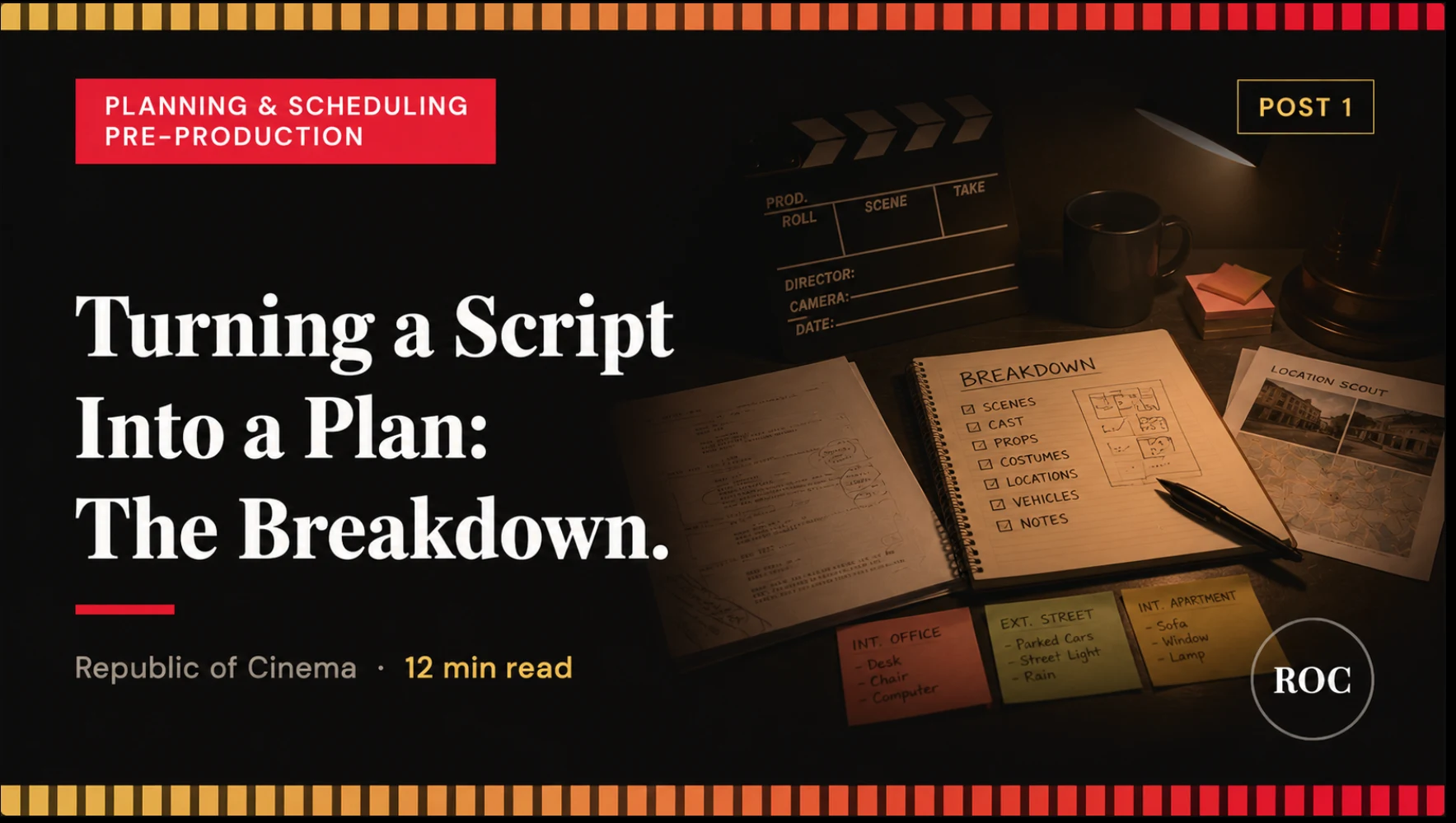
A breakdown sheet exists for every single scene in the script — one sheet, one scene. And what's on it has almost nothing to do with what the scene is about. It lists who and what that scene physically requires to exist: which characters appear, how many background extras, what props, what wardrobe, what vehicles, what special effects, what makeup, what music, what equipment. The scene's length gets measured too, not in minutes but in eighths of a page — a half-page scene is four-eighths, and that number will quietly follow the scene through every schedule it ever appears on.
To build these sheets, someone — often the assistant director, sometimes the director themselves on a small production — goes through the entire script with a set of colored highlighters, marking every category as it appears: cast in one color, props in another, wardrobe, vehicles, special effects, animals, anything that costs money or takes time to arrange. This process has a name — lining the script — and by the time it's done, the script looks less like a screenplay and more like a piece of abstract art, every page a wash of color. That color isn't decoration. It's the script being translated, scene by scene, into a language that a schedule can actually read.
And here's the thing students miss about this stage: it feels like paperwork, but it's the first moment anyone actually seesthe film as a physical object rather than a story. A scene that reads as a single elegant paragraph — "INT. KITCHEN — NIGHT. Maya makes tea while the radio plays" — might, once lined, reveal that it needs a period radio prop, a specific kind of teapot the production designer has to source, a night shoot which means lighting the kitchen to look like night even if you're shooting at 2 p.m., and a wardrobe note because this is "script day three" and Maya's clothes need to match what she wore in scene twelve, which was actually shot eleven days earlier. None of that is visible in the prose. All of it is now visible on the breakdown sheet. This is the moment a script stops being something you read and starts being something you can actually plan around — and it's also the moment where the rookie mistake lives: looking at a tiny scene, two-eighths of a page, and assuming it'll take an hour, when in fact those two-eighths describe a car exploding and a motorcycle jumping a river. Page count tells you nothing about shoot time. The breakdown is what tells you the truth.
Once every scene has a breakdown sheet, the next step is the one most people picture when they imagine "scheduling" — the stripboard.
A stripboard, sometimes called a production board, is built from long strips — traditionally cardboard, now almost always digital, but built to look and behave exactly like the cardboard version — one strip per scene, carrying the essential information from that scene's breakdown sheet in compressed form. And the first thing you notice about a stripboard, before you read a single word on it, is color. Every strip is color-coded by exactly one thing: whether the scene is day or night, interior or exterior. Day interior is white. Day exterior is yellow. Night interior is blue. Night exterior is green. That's it. Four colors, and from across the room, before anyone has read a single scene description, you can already see the shape of a shooting day forming — a wall of yellow strips means a day spent outdoors in daylight; a cluster of blue means a night spent indoors, which means different call times, different lighting setups, different everything.
Why does this matter so much that it gets encoded in color before anything else? Because day/night and interior/exterior are the four conditions that determine almost everything else about how a scene gets shot — what light is available, what crew is needed, what time people have to show up, whether you're racing a sunset or fighting to black out windows in the middle of the afternoon. Two scenes that are pages apart in the script, with completely different characters and completely different emotional content, might sit right next to each other on the stripboard simply because they're both "day exterior" and both happen to be shootable at the same location. The story doesn't care about that connection. The schedule absolutely does.
This is also where the logic of "group by location, not by story" becomes unavoidable. If three scenes in a script all happen in the same café — one early in the story, one in the middle, one near the end — a production simply cannot afford to load in lighting equipment, dress the set, and get everyone into position three separate times on three separate days. So those three scenes get pulled together on the stripboard, regardless of where they sit in the story, and shot in one sustained block. The crew moves once. The story, on screen, will still unfold in its proper order — that's what editing is for — but the production of that order happens entirely out of sequence.
The same logic applies to people, not just places. If an actor is only available for a short window — a star with other commitments, someone flying in from abroad for a limited number of days — every scene that actor appears in gets pulled together and shot out, meaning all of that actor's scenes are filmed in a concentrated block, regardless of where those scenes fall in the story. Scheduling software can generate something called a day-out-of-days report, which is exactly what it sounds like: a grid showing, for every actor, exactly which days they're needed across the whole shoot, so a production can see at a glance whether someone's scenes are scattered wastefully across the calendar or whether they can be consolidated.
Now, here's where planning stops being just logistics and starts being a thinking tool — because a stripboard, a shot list, and a storyboard all do something beyond organizing. They let you see the film before it exists, and seeing it early is how you catch problems while they're still cheap to fix.
Storyboards are shot-by-shot drawings of how a sequence is meant to look and move — not finished art, usually, just enough information to communicate what the camera sees and how it moves between setups. Some directors storyboard obsessively; others find it limiting and prefer to work things out on the day. But where storyboards earn their place — where almost everyone agrees they're worth the time — is in sequences with a lot of moving parts: visual effects, stunts, anything where many departments need to coordinate around a single complicated shot. A storyboard for a simple conversation between two people is often unnecessary; the blocking will emerge in the room. A storyboard for a car chase, or a scene where a building needs to collapse, is the only way every department — camera, effects, stunts, art — can look at the same plan before a single person shows up on set.
This is the real argument for treating these documents as thinking tools rather than paperwork: a storyboard doesn't lock anything in. What it does is force questions to surface early, in a meeting room, on paper, where they're free — instead of on day eleven of the shoot, in front of fifty crew members, where every unanswered question costs real money per minute. The shot list works the same way. A director walking into a scene with a shot list isn't necessarily going to follow it exactly — plenty of directors will tell you the best shot of the day was one nobody planned — but having thought through the scene in advance means that when something unplanned happens, you can recognize it as a gift rather than a problem, because you already know what you don't need anymore.
Locations get this same advance-thinking treatment, and the process has a name that sounds almost too casual for how important it is: the recce — short for reconnaissance, and pronounced exactly like that. A recce isn't just the director and a location scout looking at a pretty building and saying yes. By the time a location reaches what's sometimes called a tech scout, the group walking through it includes the assistant director, the production designer, the cinematographer, the gaffer, the key grip, the sound recordist — everyone whose job will be affected by this specific room or street or field. And the central ritual of that visit is the walk-through: the director physically moves through the space, scene by scene, describing how each moment will be staged and shot — where actors will stand, which way the camera will face, how people will move from one part of the room to another.
Everyone else in that group is doing the same walk-through from their own angle. The cinematographer is thinking about where light can come from, and — just as important — which direction the camera will not be pointing, because that's where lights and equipment can hide. The sound recordist is listening: is there a flight path overhead, a generator next door, floors that creak? The grip is looking at ceiling height, at whether a dolly track will fit, at whether a crane shot would need scaffolding that isn't there. None of this shows up in the finished film as a credit or a line item anyone notices. All of it is the reason the finished film doesn't fall apart on day one.
And woven through all of this — breakdown, stripboard, recce — is the question of rehearsal, which is where planning quietly becomes a creative decision rather than just a logistical one. Rehearsal time has to be built into a schedule deliberately, because nothing else will protect it; if it isn't planned, it simply won't happen, swallowed by the more urgent gravity of locations and call times. Some productions build in dedicated rehearsal days before principal photography even starts — sometimes the same days used for costume fittings and makeup tests, because it's efficient to gather the cast for more than one purpose at once. Other productions, more often than anyone likes to admit, end up rehearsing on the day, in the minutes before a scene is shot — which isn't a disaster, but it is a different film than the one that would have emerged from a week of proper rehearsal. The schedule doesn't just decide when things happen. It decides how much time to thinkthe people making the film actually get.
If you want to see what it looks like when all of this — breakdown, stripboard, recce, rehearsal — is treated with total seriousness, look at the reputation that surrounds Mani Ratnam's productions. Within the industry, Ratnam is known less for any single stylistic signature than for the discipline of his preparation: scripts that are locked — genuinely locked, scene by scene — before a shoot begins, rather than evolving on the floor the way many large productions do. His films have repeatedly taken on locations that are not just difficult but politically and logistically loaded — Kashmir in Roja, the contested geography running through Dil Se, the Sri Lankan conflict at the heart of Kannathil Muthamittal. Films set in places like these cannot survive an undisciplined shoot. Every one of those locations comes with its own version of the recce checklist — security, access, weather windows, permissions that can change overnight — multiplied across a production this size. The reputation for meticulous prep isn't a personality quirk layered on top of the filmmaking. It's the precondition for being able to tell these particular stories at all. A loosely planned production simply could not survive contact with these locations long enough to get the film made.
Now go to the opposite end of the spectrum — a production where the plan didn't survive contact with reality, and where the failure of the plan became, by accident, one of the most famous creative decisions in modern cinema.
Jaws was supposed to feature its shark. A lot. The mechanical shark built for the production — nicknamed Bruce — was meant to be a major visual presence, filmed extensively in the water off Martha's Vineyard. Instead, Bruce barely worked. The mechanism built to operate in saltwater kept failing, sinking, malfunctioning, scene after scene, day after day — turning what was supposed to be a straightforward effects shoot into a logistical nightmare that blew through the schedule and the budget alike.
What happened next is the part every filmmaker should sit with. Unable to rely on the shark, the production was forced to find other ways to convey its presence — and what emerged was an approach built on suggestion instead of exposition: a fin cutting the surface, a POV shot gliding beneath swimmers, music doing the work that a visible monster was supposed to do. The shark that barely worked became a shark the audience barely saw — and the film is, by near-universal agreement, more frightening for it. This is the same principle Walter Murch describes from the editing room — do the most with the least, because suggestion engages the audience's imagination in a way that full exposure never can — except here it didn't arrive as a deliberate aesthetic choice from the start. It arrived because a schedule broke, and broke so badly that the only way through was to make something different from what was planned.
That's the lesson worth carrying out of this post and into the rest of this department. Planning isn't the opposite of creativity, and it isn't insurance against creativity going wrong, either. A breakdown sheet, a stripboard, a recce, a rehearsal schedule — these are the first draft of how a film is going to feel, written in a language of locations and dates and colored strips of paper, weeks or months before anyone says "action." Sometimes that first draft survives intact. Sometimes, like on Jaws, it doesn't survive at all — and what replaces it becomes the thing people remember. Either way, the plan is where the film starts to become real. Everything else in this department is about learning to read that plan, build it, and — when you have to — break it well.
💬 Discussion
0 comments