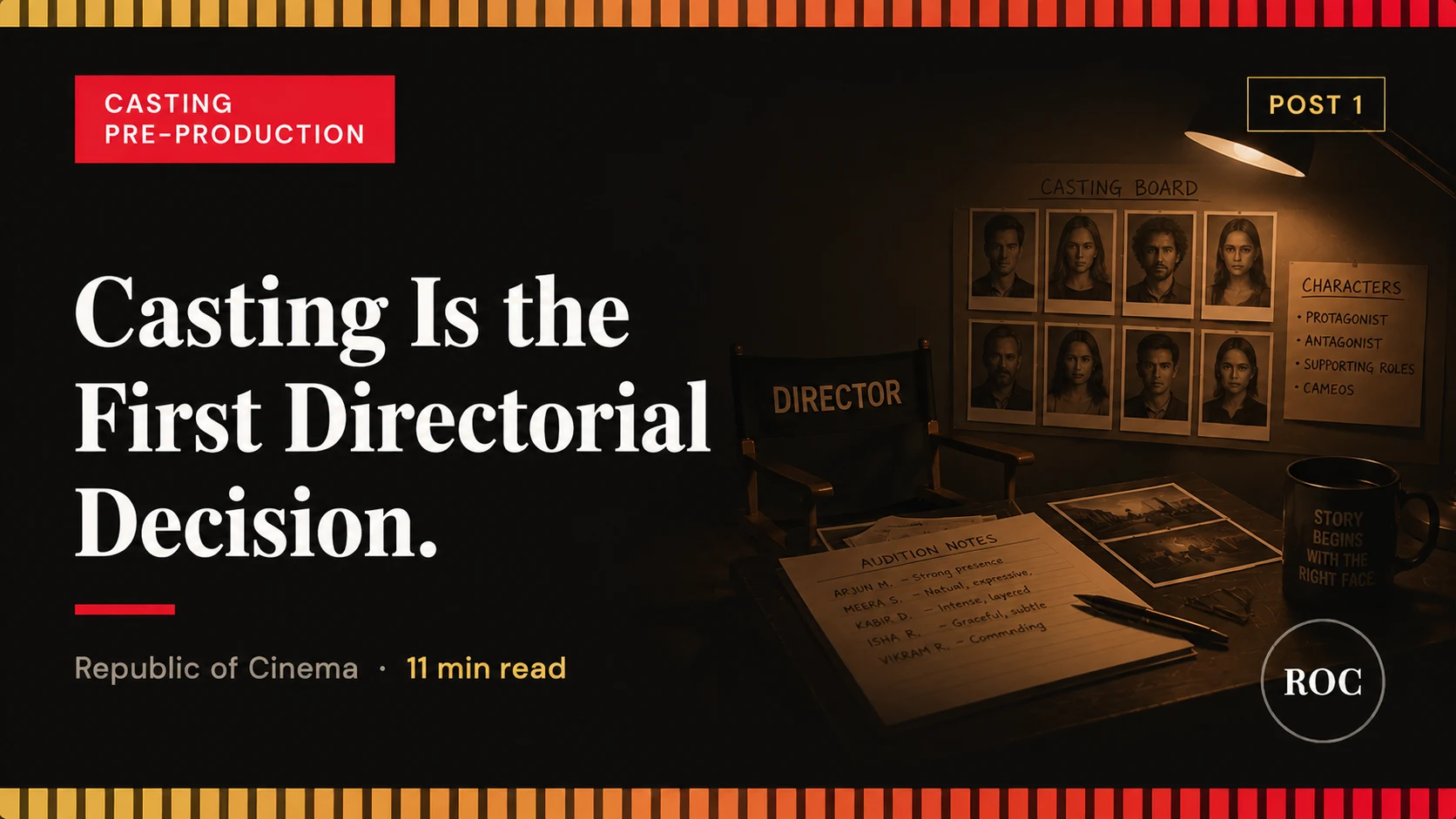
By the time you say "action" on the first day of your shoot, your film is already, in one crucial respect, made. Not finished — made. The most consequential interpretation of your script happened weeks or months earlier, in a room with no camera and no lights, when you decided who was going to embody these people on screen. Everything that follows — every lighting choice, every camera move, every cut — is in conversation with that earlier decision. Casting is not preparation for the film. Casting is the film's first draft, written in human faces rather than words.
Most students don't think about it this way. Casting feels like logistics: you have roles, you find people to fill them, you move on to the "real" work. This is the misunderstanding the rest of this department is designed to correct. John Huston, asked once about the craft of directing, gave an answer that sounds like a provocation: "The art of direction is casting. If you've cast right, you don't have to say anything." He meant it literally. A director who has found exactly the right person for a role has already made most of the directorial choices that matter — the character's physical truth, their internal life, the way they'll fill or complicate the audience's understanding of the story — before a single line is rehearsed.
The moment casting becomes visible as a creative act — as interpretation, not hiring — is the moment you stop asking "who can play this?" and start asking "what does my casting of this person say about what this film is?"
No director has articulated this distinction more precisely than Sidney Lumet, and the proof is in the opposite directions he went on two different films, for reasons that had nothing to do with availability or budget and everything to do with what each story needed the audience to feel about the person they were watching.
Prince of the City is a film about a New York detective named Danny Ciello who becomes an informant inside his own department — a man who believes he can control forces that will eventually consume him. Lumet's central question for that film: the audience must never quite know whether Danny is a hero or a villain. Ambivalence is the point. The audience has to live with the same uncertainty the story lives with. The moment Lumet understood that, one casting decision became impossible. De Niro. Pacino. Any star of that magnitude. "By their nature," Lumet writes, "stars invite your faculty of identification. You empathize with them immediately, even if they're playing monsters. A major star would defeat the picture with just the advertising." The advertising. Not even the performance — just the face on the poster, already freighted with everything an audience has felt watching that face before, would collapse the ambiguity the film needed to survive. So Lumet chose Treat Williams — a superb actor, but not yet a star, not yet a face the audience arrived already in relationship with. And he went further. Out of 125 speaking parts in the film, he cast fifty-two from what he called "civilians" — people who had never acted before. The choice worked in two ways. It distanced the audience from easy identification, since these were faces they had no prior feeling about. And it gave the film a texture he describes as "disguised naturalism" — a surface reality that would slowly erode as the film darkened around Danny Ciello.
Now hold that choice in your mind and look at what Lumet did on Long Day's Journey Into Night, Eugene O'Neill's tragedy of the Tyrone family and its slow, mutual destruction. The thematic logic was exactly reversed. This was genuine tragedy, the kind that demands what Lumet called "tragic dimensions." Ambivalence would have killed it. Distance was the last thing this film needed. It needed the audience to be overwhelmed, to feel the weight of people falling from a great height — which means they first needed to feel those people as giants. Lumet didn't want stars. He wanted giants. He wanted Katharine Hepburn for Mary Tyrone, even after his first meeting with her went badly, even when the producer asked if he wanted to look elsewhere. "No," Lumet said. "She's magnificent. When Mary Tyrone falls, it's got to be like a giant oak falling." The image is precise. An oak doesn't just fall — the scale of its falling is part of what makes the fall matter. Hepburn's persona, her four decades of formidable screen presence, the sheer force of her in a room — all of that wasn't a distraction from the character. It was the instrument the character required. Ralph Richardson. Jason Robards. Actors with powerful personalities that would amplify the material rather than simply serve it.
Two films. Two opposite casting strategies. Both governed by exactly the same question: what does this story need its audience to feel, and who — or what kind of person — produces that feeling? That question is the only one casting is really trying to answer.
Lumet's account of what a star actually does to an audience is worth sitting with, because it goes deeper than marketing. There is, he says, "a mysterious alchemy between star and audience." It isn't just physical beauty or sex appeal, though those are part of it. Every major star, he observes, evokes something unmanageable — a sense of danger, something larger than life that each person in the audience secretly feels they might be the one to handle. Clint Eastwood isn't like you or me. Katharine Hepburn wasn't like you or me. That quality — the persona that precedes any individual performance — is a resource a director can use, or a force a director has to work around. The mistake is to be unconscious of it either way.
Think about what this means for every casting decision you'll ever make. A star doesn't arrive as a blank page. They arrive as a history. The audience brings years of accumulated feeling — for or against, projected onto or identified with — and that feeling will be present in the cinema whether the director accounts for it or not. When you cast a famous face in a role, you are casting their entire prior filmography alongside them. That can work for you: Lumet used Hepburn's magnitude to amplify O'Neill's tragedy. Or it can work against you: a star's magnetic pull toward audience sympathy might dissolve a film's ambiguity before the opening scene is finished. Either way, the director made a choice. Casting is always already an argument about what the film is for.
This logic extends to the question of casting against type — one of the most overused phrases in film writing, and one of the least examined. "Against type" usually means against what an audience expects based on prior roles, or against what a character's description implies on the page. It can work powerfully, but only when the contradiction is in service of something the film is actually saying. Casting a gentle face as a villain works if the film is about how evil hides behind kindness. Casting a villain's face as someone innocent works if the film is about the injustice of assumption. The against-type choice has to carry meaning. A director who casts against type simply to be surprising, or to demonstrate range, is using the audience's expectation as a game rather than a tool.
Now cross to the opposite end of the spectrum from a director using a star's persona as primary creative material. Go to 1955, to Satyajit Ray, about to shoot his first film with no budget, no studio, and a script that took years to write and would take years more to finance.
Pather Panchali required a cast of village people in rural Bengal — a world of poverty, dust, ancient women, and children moving through it without any awareness of being observed. Ray knew immediately what this meant for casting. A trained actor would bring the wrong thing to this material. A trained actor knows they're being watched. They have learned to present, to indicate, to shape emotion for an audience. That's exactly the skill Pather Panchali could not afford. This film needed people who simply were — whose faces had not been trained to perform a face.
The most striking casting choice in the trilogy is Chunibala Devi as the aged Indir Thakrun, the old aunt who haunts the edges of the Apu household and dies alone in the field. Chunibala had been a performer in silent-era Bengali theatre and films, but decades had passed, the work had dried up, and by the time Ray found her she was elderly, almost forgotten, living in reduced circumstances. When you see her on screen, you are not watching an actress playing an old woman close to death. You are watching a face that has genuinely lived a long and difficult life, and the camera — Subrata Mitra's camera, which we'll return to in the Cinematography department — knows the difference. Every line and hollow in that face is real history. No amount of training or makeup produces what Ray found in that room.
Then look at the children. Apu and Durga. Subir Banerjee as Apu and Uma Dasgupta as Durga were not trained child actors. Ray worked with them carefully, shaped the scenes around what they could actually give rather than what a script might abstractly demand. And what came out — the improvised-feeling energy between the siblings, the boredom and joy and sibling cruelty and love — has a texture that trained performance almost never reaches, because trained performance is always slightly aware of itself. Untrained children playing at the right director's direction are simply doing, and the camera catches that doing without ceremony.
By the third film in the trilogy, Apur Sansar, Ray cast an unknown theatre actor named Soumitra Chatterjee as the adult Apu — a man who would go on to become one of Bengal cinema's most celebrated actors, but who arrived at that role as a newcomer — and a teenage girl with no screen experience at all, Sharmila Tagore, as Aparna, the woman Apu impulsively marries. Ray worked with Tagore before shooting, shaped her understanding of the role, found the specific quality of openness and fragility she could bring without performing either. What you see in that film is a real young face encountering real emotional situations on screen for the first time. The result is a kind of nakedness — a quality of being genuinely seen rather than skillfully presenting yourself to be seen — that trained actors spend years trying to recover and rarely fully do.
Ray and Lumet are making the same foundational argument from opposite positions. Ray strips the cast of everything that might interfere with the audience experiencing these people as real human beings in a real world. Lumet, on Long Day's Journey, assembles giants whose weight of presence the audience needs in order to receive the full force of the tragedy. Both are answering the question: what does this story need its audience to feel? And both are reaching for the same thing: the right instrument for what the story actually is, not what custom or convenience suggests it should be.
Now to the most practical question in all of casting, the one students ask most often and understand least: what is a chemistry read actually testing for?
The answer most people give — that it's testing whether two actors "work well together" — isn't wrong, but it's too vague to be useful. What a chemistry read is really asking is a set of very specific questions. Does the dynamic between these two people on screen match the dynamic the script describes between the two characters? Does watching them together tell you something about the relationship that neither of them communicates alone? Is there friction or ease between them that serves the story — and be careful here, because sometimes ease is wrong and productive discomfort is exactly what the film needs? And perhaps most usefully: does the space between them feel like something?
Lumet understood this intuitively, and his account of how actors reveal themselves to each other during the rehearsal process is the best description of what a chemistry read is ultimately testing in compressed form. During his rehearsal process — two weeks, minimum, often longer for complex material — he observed that actors are doing two things simultaneously: they're learning about the material, and they're revealing themselves to each other. Performing scenes together is a form of exposure. An actor who has learned to indicate emotion can sustain that indication through a monologue. Put them opposite another person and ask them to listen and respond in real time — that's where the indication breaks down, or where something genuine surfaces instead. A chemistry read in a casting session is a compressed version of this exposure. You're watching whether two people can actually receive each other, not just perform alongside each other.
There's another thing the chemistry read is testing, less often acknowledged: the actor's relationship to the director. When you invite an actor into the room and watch them read opposite another actor, you're also watching how they respond when you redirect them. Do they adjust? Do they double down? Do they understand what you're asking for? Lumet describes this as one of the most important discoveries of rehearsal — finding out what stimulates each actor, what triggers their emotions, what annoys them, how their concentration holds. The chemistry read gives you a first glimpse of all of this before the clock starts running.
Because this is also what a chemistry read is: a tiny piece of rehearsal, conducted before the commitment is made. The director isn't just auditioning an actor's fitness for a role. They're auditioning whether this person is someone they can actually work with — whether the communication between director and actor will be productive, whether trust is possible. Lumet was explicit about this: the mutual trust between actor and director is the central condition of any good performance. A director who hires someone brilliant but impossible to communicate with has made their own job harder and the film worse.
One more thing about casting, before this department moves toward the craft that happens after the choices are made. The temptation, especially for first-time directors working with constraints of time and money, is to cast the most available person rather than the right person. Resist this. Availability is a logistical problem; casting the wrong person is a creative one, and a creative problem follows the film into the edit and stays there. You can rewrite a scene. You can reshoot a setup. You cannot, without enormous cost and usually without the option, recast a performance that doesn't work. Lumet's account of his rehearsal process includes this principle embedded in its structure: he rehearsed in sequence, even though films are shot out of sequence, precisely because he needed the actors to discover the arc of their characters together before the camera rolled. That discovery — of character, of relationship, of emotional truth — is what casting sets in motion. If the casting is wrong, there's nothing to discover.
The rest of this department will take you deeper into the specific craft that emerges once you've made those first decisions — how the casting director functions as a creative collaborator rather than just a logistics manager, how to read a room during an audition, what the history of specific casting decisions tells us about the films they shaped, and what the tradition of the casting director in Indian cinema looks like compared to the system that produced the choices Lumet and Ray made. All of that is ahead. What this post is asking you to carry into all of it is a single shift in how you think about the process: casting is not a prelude to the film. Casting is the film's first irreversible act.
💬 Discussion
0 comments