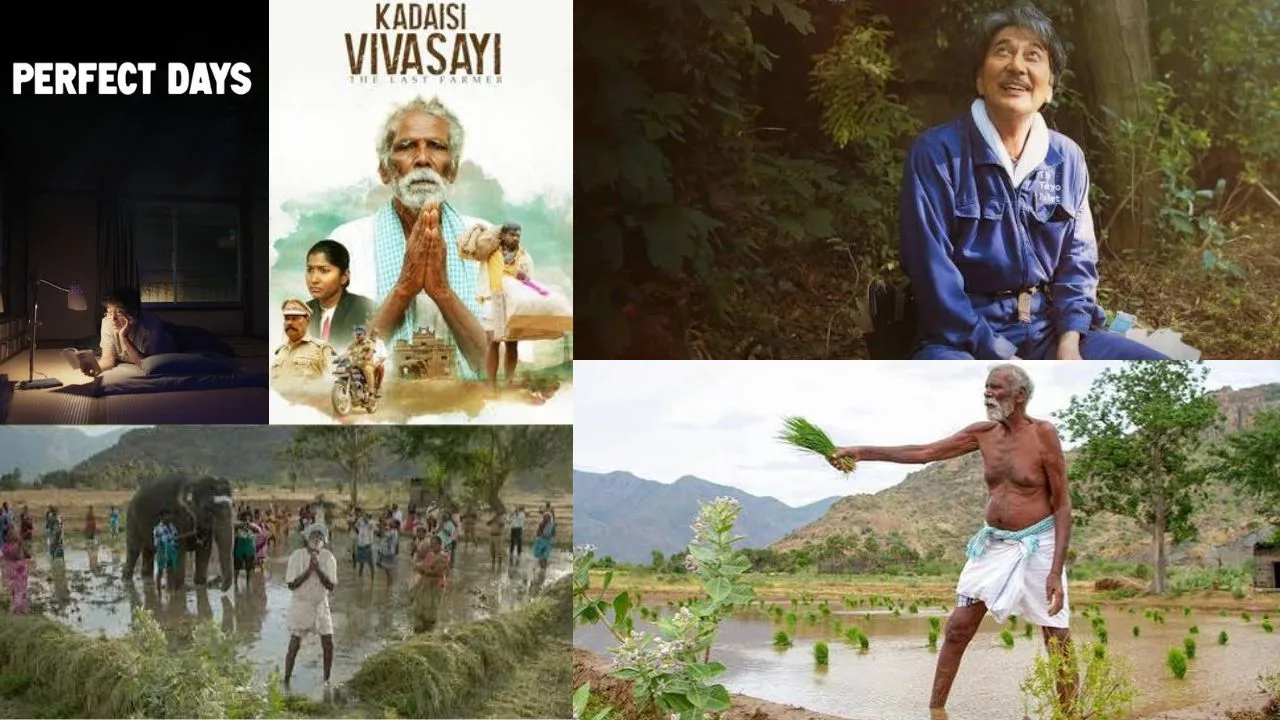
In the same season of world cinema, two films arrived about old men and their work. One cleans public toilets in Shibuya. The other ploughs the last paddy field in a village near Usilampatti. Neither man has money. Neither man wants any. Both wake before dawn without an alarm, because the body of a man who has found his work does not need to be summoned to it. Watched side by side, Wim Wenders' "Perfect Days" and M. Manikandan's "Kadaisi Vivasayi" stop being two films and become one discovery — and the discovery is not that one philosophy explains them both. It is stranger and larger than that. It is that two civilizations, India and Japan, with no need of each other, arrived independently at the same understanding: that work is not what a person does to afford a life. Work, rightly done, is the life. Both traditions refused, at their roots, to separate labour from being — and here are two films, made half a world apart in the same breath of the 2020s, arriving at that refusal again through a toilet brush and a plough.
The Indian name for this understanding is karma yoga — the Gita's teaching that action itself, performed with full skill and released from all claim on its rewards, becomes a spiritual discipline; the tradition calls the perfected form nishkama karma, desireless action. Say it once and let the films do the rest, because the films say it better. The Japanese tradition never read the Gita and never needed to. It arrived by its own roads: the Zen monasteries that made sweeping and cooking into meditation itself, with Dōgen instructing his cooks that washing rice with total attention is the whole of the Way; the shokunin, the craftsman whose obligation runs not to the customer but to the work; the daily gyō, the practice that is not preparation for a life but the substance of one. Two vocabularies, two liturgies, one insight. Neither film is evidence for the other's philosophy. They are parallel proofs.
The question of the morning. The heart of the pairing — and I think the deepest thing either film contains — is spoken by only one of them. Mayandi says it, in his handful of words: the land is why he wakes up in the morning. Without her, why get up? What would he do? He is not being sentimental, and he is certainly not talking about income; he is stating, as plain fact, that his existence and his work are a single object, and that the builder's money, however large, cannot purchase a reason to rise. Now listen to what a Japanese viewer hears in that line, instantly: ikigai. The word has been mangled by a decade of self-help diagrams into "find your passion," but its original meaning is humbler and more exact — the reason one gets out of bed. Not a grand mission. A morning-sized answer. Hirayama never says his version of the line. He doesn't have to. Every dawn of the film answers it: the folded bedding, the trimmed moustache, the watered seedlings, the smile at the sky. The Sanskrit tradition has its own word standing in the same doorway: swadharma, one's own duty, the work that belongs to your nature as your nature belongs to you. A Tamil farmer and a Tokyo toilet cleaner, in films that know nothing of each other, are answering the same existential question with the same answer in two languages. That convergence is not influence. It is confirmation.
And swadharma, read carefully, deepens the harder case of the two. Krishna's claim is not merely "work without reward"; it is that one acts because one's nature seeks expression — Arjuna fights because he is a warrior down to the bone. Mayandi farms because he is a farmer down to the bone; his dharma and his occupation are the same thing, inherited with his mother's field. But Hirayama was not born a toilet cleaner. The film lets us suspect he came from a far more privileged world than the one he now inhabits, and that he chose this one — which means his swadharma cannot be the occupation. It must be something the occupation carries. Watch him and the answer is obvious: his dharma is attention. The care is the calling; the toilet is incidental. He could have become a gardener, a cook, a sweeper of temple steps, and been exactly the same man. What he could not have remained is careless.
Attention is what both films worship. This is the thing modernity has made hardest to see, because modernity measures work in productivity, and neither of these men is productive in any sense a spreadsheet recognizes. What they are is attentive, totally, and both civilizations understood attention itself as a devotional act. Mayandi does not merely farm; he notices — the water level on the bund, the mood of his bullocks, the sky before rain, the dead peacocks that another man would have kicked aside and he buries like kin. Hirayama notices light through leaves, dust in corners, the underside of a toilet rim no eye will inspect, a seedling pushing up where a tree was lost. In Vedanta, sustained attention offered without self-interest shades into worship; in Zen, it is the practice — ichigyo zammai, the samadhi of one act. The mirror under the rim and the palm testing the soil are the same gesture: skill in action, offered to no one, which is to say offered to everything. These films are not slow. They are attentive, and they train us, scene by repeated scene, to become the kind of viewer who can tell the difference.
Custodians, not owners. Here is a rhyme between the films that almost nobody writes about. Neither man owns his work's object, and neither would understand the suggestion that he should. Mayandi does not own the field in any sense that matters to him — the earth is Bhoomi, mother before property; the first grain belongs to the goddess before it is a crop; his farming discharges ṛṇa, the sacred debts every person is born carrying to gods, ancestors and the earth itself. He is the field's servant and son, and this is precisely why the developers' money is not a temptation but a category error. Hirayama, likewise, owns nothing he tends. The toilets belong to the city; more truly, they belong to the strangers who will use them, and what he maintains every day is the invisible social contract by which a metropolis of millions agrees to trust people it will never meet. He keeps rooms ready for others. Both men, in other words, are custodians — and both films quietly propose custodianship as a higher relation to the world than ownership. This is a deeply Asian intuition: duty before possession, stewardship before rights. Modern politics speaks endlessly of rights, of what is owed to us. These two films ask, without raising their voices, whether civilization actually survives on something else entirely — on the people who go on fulfilling obligations without checking who is watching.
The image of the impermanent. Each film seals its philosophy with a natural image that cannot be kept. In "Perfect Days" it is komorebi, the light through leaves that exists once and never again, which Hirayama photographs daily knowing the photograph is not the point. In "Kadaisi Vivasayi" it is the peacock — Murugan's own bird, buried by Mayandi with a deity's honours, returning at the end to dance. The Japanese eye reads the light through mono no aware, the tender sorrow of passing things; the Indian eye reads the dance as prasāda — grace, not earned by the devotee but returned from the offering, arriving unbidden in the field of the man who kept the compact. And around these two images, both films arrange their unquiet souls — Hirayama's sister sealed in her chauffeured car, Ramaiah wandering in his grief, the villagers waiting beside their sold plots — not as villains, and not as people punished for leaving the land, but as ordinary people whom the modern arrangement has left holding money or memory where a practice used to be. The films do not judge them. They simply let us see what the two old men still have and the others are missing, and let us name it ourselves.
Where the films truly differ. It is tempting to say one film is about an individual and the other about a community, and there is truth in it — Wenders ends on a single face, Yakusho weeping and smiling through Nina Simone, a man become komorebi; Manikandan must end on a festival restored, because Mayandi's practice is load-bearing for a whole village's compact with its goddess. But the deeper difference is in the question each film is asking. "Perfect Days" asks: how should one live? — and answers with a demonstration, one man's practice, repeatable by anyone with the discipline to attend. "Kadaisi Vivasayi" asks something that stands behind that question and is far less comfortable: what kind of civilization allows such a life to survive? Hirayama's Tokyo, whatever its loneliness, still maintains him — the bathhouse, the izakaya, the book stall, the toilets themselves are a society's infrastructure of small dignities. Mayandi's world is being sold out from under him plot by plot, and the film knows that when the last field goes, no amount of individual serenity will grow rice. One film is a manual. The other is an elegy with a manual buried inside it. Both are mourning the same modern loss, which has a better name than unemployment or development: the disappearance of vocation — of work as a summons rather than a salary — and its replacement by mere employment, which can feed a man and cannot, as both films demonstrate frame by frame, give him a reason to wake.
Notice, finally, the question neither man ever asks. Modern narratives — and modern lives — turn on Who am I?: identity, authenticity, self-discovery, the self as a thing to be found and then expressed. Hirayama and Mayandi ask a different question, and it is the same question in both films: What is mine to do today? The Indic tradition asks it as swadharma; the Japanese asks it through ikigai and the shokunin's discipline. And the answer, in both films, is never abstract, never a destiny or a dream. It is always concrete and always today-sized: clean this toilet well; water this paddy now. The self is not discovered first and expressed later. It is formed, day by day, through faithful action — which may be why both men seem more solidly themselves than anyone else on screen, despite never once discussing themselves at all.
Modern civilization teaches that work exists to support life. These two films quietly reverse the equation: life exists so that one may continue the work one has been entrusted with. Remove the salary and Hirayama still cleans. Raise the offer and Mayandi still ploughs. Neither is moved by success, security or recognition; their work long ago stopped being employment and became existence itself. That is why both films leave us with images rather than arguments — a man driving into the morning light with tears and a smile fighting on his face, another watching a peacock open its feathers above a harvested field. They have not found happiness, exactly. They have found their place in the order of things, and they keep it the only way a place can be kept: by showing up, at dawn, to the work that is the prayer.
Perfect Days: ★★★★★ | Kadaisi Vivasayi: ★★★★★
💬 Discussion
1 comment