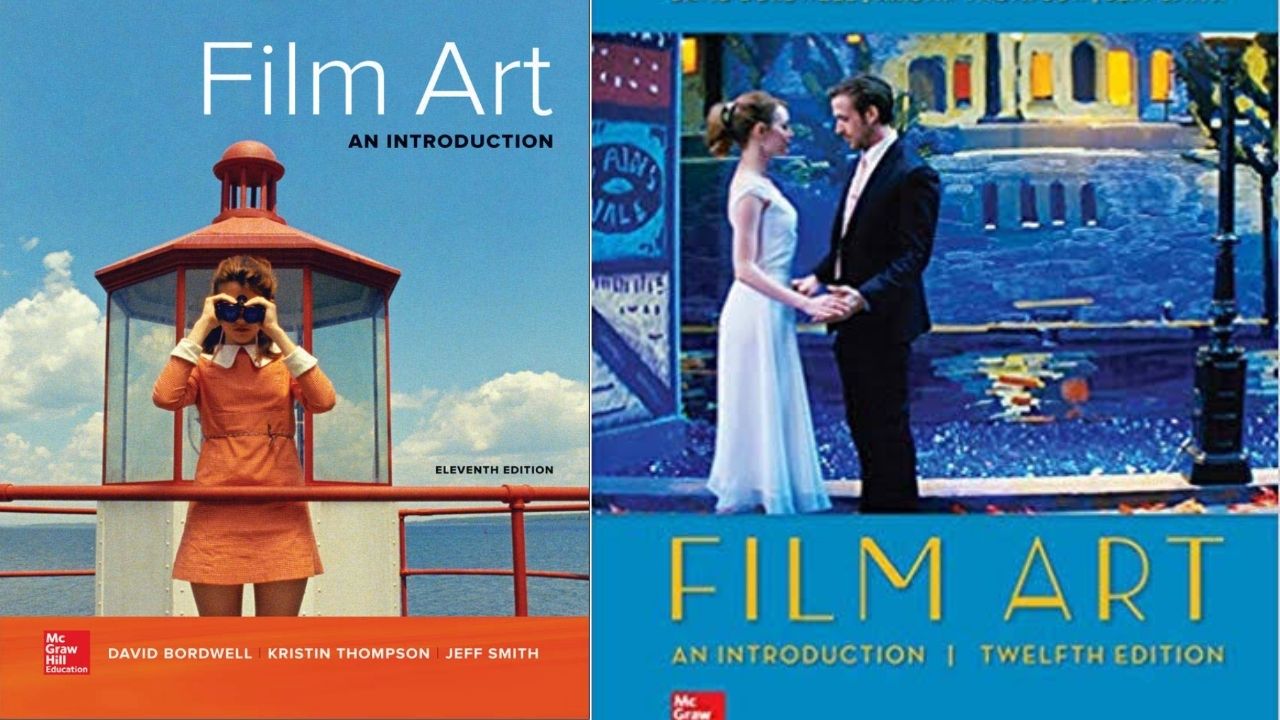
There are books you read, and there are books you live inside. Film Art: An Introduction belongs firmly in the second category. For more than four decades, this single volume by David Bordwell and Kristin Thompson has shaped the way generations of filmmakers, critics, scholars, and serious cinephiles have learned to look at moving images. To open its pages is not simply to read about cinema; it is to begin acquiring a new kind of vision — the vision of someone who can watch a film and actually see it.
Most introductory books on cinema fall into one of two traps. Either they drown the reader in dense academic theory until the love of movies feels suffocated under footnotes, or they hover on the surface, offering little more than glossy trivia, star worship, and Top Ten lists. Film Art does neither. It is one of the rare books that takes cinema seriously as both an art and a craft, treating the reader as a future filmmaker, a future critic, a future thinker — never a passive consumer. It assumes you love movies, and then it offers to deepen that love by teaching you the very grammar that makes movies work.
For anyone who has ever paused a film and wondered why a shot lingers a beat longer than expected, why a single cut suddenly breaks your heart, why a piece of music transforms a scene into a memory, or why one performance feels alive while another feels staged, this book is the most reliable place to begin. It is the gateway text. The map. The grammar manual of the medium. And once you have read it carefully, you can never go back to watching films the way you did before.
About David Bordwell and Kristin Thompson
David Bordwell and Kristin Thompson are arguably the most influential film scholars of the past half century in the English-speaking world. Both spent the bulk of their academic lives at the University of Wisconsin–Madison, building what came to be known as a neoformalist tradition of film studies. Their shared project, expressed across many books and decades of writing, was disarmingly simple in its ambition: to give ordinary viewers and serious students the precise vocabulary they need to talk about how films are actually made and how they actually work on us.
Bordwell, who passed away in early 2024, was the kind of scholar who could move from a deep formal analysis of Yasujiro Ozu to an enthusiastic appreciation of Christopher Nolan in the same week without ever changing intellectual gears. His writing was rigorous yet generous, technical yet warm. Books such as Narration in the Fiction Film, The Classical Hollywood Cinema (co-authored with Thompson and Janet Staiger), Poetics of Cinema, and The Way Hollywood Tells It revolutionized how academics and serious cinephiles understood storytelling, style, and the historical evolution of cinematic technique.
Kristin Thompson, an equally formidable scholar, contributed a similarly wide-ranging body of work, including Breaking the Glass Armor, Storytelling in the New Hollywood, and a deeply researched series on Peter Jackson and contemporary blockbuster cinema. Together, the two also maintained Observations on Film Art, one of the most respected film blogs in the world, where they continued to write with the curiosity and clarity that defines all of their work.
Film Art: An Introduction, first published in 1979 and now in its twelfth edition, is the book in which their entire intellectual project is gathered into a single, teachable form. It is the doorway through which most readers first meet them — and for a great many filmmakers, critics, and teachers, it remains the single most important book they ever read about cinema.
What the Book Is Really About
On the surface, Film Art looks like a textbook. It has chapters, summaries, illustrated examples, and a steady pedagogical structure. But to call it a textbook is to undersell what it actually does. The book is built around a single, powerful idea: that every film, regardless of country, genre, era, or budget, is a system. It has a form. It has a style. Every choice in it — what is shown, what is hidden, how long a shot lasts, where the camera stands, what the music is doing — is meaningful, and these choices interact with one another to create the experience we feel as viewers.
Bordwell and Thompson begin with the premise that a film is not just a story illustrated by pictures. A film is an organized aesthetic object. The plot you remember and the emotions you carry out of the theater are the surface phenomena of a much deeper architecture of decisions, patterns, and techniques. The purpose of the book is to help you see that architecture — and once you can see it, to help you understand why some films feel inevitable and others feel arbitrary, why some scenes haunt you for years and others vanish the moment they end.
Crucially, the book never treats this study as cold dissection. Bordwell and Thompson are not engineers tearing apart a watch to see how it ticks; they are guides showing you the hidden architecture of an art form they clearly love. The analyses are written with affection, often with wit, and always with a sense that understanding a film deepens enjoyment rather than diminishing it. This is one of the book’s quiet miracles. It teaches rigor without killing wonder.
Learning the Language of Cinema
If literature has its grammar, cinema has its own — and one of the great gifts of Film Art is that it teaches that grammar so patiently and concretely that it begins to feel obvious in retrospect. Cinema speaks through movement, light, framing, duration, sound, and arrangement. It does not communicate the way novels or paintings or theater communicate. It has its own logic, and that logic is what the book sets out to map.
The authors organize cinematic language into a clear conceptual architecture. They begin with the broad idea of film form, then move into the more specific tools that filmmakers use to shape that form. They identify four major systems of film style — mise-en-scène, cinematography, editing, and sound — and devote a generous chapter to each. Around these systems they build everything else: narrative, genre, documentary, experimental cinema, history. The result is a book that resembles a great cinematographer’s lighting plan: nothing is wasted, every element supports the next, and the whole thing illuminates the subject.
Reading the book in order is like learning to read a foreign language by being introduced first to letters, then to words, then to sentences, then finally to the great novels written in that language. Except in this case, the language is already half familiar. You have been speaking it your whole life as a viewer, even if no one ever told you the names for what you were seeing.
Mise-en-Scène: Everything in the Frame
The chapter on mise-en-scène — a French term meaning, roughly, the staging of the action — is one of the most enlightening in the entire book. Here Bordwell and Thompson walk the reader through the four major elements that make up everything inside the frame: setting, costume and makeup, lighting, and staging or performance. They show how each of these elements is a deliberate, expressive choice, even when filmmakers strive for a documentary or naturalistic look. The empty white wall in a Bergman interior is as much a decision as the gilded baroque excess of a Visconti palace.
Lighting receives particularly careful attention. The book introduces classical concepts such as three-point lighting, hard and soft light, high-key and low-key schemes, and frontal versus backlighting — but it does so by reading actual scenes, showing how the lighting in a film noir like Double Indemnity is not merely atmospheric but morally and psychologically expressive. Once you have read this chapter, you can never again watch a scene without noticing where the light is coming from, what it reveals, and what it conceals.
Performance and staging are treated with the same precision. The reader learns to see how a small movement, a glance held for a fraction of a second too long, the position of a body within the frame, the relationship between foreground and background, all carry meaning. Bordwell and Thompson demonstrate that performance in cinema is not simply acting in front of a camera; it is a collaboration between actor, director, designer, and cinematographer in which the body becomes part of the composition.
Cinematography: The Eye That Chooses
Few topics are as misunderstood by beginners as cinematography. It is often confused with simply pretty images. Film Art corrects this misunderstanding firmly and elegantly. Cinematography, the authors explain, is the totality of photographic choices that shape what we see and how we see it. It includes the range of the image (lens, focus, exposure, color, tonality, speed of motion), the framing of the image (camera position, angle, height, distance, level), and the duration of the image (the length of a take).
The chapter introduces readers to the difference between long lenses and wide lenses, deep focus and shallow focus, high angles and low angles, mobile framings and static ones. But the real power of the chapter lies in how it ties every technical idea to expressive meaning. A low angle is not just a low angle; it is a relationship between viewer and subject. A long take is not just a stylistic flourish; it is a contract with the audience about how time will be experienced. By the time you finish this chapter, you will understand why a single long take by Andrei Tarkovsky in The Mirror, or by Alfonso Cuarón in Children of Men, or by Béla Tarr in any film he ever made, can carry the same weight as an entire montage by another director.
This is where Film Art begins to feel less like a textbook and more like a master class. It does not flatten cinema into a list of techniques; it shows that every technique is a doorway into a different way of seeing the world.
Editing: The Invisible Author
If cinematography is the eye, editing is the mind. The chapter on editing is one of the most rigorous and rewarding in the book. Bordwell and Thompson argue that editing is far more than the assembly of shots; it is the orchestration of relationships — graphic, rhythmic, spatial, and temporal — between one image and the next. These four dimensions, introduced with crystalline clarity in the book, give the reader a permanent toolkit for analyzing any edited sequence ever made.
Graphic relations consider how the visual elements of one shot connect to or contrast with the next: shape, color, line, brightness. Rhythmic relations consider the relative length of shots and how that length creates pace, urgency, calm, or unease. Spatial relations consider how editing constructs or fragments the geography of a scene. Temporal relations consider how editing manipulates time itself — compressing, expanding, reordering, or even halting it. Once these four lenses are clear in your mind, you can read any montage sequence in cinema, from Sergei Eisenstein’s Battleship Potemkin to Thelma Schoonmaker’s work in Raging Bull, with new precision.
Just as importantly, the book introduces the principles of continuity editing — the system of invisible rules that classical Hollywood developed to make cuts feel seamless. The 180-degree line, the eyeline match, the shot/reverse shot, the match on action: these are the silent conventions that govern most of the films you have ever loved. Bordwell and Thompson explain why these conventions exist, how they create coherent worlds out of fragments of footage, and how filmmakers from Yasujiro Ozu to Jean-Luc Godard have deliberately broken them in order to mean something specific. For any aspiring editor, screenwriter, or director, this single chapter is worth the price of the book several times over.
Sound Design: The Half of Cinema We Forget to Hear
It is often said that sound is at least half of the experience of cinema, and Film Art takes that idea seriously in a way few introductory texts ever have. The sound chapter teaches readers to distinguish between dialogue, music, and sound effects; between diegetic sound (sound that exists in the world of the film) and nondiegetic sound (sound that exists only for us, the audience); between on-screen and off-screen sound; between sound that is synchronous and sound that floats in some looser, more suggestive relationship to the image.
This vocabulary is not jargon. It is a way of unlocking the most powerful and most invisible art in cinema. Once you can name the sound bridge that ties two scenes together, or the moment when a piece of music slips from being heard by a character into being heard only by you, you suddenly understand how filmmakers like David Lynch, Walter Murch, Apichatpong Weerasethakul, and Christopher Nolan craft experiences that feel like dreams. Bordwell and Thompson have a deep respect for the sound editors and sound designers whose labor often goes uncredited in mainstream film criticism, and they teach you to listen as carefully as you watch.
Narrative Structure: The Architecture of Story
Bordwell’s lifelong scholarly interest in narrative gives the book’s chapters on storytelling a particular depth. Here the reader learns the foundational distinction between story and plot — the entire chronological set of events implied by a film versus the specific arrangement of those events that the film actually presents. This single distinction, once internalized, transforms how you understand films like Citizen Kane, Pulp Fiction, Memento, Mulholland Drive, or any work that plays seriously with the order of its own telling.
The book also introduces concepts such as narration, range of story information, depth of story information, and reliability of narration. Who knows what, and when? Are we limited to one character’s perspective, or are we permitted godlike access to multiple lives? Can we trust what we are being shown? These are the questions every screenwriter has to face, and the book provides a vocabulary for answering them that is both practical and elegant.
Beyond classical narrative, Bordwell and Thompson explore alternative storytelling traditions: art cinema narration, experimental narrative, parametric narration, and the looser, more associative structures of documentary and avant-garde film. The result is a book that does not impose a single model of storytelling on cinema but instead reveals storytelling itself as a vast, varied, and constantly evolving art.
Film Form and Film Style: The Two Great Lenses
Two terms recur throughout the book, and understanding them is essential to understanding everything else: form and style. Form, in Bordwell and Thompson’s use, refers to the overall system of relationships in a film — how its narrative pieces, characters, motifs, and patterns fit together into a coherent whole. Style refers to the systematic use of cinematic techniques across the film: how mise-en-scène, cinematography, editing, and sound work together to create a recognizable texture and approach.
This distinction may sound abstract at first, but in practice it becomes the most useful pair of lenses a viewer can wear. Form helps you ask: what is this film as a whole? What patterns, repetitions, contrasts, and developments shape it? Style helps you ask: how is this film made? What recurring techniques give it its particular fingerprint? Together, the two questions open up almost any film to serious, pleasurable analysis. They are the reason a student who has internalized Film Art can walk out of a screening of a film they have never seen before and immediately begin to talk about it intelligently, technically, and emotionally.
Why This Book Became the Standard Around the World
It is no accident that Film Art has been adopted by film programs on virtually every continent. Its global influence rests on several qualities that few competing textbooks can match. First, it is genuinely comprehensive. It does not pretend that cinema means Hollywood. The book draws its examples from American studio films, European art cinema, Japanese masters, Indian and Iranian filmmakers, Latin American and African cinemas, documentary, and the avant-garde. Students who learn from this book learn that world cinema is the norm, not an exotic appendix.
Second, the book’s teaching style is built for clarity rather than for performance. Bordwell and Thompson write to be understood, not to impress. They define each new term carefully, illustrate it immediately with examples, and revisit it in later chapters as the discussion grows more complex. This patient, layered teaching style makes the book effective for a complete beginner while still rewarding repeat readings by advanced students.
Third, and perhaps most importantly, the book is grounded in actual film analysis rather than abstract theory. Every concept is anchored to specific scenes, specific shots, specific moments. When the book discusses depth of field, you are looking at a frame from Citizen Kane. When it discusses graphic editing, you are seeing how Eisenstein arranged his images. When it discusses tone, you are reading a careful analysis of a sequence from His Girl Friday or Tokyo Story or Do the Right Thing. This insistence on grounding theory in concrete observation is what gives the book its lasting power. It teaches you not just what to think about cinema but how to look at it.
These qualities have made Film Art a kind of common language across the international film studies community. A student in Mumbai, a director in Mexico City, a critic in Seoul, and a teacher in Berlin can all reference the same vocabulary because, very often, they all learned it from the same book.
Why Every Aspiring Filmmaker Should Read It
There is a romantic myth, still widely circulated, that the best filmmakers are pure intuitive geniuses who learned everything they know by simply watching movies. The myth is half true and half misleading. Of course, filmmakers learn by watching. But the great filmmakers also learned by reading, by talking, by analyzing, by submitting their intuitions to the discipline of conscious thought. They built a vocabulary that allowed them to communicate with their collaborators — with cinematographers, editors, designers, actors, composers — and to make precise decisions instead of vague gestures.
Film Art is one of the most reliable ways to acquire that vocabulary. Aspiring directors learn to think shot by shot, to understand the relationship between staging and framing, to make conscious choices about pace and rhythm. Aspiring cinematographers gain a fluency in the language of light, lens, and movement that allows them to talk meaningfully with directors about what an image should feel like. Aspiring editors come to see editing as a creative authorship rather than a mechanical task. Aspiring screenwriters discover that narrative structure is far more varied and flexible than the templates sold in popular screenwriting manuals.
For critics, the book is equally vital. A critic who cannot describe what is actually happening on screen — who cannot name the techniques, who cannot identify the patterns — is a critic limited to vague impressions. Film Art equips the critic with the precision necessary to make genuine arguments about films, supported by what is visibly there in the frame.
And for the growing community of cinema-focused YouTubers, video essayists, and online critics — a community to which Republic of Cinema proudly belongs — this book is the foundation. The best video essays you have ever watched on cinema, the ones that genuinely teach you something, are almost always written by people who internalized this kind of thinking long before they picked up a microphone.
The Book’s Greatest Strengths
The first and most obvious strength of Film Art is its breadth. Few introductory books even attempt to cover narrative film, documentary, experimental film, genre, film history, and critical analysis in a single coherent volume. Fewer still succeed. Bordwell and Thompson manage this by maintaining a consistent conceptual spine — form and style — that runs through every chapter. No matter how varied the films discussed, the underlying questions remain the same. This gives the book an intellectual unity that is rare in introductory texts.
A second great strength is the quality of the writing itself. Bordwell in particular had an unusual gift for explaining complex ideas in plain English without diluting them. He wrote sentences that respected the reader’s intelligence while never showing off. Thompson’s prose has the same quiet, confident clarity. Together they produce a book that you can actually read for pleasure — not always the case with film theory.
A third strength is the book’s ongoing freshness. With each new edition, Bordwell and Thompson updated their examples to include contemporary films, new technologies, and new debates. The discussions of digital cinematography, of streaming, of computer-generated imagery, of contemporary directors like Wes Anderson, Hayao Miyazaki, Bong Joon-ho, Christopher Nolan, and Greta Gerwig have kept the book vital long past the era of its first edition. The conceptual framework was strong enough to absorb every new development without losing its shape.
Finally, the book is profoundly humane. It treats cinema as a global art made by countless artists working in countless traditions, and it treats readers as serious people capable of engaging with that art on its own terms. There is no condescension here, no pandering, no shortcut. The book trusts you, and that trust is part of why it works.
Honest Limitations for the Complete Beginner
No book is perfect, and a fair review must acknowledge a few honest challenges. Film Art is a long book — well over 500 pages in its current editions — and for a complete beginner, the sheer density of new vocabulary can feel intimidating. A reader who has never thought analytically about film before may find the opening chapters slower going than the later ones, simply because so many new concepts are being introduced at once. The remedy is patience. The book rewards the reader who slows down and watches the films it discusses rather than racing through the prose.
A second mild limitation is that the print editions, especially newer ones, can be expensive, and access to the full range of color illustrations and online resources can require an institutional subscription or a textbook purchase that strains a personal budget. Many readers solve this by seeking out earlier editions, which remain conceptually almost identical to the most recent ones; the differences from edition to edition lie mostly in updated examples rather than in fundamental ideas.
A third consideration, more philosophical than practical, is that the book’s neoformalist orientation places great emphasis on the analysis of form and style and somewhat less on questions of ideology, identity, political economy, and cultural context. These dimensions of cinema are not ignored, but readers interested in feminist film theory, postcolonial cinema studies, queer film theory, or political economy will eventually want to supplement Film Art with other texts. This is not a flaw so much as a reflection of the book’s particular scholarly tradition. Film Art teaches you to see the film on the screen with extraordinary precision; other books will teach you to see the world around the film.
These caveats do not undermine the book. They simply remind us that no single volume can do everything. Film Art does what it sets out to do better than almost any other book in the field, and the right response to its limitations is to read it first and then keep reading.
Why It Still Matters in the Streaming Era
There is a temptation, in an era when we carry entire film libraries in our pockets and consume cinema in chunks on phones and tablets, to think that classical questions of form and style no longer matter. The opposite is true. In a moment when so much screen content is designed for distracted viewing, the ability to look at a film with full attention and full understanding is more precious than ever. The viewer who has read Film Art is the viewer who can still see the difference between a series episode designed to be half-watched and a film designed to be fully witnessed.
Bordwell and Thompson have always insisted that the principles of cinematic form transcend technological format. Whether you are watching a 70mm projection of Lawrence of Arabia in a theater, a 4K stream of Roma on a television, or a short film on a smartphone, the questions remain the same: how is the frame composed? how is time being shaped by the cut? what is the sound doing to your perception of the image? what story is being told and how is that story being structured? The book’s framework is platform-independent. It works for cinema, for television, for streaming, for short-form online video, even for the increasingly cinematic forms emerging in video games and immersive media.
If anything, the book has become more useful in the streaming era than it was in the era of repertory cinemas. We now have unprecedented access to films from every tradition and every period in history. Film Art gives us the tools to make sense of that abundance rather than drowning in it.
Final Verdict: The Foundational Book for Every Serious Cinephile
To recommend Film Art: An Introduction is almost too easy. It is the book that taught a generation of working filmmakers how to think about their craft. It is the book that shaped the curricula of film schools from Los Angeles to London to Pune to Beijing. It is the book that critics quietly keep on their shelves long after they have stopped needing to consult it, because its way of seeing has become their own way of seeing. It is, quite simply, the book.
For the Republic of Cinema reader, the recommendation is unambiguous. If you are serious about cinema — if you want to direct films, write films, edit films, shoot films, score films, criticize films, teach films, or simply love films more deeply than you do today — read this book. Read it slowly. Read it with a notebook beside you. Read it while watching the films it discusses. Read it once for general understanding, and again, years later, when you are ready to find the deeper layers you missed the first time. Few books reward rereading the way this one does.
There is a particular pleasure in finishing Film Art and then sitting down to watch a film you have already seen a dozen times. You will find that you are watching, in some real sense, a different film. The same images, the same actors, the same story — but now the entire architecture of choices is visible to you. The lighting decisions, the lens choices, the cuts, the sound cues, the rhythmic patterns, the structural design. Cinema reveals itself to you in a way it never did before. And once that revelation happens, there is no going back. You are not a passive viewer anymore. You are someone who can see.
That, in the end, is the gift of David Bordwell and Kristin Thompson. They have spent their lives teaching the rest of us how to look. To read Film Art is to accept their invitation. For any aspiring filmmaker, any serious film lover, and any reader of Republic of Cinema, that invitation is the beginning of a lifelong conversation with the medium we love.
Get the Book → Buy on Amazon https://link.amazon/B01eFq5Ae
💬 Discussion
0 comments