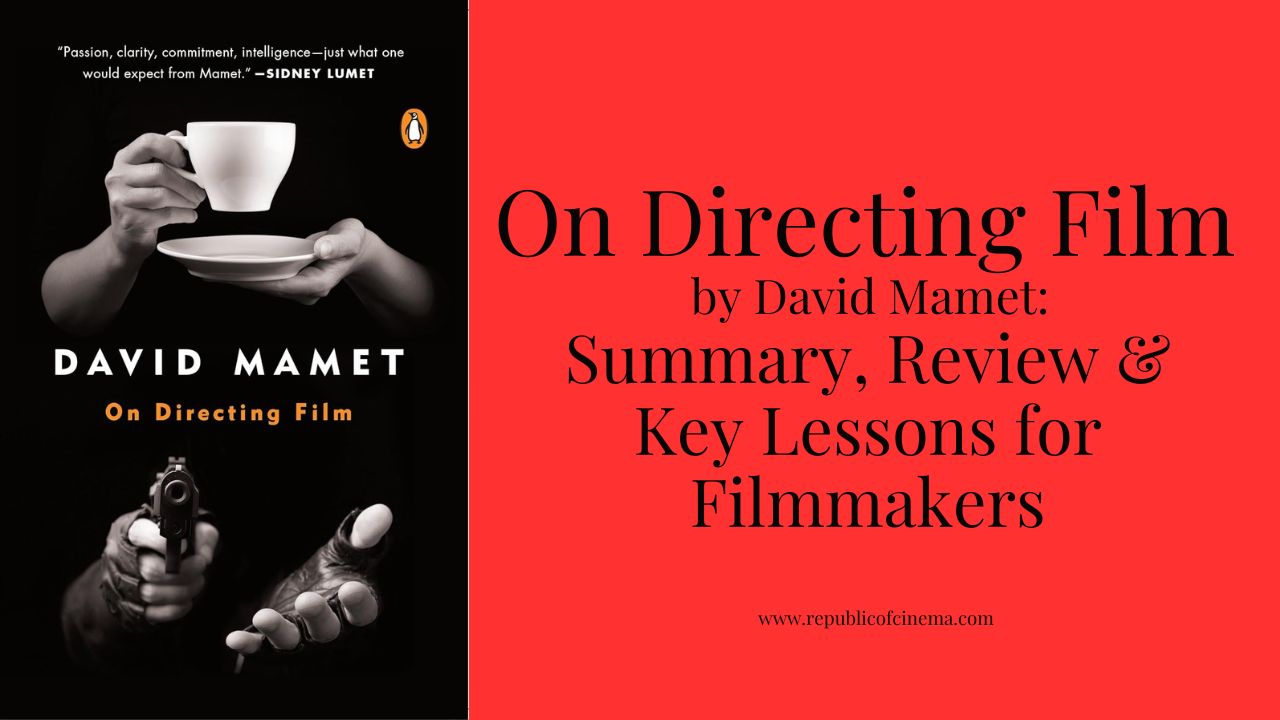
There is a persistent mythology surrounding the figure of the film director, one that cinema itself has done much to cultivate. The director appears in this mythology as a kind of visionary — someone possessed of an instinct, a "feel" for the image, an ineffable sense of where the camera ought to go that cannot quite be taught, only recognized in those rare individuals who have it. Film schools, interview culture, and the cult of the auteur have all reinforced this image, to the point where the actual mechanics of directing — the decisions that separate a coherent sequence from an incoherent one — often go undiscussed, treated as too mysterious, too personal, or too obvious to require explanation. David Mamet's On Directing Film enters this gap with something close to contempt for the mythology itself. It is a short book, built from a series of seminars Mamet gave to directing students at Columbia University in the late 1980s, and its central claim is almost aggressively unglamorous: directing is not a mystery. It is a problem of structure, and structure can be taught.
The book's premise is best understood against the backdrop of where its author came from. Mamet arrived at directing already a celebrated playwright, with decades of experience asking a question that has nothing to do with cameras: what does this scene need, and what can be cut without losing it? That instinct for structural economy — the dramatist's discipline of identifying the smallest unit of action that carries meaning — is transplanted wholesale into his account of filmmaking. The result is a book that reads less like a manual for operating equipment or composing pretty frames, and more like an argument about what a shot is for. For Mamet, a shot exists to communicate one piece of information. Nothing more. A film, in turn, is the sequence in which those pieces of information are arranged, and the meaning of the film — its drama, its emotion, its argument — emerges not from any single image but from the relationship between images: from the cut.
This is, of course, not a new idea. It is the central claim of Soviet montage theory, and Mamet is explicit about his debts to Eisenstein, Pudovkin, and especially the Kuleshov experiments, in which audiences attributed different emotional states to the same neutral shot of an actor's face depending on what it was cut against. What makes On Directing Film distinctive is not the theory itself but the use to which Mamet puts it. He is not writing film history or theory in the academic sense; he is using a body of 1920s Soviet formalist thought as a corrective for a very specific, very contemporary problem — the habits of American film students steeped in naturalistic performance, "coverage"-based shooting, and an unexamined faith that if you film a scene from enough angles, meaning will somehow assemble itself in the edit. Against this, Mamet proposes something close to a discipline of refusal: before any shot is designed, the director must be able to state, in the simplest possible terms, what the character wants in this scene — the throughline — and every shot must either advance or obstruct that want. If a shot cannot be justified against that throughline, it does not belong in the film, regardless of how striking it might look on its own.
The book's method follows directly from this argument. Rather than survey the history of directing or catalogue techniques, Mamet and his students spend much of the book working through a single, deliberately mundane scene, breaking it down shot by shot, debating each choice in something close to real time. The effect is closer to a Socratic dialogue than a textbook. Ideas are tested against the scene, revised, occasionally abandoned. This gives the book an unusual texture for a work of film pedagogy: it is conversational, occasionally repetitive, and resistant to the kind of comprehensive coverage one might expect from a guide to "directing" as a whole. There is, notably, almost nothing here about working with actors in the conventional sense, nothing about blocking for visual composition, nothing about the collaborative relationship between director and cinematographer beyond the question of what a shot must contain. Performance itself is treated with suspicion — Mamet repeatedly argues that actors should perform simple, observable physical actions, and that the emotional content of a scene is generated by montage, not by what an actor is feeling. A "great performance," in his account, is frequently a byproduct of good structure rather than its source.
It is worth pausing on how original this argument actually is, because the honest answer is layered. As a body of theory, almost nothing in On Directing Film is new — Eisenstein's writings on montage, Pudovkin's experiments, the structuralist instinct to reduce a story to its essential units of action, all predate Mamet by decades, and readers familiar with Russian Formalism will recognize the shape of the argument immediately. What is original is the application: Mamet takes a body of theory developed for a specific historical and technological context — silent cinema, where the absence of synchronized dialogue forced filmmakers to solve the problem of meaning entirely through images — and reintroduces it as a corrective for filmmakers working in an entirely different context, one saturated with dialogue, naturalistic acting traditions descended from the Method, and production economics that reward shooting everything and deciding later. The book's argument is, in effect, a provocation: you have forgotten what silent cinema knew, and you need to relearn it. That reframing — using a historical theory polemically, as a discipline against contemporary bad habits — is where whatever originality the book possesses actually lies.
As evidence and methodology, the book makes no pretense toward scholarly apparatus. There are no citations in the academic sense, no engagement with the secondary literature on Soviet formalism, no acknowledgment of the decades of film theory that followed and complicated the montage tradition Mamet draws on. The book's evidence is demonstrative rather than documentary: it shows its argument working, scene by scene, rather than building a case from external sources. This is both the book's greatest strength and its most significant limitation. As a strength, it makes the argument unusually concrete and immediately applicable — a reader can take the method described and test it against their own scene by the end of the book. As a limitation, it means the argument is tested against exactly one kind of scene: a small, functional, dialogue-light exchange in which a character wants something simple and concrete. The book never extends its method to the kinds of scenes where montage theory's limits become most visible — ensemble scenes with multiple competing objectives, musical or dance sequences where rhythm and duration carry meaning independent of any single character's want, or the long, observational takes associated with filmmakers like Tarkovsky or the Italian neorealists, where the absence of a cut is itself the meaning. Mamet's silence on these forms is not neutral; it is, implicitly, a dismissal, and the book never has to defend that dismissal because it never raises the cases that would require one.
This connects to a broader limitation in the book's theoretical framework, which is its near-total silence on everything that is not the cut. Sound design, music, color, the texture of a performance, the duration of a shot held past the point of "necessary information" — all of these are either absent from the book's account of meaning-making or treated as secondary to the structural skeleton of shot-and-cut. For a book about directing film, this is a striking omission, and it reflects the degree to which Mamet's framework is really a writer's framework transposed onto cinema: it treats the image the way a playwright treats a line of dialogue, as a discrete unit of information whose meaning is contextual and relational, and it has comparatively little to say about the qualities of cinema that exist precisely because it is not theatre — the texture of light, the rhythm of a held frame, the way music can carry an emotional register that no sequence of "uninflected" images could produce on its own. Readers coming to the book from a background in cinematography, sound design, or any tradition where mise-en-scène itself is the primary carrier of meaning will find large parts of their craft simply unaddressed.
And yet the book's prose style is inseparable from its argument, which is part of what makes it so durable as a teaching text. Mamet writes the way he argues a shot should function: tersely, with no wasted motion, often in declarative sentences that brook little argument. This can tip into dogmatism — the book is frequently more interested in winning an argument than in acknowledging its own limits — but the dogmatism is also what gives the book its force. A more hedged, more theoretically generous version of this argument would almost certainly be a less useful teaching tool, because its central value is precisely as a corrective, a deliberately one-sided counterweight to habits Mamet sees as dominant and unexamined. Whether the book constitutes a "contribution to scholarship" in the conventional sense is therefore almost the wrong question. Its contribution is pedagogical and polemical: it gave several generations of film students a vocabulary — the uninflected shot, the throughline, the silent-film test — for interrogating their own instincts, and that vocabulary has circulated through film schools far beyond anyone who has actually read the book.
Placed within the wider history of cinema studies, On Directing Film is best understood as a late, practitioner-facing echo of one side of a debate that has structured film theory for a century: the disagreement between the montage tradition descended from Eisenstein and the realist tradition associated above all with André Bazin, who argued that cinema's unique power lay in its capacity to preserve the ambiguity and duration of reality, and that excessive cutting was a kind of violence done to that ambiguity. Mamet does not engage with Bazin directly, but his book is, in effect, an argument for one side of that century-old quarrel, restaged as craft advice rather than theory. Read alongside Bazin, the two books illuminate each other precisely through their disagreement: one trusts the cut, the other trusts the frame; one treats meaning as constructed, the other as discovered. Neither position is complete on its own, and the productive friction between them is arguably more valuable to a working filmmaker than either position taken in isolation.
The book's significance also extends into media studies more broadly, largely because of the Kuleshov effect at its center. The idea that meaning is substantially constructed by the viewer through the act of connecting discrete images — rather than residing "in" any single image — has implications that reach far beyond cinema, into how we understand the psychological effects of editing in television, advertising, and the endless stream of short-form video that now constitutes much of how people encounter moving images. Mamet's book, written in 1991, could not have anticipated the world of algorithmically sequenced video feeds, but its central insight — that sequence itself is a rhetorical act, that placing one image after another is already an argument — has only become more relevant as the sheer volume of edited moving images in everyday life has exploded.
There is also a quieter cultural argument embedded in the book's insistence that directing is a craft rather than a mystery. By treating the director's judgment as something that can be broken down, taught, and tested against a simple rubric, Mamet implicitly pushes back against the romantic mythology of authorship that has shaped how cinema is discussed — the idea of the director as a singular genius whose choices are intuitive and therefore unexplainable. This has a democratizing undercurrent: if directing is a discipline rather than a gift, it can be learned by people who were never going to be anointed as visionaries by virtue of temperament or personality. At the same time, this demystification carries its own risk of flattening — of suggesting that there is one correct way to construct meaning through images, when in fact the history of world cinema is, among other things, a history of filmmakers who built meaning through means Mamet's framework barely acknowledges: through duration, through music, through ensemble performance, through the deliberate refusal to cut.
This last point matters considerably for readers thinking about cinema beyond the Hollywood and Soviet traditions that frame Mamet's argument. Indian cinema, for instance, has long operated with a relationship to performance, music, and duration — the extended song sequence, the sustained emotional register of a scene that a Mamet-trained editor might be tempted to compress — that sits uneasily with a framework built entirely around the "uninflected shot" and the single-objective throughline. This is not necessarily a weakness of Indian cinema measured against Mamet's standard; it is evidence that Mamet's standard is itself local, however persuasively it is argued. A useful exercise for a filmmaker working outside the Anglo-American tradition might be to apply Mamet's method to a scene from a film built on entirely different premises — a Ritwik Ghatak melodrama, an Ozu domestic scene, a Satyajit Ray long take — not to find the method vindicated or refuted, but to discover precisely where it stops being useful, and what that limit reveals about the assumptions buried inside it.
What, then, is left of On Directing Film once its limitations are acknowledged? Not a complete theory of cinema, and not a work that asks to be measured against one. Its lasting value lies somewhere more modest and, in practice, more useful: as a discipline-inducing provocation, a deliberately narrow argument that forces anyone who takes it seriously to ask a question they may never have been required to ask before — why does this shot exist, and what happens to the film if it doesn't? That question survives the book's narrowness, because it is a question that can be asked of any scene, in any tradition, even traditions the book itself never considers. The more interesting conversation the book opens, then, is not whether Mamet is right, but what happens when his question is put to films and traditions he never anticipated — what a director steeped in duration, music, and ensemble performance discovers when they ask, in Mamet's terms, what a shot is for, and whether the answer they arrive at confirms his framework, exposes its limits, or — as is most likely — does both at once.
Affiliate disclosure: This page contains affiliate links. If you purchase through them, Republic of Cinema earns a small commission at no additional cost to you.
| Book | On Directing Film |
| Author | David Mamet |
| First Published | 1991 |
| Publisher | Viking Penguin |
| Pages | 107 |
| Get the Book | Buy on Amazon → |
David Mamet — On Directing Film A compact, forceful argument for structural discipline in filmmaking. One of the most argued-over books in any serious film school curriculum. Get the book on Amazon →
Republic of Cinema is an independent platform. We do not accept payment for coverage. Affiliate links help sustain the work.
💬 Discussion
0 comments