The Ancient Technology of Narrative
Before the screenplay. Before the scene. Before the character. Before the structure, the arc, the act break, the inciting incident — before any of the tools this course will eventually teach you — there is a question so fundamental that most filmmaking courses never pause to ask it properly.
What is a story, and why do human beings tell them at all?
Imagine a village in northern India two thousand years before cinema was invented. It is the night of Diwali, or some older festival whose name has not survived, and a storyteller sits in the centre of a gathered crowd. The night is cool. The lamps flicker. And the storyteller begins to speak, and the crowd goes still.
What is happening in that moment? On its surface, a person is speaking words that describe events which did not happen, involving people who do not exist, in a world that may be quite different from the world in which the crowd actually lives. And yet the crowd is riveted. A child grips their mother's sari. An old man leans forward. When the hero faces his moment of greatest danger, someone in the back of the crowd stops breathing.
This is the mystery at the heart of all storytelling. We know the story is not real. We surrender to it completely anyway.
Cinema is the most technologically elaborate version of what that storyteller was doing in the firelight. The tools are different — cameras, sound design, editing, the entire industrial apparatus of film production — but the fundamental transaction between storyteller and audience has not changed by a single atom. The audience still sits in the dark. The story still unfolds. And when the story is doing what a story is supposed to do, the audience is still holding its breath.
Before you learn a single structural system, before you understand what a three-act break is or how to write a logline, you need to understand this: you are entering one of the oldest crafts in human history. You are not learning to fill in a template. You are learning to participate in a tradition that is older than writing itself.
The Cave
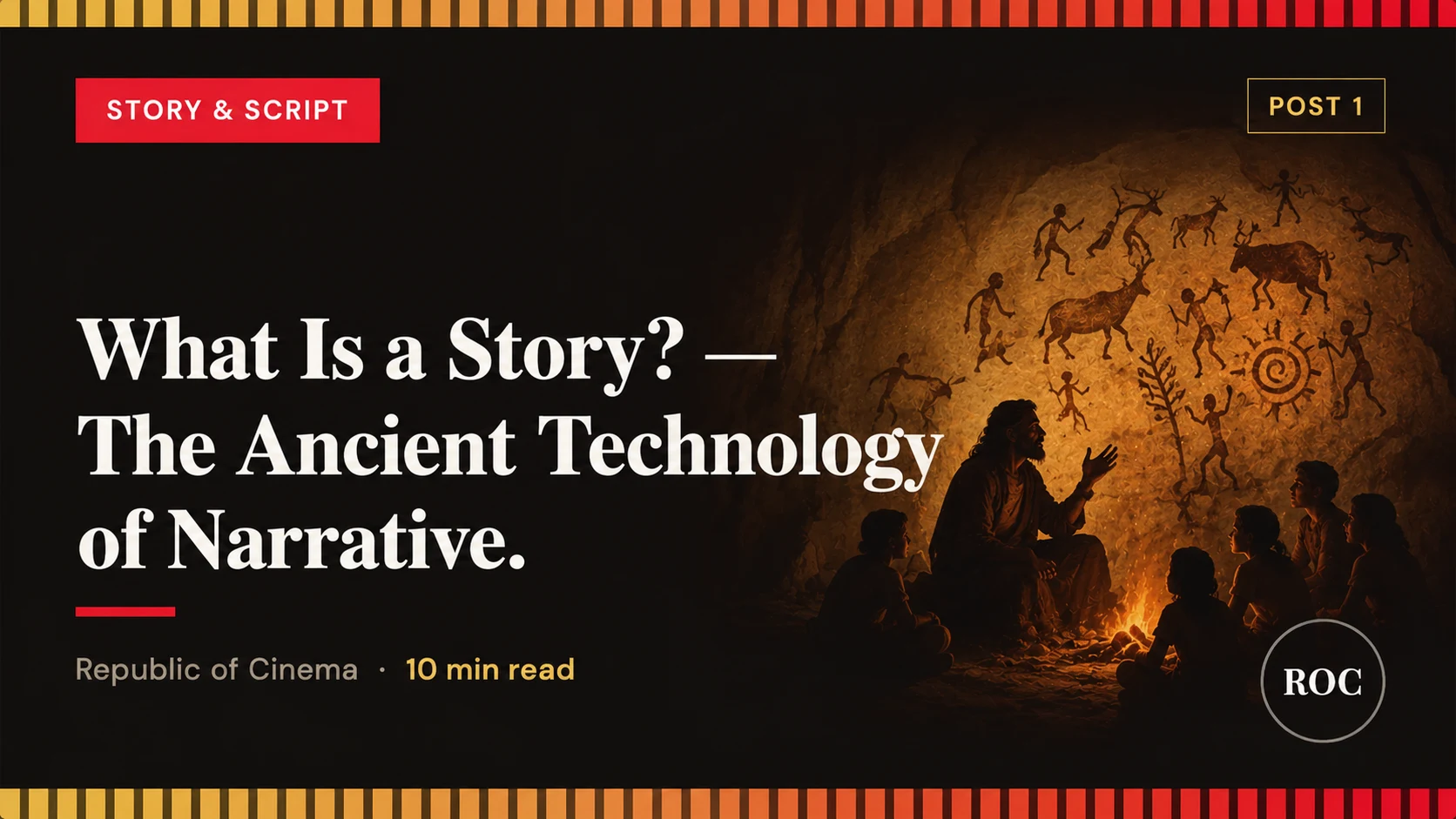
The oldest stories we have physical evidence of are the paintings on the walls of caves in France and Indonesia — some of them more than forty thousand years old. What is extraordinary about these paintings is not merely their antiquity but what they depict: animals in motion, hunters in pursuit, the drama of the kill. These are not static images. They are sequential images. They are the first frames of the first stories.
The human species, as far as we can determine, has always told stories. Anthropologists have found no culture on earth, past or present, that does not have narrative art. Myths, legends, epics, folktales, parables, oral histories — every human community that has ever existed has had them. This universality is not a coincidence. It is a signal.
Stories are not entertainment. Entertainment is the word we use when we have forgotten what stories are actually for.
The evolutionary biologists who study narrative suggest that stories were a survival technology. Before writing, stories were how a community preserved and transmitted everything it had learned about how to live — which berries were poisonous, which strangers could be trusted, what happened when someone broke the community's moral code, what kind of person deserves to be followed into battle. A story is not just a sequence of events. A story is a simulation of experience. It allows the listener to rehearse situations they have not yet encountered, to feel the consequences of choices they have not yet made, to be changed by events that have not yet happened to them.
When Robert McKee writes in his seminal work Story that human beings dream in narrative and daydream in narrative and remember in narrative, he is not making a literary observation. He is making a biological one. We are the narrative animal. We do not merely tell stories. We think in stories. We construct our identities from stories. We understand cause and effect through stories. We make moral judgements through stories. Remove the story, and you do not get a simpler mind. You get a broken one.
This is the authority that every filmmaker inherits. You are not simply trying to entertain people for two hours. You are participating in the most fundamental technology the human mind has ever developed for making meaning out of the chaos of existence.
What a Story Is — and What It Is Not
The confusion between story and plot is one of the most consequential mistakes a screenwriter can make, and it is a mistake that almost every beginner makes. Let us be precise about the distinction, because on this distinction everything else depends.
A plot is a sequence of events. A man loses his job. He argues with his wife. He finds a briefcase full of money. He must decide whether to keep it. That is a plot.
A story is what those events mean. The story beneath that plot might be: a man discovers that his sense of his own virtue is the last thing separating him from the person he has always feared he might be. That is a story.
The plot is the surface. The story is the undertow.
William Goldman, who wrote Butch Cassidy and the Sundance Kid and All the President's Men and who remains one of the most clear-eyed voices in the literature of screenwriting, put it with characteristic bluntness: "Screenplays are structure." But what he meant by structure was not merely the sequence of scenes or the placement of the act breaks. He meant what Lew Hunter, who taught at UCLA for three decades, calls the spine — the "what's-it-really-about" that every great screenplay possesses and every weak one lacks.
The spine of Chinatown is not the water conspiracy. The spine is: a man who believes he understands corruption discovers that he has been inside corruption all along. The spine of Deewar is not the story of two brothers on opposite sides of the law. The spine is: what does loyalty owe to justice, and what does justice owe to love? The spine of Pather Panchali is not the story of a boy growing up in a Bengal village. The spine is the discovery that beauty and loss are inseparable from each other — that to be fully alive is to be perpetually on the edge of grief.
You can make a film about the water conspiracy in Chinatown without that spine. It would be a competent thriller. You could not make Chinatown — one of the few perfect films Hollywood has produced — without it. The spine is not what the film is about on the surface. The spine is what the film is about underneath, and it is the writer's primary obligation to know what that is before they write a single word.
The Three Elements — and the Hierarchy Among Them
Alexander Mackendrick, who directed Sweet Smell of Success before giving thirty years of his life to teaching at CalArts, identified three basic elements of any film story: plot, character, and theme. His observation — still startling when you first encounter it — was that of the three, plot is in many ways the least important.
This requires unpacking, because it seems to contradict every instinct a beginning screenwriter has. Surely the story is what happens? Surely the sequence of events is the fundamental unit?
Mackendrick's argument is that when a good story is over, it is seldom the plot that stays with us. It is the situations, the characters — and, at its best, what we call the theme. We remember Rick letting Ilsa go in Casablanca, not the mechanics of the transit papers. We remember Vijay holding up his bracelet outside the temple in Deewar, not the chain of events that brought him there. We remember Apu watching the horizon from the train in the final scene of Apur Sansar, not the specific narrative circumstances that led to that moment.
Plot is the framework that holds the other two in place. It is necessary — without the underpinning of a solid plot, even the richest character and the most resonant theme will fail to hold the audience. But plot by itself, without character depth and without thematic weight, produces the kind of film that you have forgotten by the time you reach the car park.
This is not to dismiss genre films, or commercial cinema, or the beautifully constructed thriller. It is to say that the finest examples of every genre — including the thriller, including the romantic comedy, including the action film — achieve their power because the plot is in service of something larger. The greatest Bollywood masala films are not great because of their plots, which are often baroque to the point of incoherence. They are great because of their emotional architecture, their rasa orchestration, their characters who feel like real people in impossible situations.
Drama Is Anticipation Mingled With Uncertainty
Mackendrick left his students with a definition of drama that is, in this author's judgment, the most useful single sentence ever written about the subject.
Drama is anticipation mingled with uncertainty.
Read it again. The definition seems almost too simple. And then you begin to test it against every film you love, and you discover it is not simple at all.
The audience is in a state of anticipation — they want to know what will happen. They sense that something is coming. They lean forward. But they are not certain how it will arrive, whether the character will survive it, whether it will be what they fear or what they hope. That mixture — the anticipation and the uncertainty held simultaneously — is the experience of watching great cinema.
Every great scene generates this state. Every great screenplay sustains it across two hours. And every structural decision a screenwriter makes — where to withhold information and where to release it, which character to follow into a scene and which to leave at the door, when to resolve a tension and when to deepen it — is a decision about how to create and maintain that experience in the audience.
The corollary of this definition is also important. When anticipation disappears — when we cease to care what happens next — the film dies. When uncertainty disappears — when the outcome is completely predictable — the film dies in a different way. The writer's job is to keep both alive simultaneously throughout the entire duration of the film.
The Once-Upon-a-Time Grammar
Mackendrick, drawing on the oldest storytelling tradition in the world, offered his students a template that he claimed contains the deep grammar of every story ever told.
Once upon a time... there lived a [character]... who [had a problem or desire]... but [an obstacle stood in the way]... and so [a complicating event occurred]... so then, as a result of which... [the story unfolds].
This formula is not a formula. It is a diagnostic tool. It allows you to identify, before you have written a single page of your screenplay, whether you actually have a story or merely an idea.
Fill in those blanks for any film you admire and you will be surprised by what you discover. Fill in those blanks for any screenplay you are developing and you will discover almost immediately whether the story has a foundation or whether it is a collection of interesting situations waiting for a backbone.
The character must want something. The obstacle must be real. The complicating event must change everything. And the chain of cause and effect that follows must feel, in retrospect, inevitable — even though the audience did not see it coming.
This is the paradox at the heart of all great storytelling: the ending must be both a surprise and an inevitability. The audience did not predict it. But when it arrives, they recognise it as the only way the story could have ended. Chinatown could not have ended any other way. Pather Panchali could not have ended any other way. Do Bigha Zameen could not have ended any other way. And yet none of us, watching for the first time, saw the ending coming until it was upon us.
That quality — the inevitable surprise — is the deepest ambition of the screenwriter's craft.
The Indian Inheritance
This course will return to Indian storytelling traditions in depth during Phase Five. But it is worth introducing one idea here, at the very beginning, because it reframes every subsequent lesson.
Indian story philosophy, unlike the Aristotelian tradition that has dominated Western screenwriting education, has never been primarily interested in plot. The Natyashastra — Bharata Muni's two-thousand-year-old treatise on drama and performance — organises its entire theory of storytelling around the concept of rasa: the essential emotional flavour that a dramatic work produces in its audience. The eight classical rasas — love, comedy, pathos, fury, heroism, fear, disgust, wonder — are not themes or plot elements. They are emotional states. They are what the story is designed to do to the person watching it.
From this perspective, a story is not primarily a sequence of events. A story is a designed emotional experience. The events are the mechanism. The rasa is the purpose.
This framework, which we will examine in full during Phase Five, is not in conflict with the Western structural systems you will learn in Phase Two. It is complementary to them. The structural systems tell you how to build the architecture. The rasa framework reminds you why the architecture exists — to create, sustain, and ultimately release a specific kind of emotional experience in a human being sitting in the dark.
The greatest Indian films hold both frameworks simultaneously. Sholay is structurally impeccable — it obeys the laws of three-act structure with a precision that would satisfy the most orthodox Hollywood script doctor. And it is rasically perfect — it moves through comedy, romance, pathos, fury, heroism, and grief with the precision of a master musician moving through the notes of a raga. These are not separate achievements. They are the same achievement, approached from two different directions.
The Practical Question
So what does all of this mean for you, sitting at a desk with a blank page and a story idea?
It means this: before you outline your screenplay, before you build your characters, before you plan your structure — ask yourself the foundational questions. Ask them honestly, and do not proceed until you can answer them.
What is my story really about? Not the plot. Not the genre. Not the concept. What is the human experience at the centre of this film? What will the audience understand about themselves, or about the world, when the last frame fades to black that they did not understand when they sat down?
Who wants what, and what stands in the way? The protagonist's desire and the obstacle to that desire are the engine of your story. Without them, you have situations but not a story.
What is the emotional experience I am designing? What rasa — what essential feeling — do I want this film to produce in the audience? And have I built the entire film in service of that experience?
What is the spine? Goldman's question, Hunter's question, Mackendrick's question, the question every producer will ask you and every audience will answer with their feet. What is it really about?
The writer who can answer these questions is ready to build a screenplay. The writer who cannot should continue to think, because all the structural knowledge in the world cannot substitute for the clarity that comes from knowing — truly knowing — what your story is.
What Comes Next
In Post 2, we will go deeper into the question of why human beings tell stories — into the psychology, the mythology, and the philosophical traditions that explain what storytelling does to us and for us. We will meet Joseph Campbell, Carl Jung, and Roland Barthes, and we will examine what their different understandings of narrative reveal about the obligations of the contemporary filmmaker. And we will begin to understand why the story you choose to tell is not merely a creative decision but, in ways you may not yet have considered, an ethical one.
Key Concepts Covered
Story versus plot versus structure. The spine — Goldman and Hunter. Drama as anticipation mingled with uncertainty — Mackendrick. The three elements: plot, character, theme. Rasa theory as a framework for understanding the purpose of story. The once-upon-a-time grammar. The inevitable surprise. Story as evolutionary technology.
Reference Films
Chinatown (Roman Polanski, 1974). Deewar (Yash Chopra, 1975). Pather Panchali (Satyajit Ray, 1955). Do Bigha Zameen (Bimal Roy, 1953). Casablanca (Michael Curtiz, 1942). Sholay (Ramesh Sippy, 1975). Apur Sansar (Satyajit Ray, 1959). The Bicycle Thief (Vittorio De Sica, 1948).
Screenwriting Theories and Writers Referenced
William Goldman — Adventures in the Screen Trade. Alexander Mackendrick — On Film-Making: An Introduction to the Craft of the Director (Faber and Faber). Lew Hunter — Screenwriting 434 (Perigee/Penguin). Robert McKee — Story: Substance, Structure, Style, and the Principles of Screenwriting. Bharata Muni — Natyashastra. Aristotle — Poetics.
Practical Exercise
Take three films you have seen in the past month — one Hollywood, one Hindi, one from any regional Indian cinema — and complete the following for each.
Write one sentence that describes the plot: what happens.
Write one sentence that describes the story: what it means.
Write one sentence that answers the question: what is it really about — the spine?
Do not move forward until these three sentences feel genuinely distinct from one another. If the first and third sentence are the same, you have described a plot but not a story. That is the fundamental insight this post asks you to carry forward.
Then take your own current story idea and attempt the same exercise. If you cannot write the third sentence — if you cannot identify the spine — that is not a failure. That is the beginning of the real work.
Recommended Reading
Alexander Mackendrick, On Film-Making (Faber and Faber, 2004) — read the chapter "What Is a Story?" and the chapter "Dramatic Construction." These two chapters alone contain more practical wisdom about storytelling than most full-length screenwriting books.
Lew Hunter, Screenwriting 434 (Perigee/Penguin, 2004) — read the opening chapters on structure. Pay particular attention to Hunter's discussion of the spine and the step outline.
Robert McKee, Story (HarperCollins, 1997) — the first hundred pages, establishing the foundational vocabulary.
Bharata Muni, Natyashastra — any reliable translation. Read the chapters on rasa theory, and keep them nearby throughout this entire course. They will become more rather than less useful as you advance.
Stage 02 · Pre-Production
/filmmaking/pre-production — The money, the plan, and the preparation between a finished script and the first day on set.
💬 Discussion
0 comments