Why the First Shot of Pather Panchali Contains Everything the Film Is Going to Say — and What Learning to Read It Teaches You About Every Film You Will Ever Watch
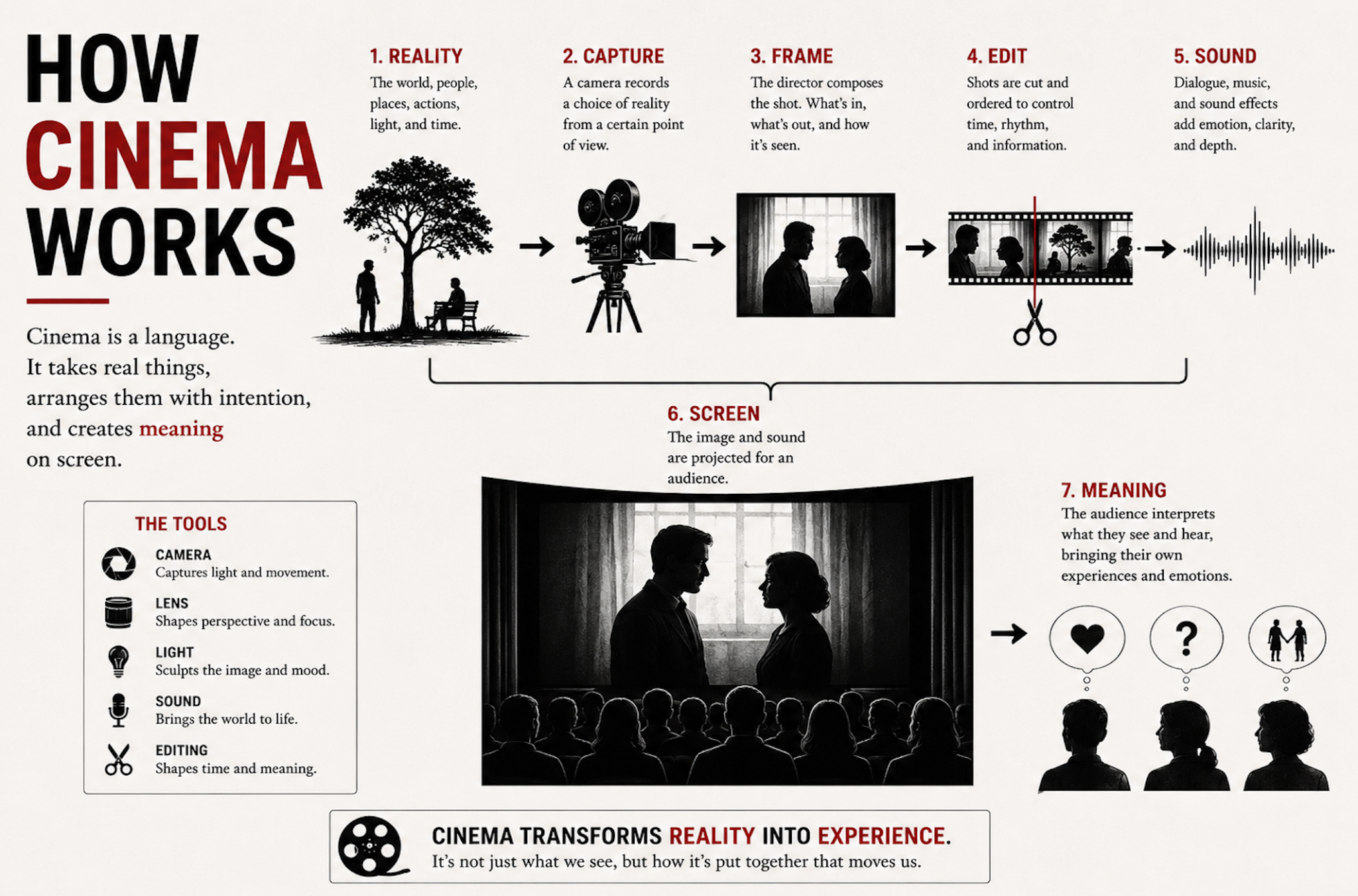
The opening shot of a great film is never arbitrary. It is a complete statement of intent — the filmmaker telling you, in visual language rather than words, exactly what kind of attention the next two hours will require. Learning to read that statement is the single most useful skill a cinephile can develop.
Pather Panchali begins with a shot of a spider's web.
Not a person. Not a house. Not an establishing shot of the village that will be the film's world. A spider's web, filmed in close-up, with the specific quality of early morning light that makes the web's threads visible — each one catching the light separately, the whole structure simultaneously fragile and precise, beautiful and functional, a trap and a home at the same time.
The shot lasts approximately eight seconds. Then Ray cuts to a young girl — Durga — stealing fruit from a neighbour's orchard. The film has begun.
Most viewers do not consciously register the spider's web shot. It passes quickly. Nothing in the film subsequently refers back to it. No character mentions it. No plot point depends on it. If you asked a viewer to describe the opening of Pather Panchali they would almost certainly begin with Durga stealing fruit rather than with the web.
But the web is doing work that the entire film depends on.
What the shot is saying
A spider's web is simultaneously a structure of extraordinary beauty and a mechanism of death. It is built with absolute precision from the most fragile available material. It catches light. It catches flies. It is home to something and fatal to something else, and these two facts are inseparable — you cannot have the beauty without the trap, cannot have the home without the death.
Ray is telling you, in the first eight seconds of his first film, that Pather Panchali will look at the world the way a spider's web looks — finding beauty and death in the same place, refusing to separate them, insisting that you cannot have one without the other.
The film that follows is built on exactly this principle. The death of Indir Thakrun, the old aunt, is filmed with the same unhurried attention as the scene of Apu and Durga running through the fields to see a train. The death of Durga in the rain is filmed with the same camera position, the same quality of light, the same pace as every other scene in the film. Ray refuses to distinguish between moments of joy and moments of grief at the level of form. They are filmed the same way because they are part of the same life.
The spider's web announces this before a single human character appears. It is the film's thesis stated in visual language.
What this teaches you about how films work
Every great filmmaker uses the opening of their film to establish the visual and philosophical grammar of what follows. The opening shot is not simply the first thing you see. It is the first statement of what the film believes — about the world, about cinema, about the relationship between the two.
Consider three other opening shots as a comparative exercise.
Touch of Evil (1958) · Orson Welles: The film opens on a close-up of a bomb being set, then pulls back in a single unbroken three-minute take to reveal a border town, a car, a couple walking, the street around them, other cars, other people — and the bomb ticking somewhere inside all of this ordinary life. Welles is telling you in the first three minutes that this is a film about what is hidden inside the ordinary, about the violence concealed beneath the surface of normal social life. The long take without a cut tells you that the film will refuse to let you look away, will keep you inside the same frame as the danger until the danger detonates.
Apocalypse Now (1979) · Francis Ford Coppola: The film opens on a jungle. Helicopters appear. The sound of helicopter blades begins. Jim Morrison's The End begins on the soundtrack. The jungle burns. A face is superimposed over the flames — Willard's face, upside down, as if the world has been inverted. Coppola is telling you that this is a film about a man whose interior world and exterior world have become the same world — that the jungle burning is also his mind burning, that the journey up the river is also a journey inward, that the two cannot be separated. Every subsequent image in the film is richer for having seen this opening.
Jeanne Dielman (1975) · Chantal Akerman: The film opens on Jeanne, in her kitchen, preparing the evening meal. The camera is at the height of someone seated at the kitchen table — not the height of someone standing, not the height of a director looking at their subject, but the height of someone who lives in this kitchen, for whom this kitchen is the world. Akerman is telling you that this film will refuse the conventional relationship between camera and subject — the camera will not look down at Jeanne, will not place her in a world larger than herself. The kitchen is as large as any world. The work done in it is as significant as any other work. The camera's position is the argument stated in the first frame.
The practical skill this develops
When you next watch a film — any film, not just a canonically important one — stop on the first shot and ask what it is saying.
Not what it is showing. What it is saying.
The distinction is the entire skill. A shot shows you a spider's web. It says: beauty and death are inseparable. A shot shows you a bomb in a crowd. It says: violence is always hidden inside ordinary life. A shot shows you a woman in a kitchen at the height of someone who lives there. It says: this space is as significant as any other space.
Most films do not use their opening shot with this kind of intelligence. Most films begin with an establishing shot that simply locates you — here is the city, here is the house, here is where we are. That is fine. It is also all that shot is doing.
But when a filmmaker uses the opening shot to make a statement rather than simply to establish a location, the statement is available to any viewer who knows how to read it. You do not need a film degree. You do not need to have read Bazin or Eisenstein or Kracauer. You need only to look at what is in the frame, ask what it is saying rather than what it is showing, and bring what you find into the rest of the film.
Do this with Pather Panchali's spider's web. Then do it with the opening shot of every film you watch for the next month. By the end of the month you will be watching differently. By the end of the year you will be watching at a level that most people who love cinema never reach.
💬 Discussion
0 comments