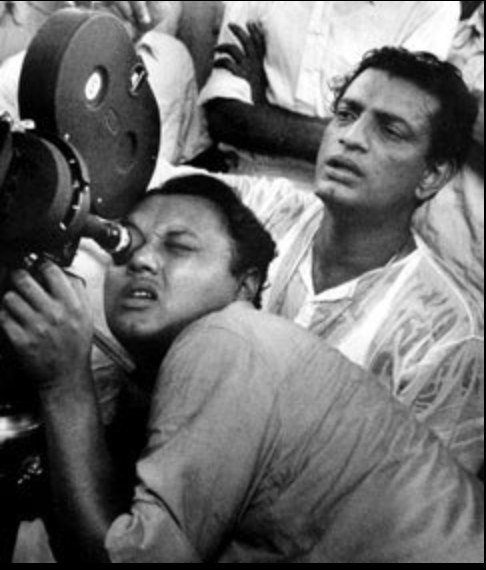
Subrata Mitra Was Twenty-Two Years Old When He Invented a Lighting Technique That Changed World Cinema — and Almost Nobody Outside Bengal Knows His Name
In 1954 Subrata Mitra had never shot a film. He had never worked on a professional production. He had a stills photography background and a deep familiarity with the films of Jean Renoir and the Italian Neorealists. When Satyajit Ray asked him to shoot Pather Panchali, the combination of his inexperience and his visual intelligence produced one of the most important technical discoveries in the history of cinematography — a discovery that Roger Deakins has cited and that shaped the entire subsequent history of natural-light cinematography.
The discovery is called bounce lighting. Its principle is simple. Instead of placing artificial light sources in front of or above the subject — which was the standard studio practice of the era — Mitra placed his light sources behind large white reflectors, bouncing the light off the reflectors and into the scene. The bounced light was softer, more diffused, and more closely approximated the quality of natural light than any direct artificial source could produce.
This technique exists and is widely used now. In 1954 it did not exist as a conscious practice. Mitra arrived at it through necessity — the budget of Pather Panchali could not afford extensive studio lighting rigs, and the actual locations in rural Bengal required a quality of light that studio equipment could not produce authentically.
What Mitra understood, when he arrived at bounce lighting through the pressure of constraint, was something more than a technical solution to a practical problem. He understood that the specific quality of light in a specific place at a specific time is not simply an aesthetic quality. It is a form of truth — a way of making the image correspond not just visually but experientially to the reality being photographed.
The light in Pather Panchali looks like Bengal. Not like Bengal in general but like the specific quality of diffused natural light in the specific landscape and interiors Ray was photographing. That specificity — which Mitra's technique made possible — is inseparable from the film's emotional truth. When Durga dies in the rain, the quality of the light in the sequence is not the quality of a lit studio set. It is the quality of actual rain, actual darkness, actual Bengal. The truth of the image is the truth of the light.
What he understood about the human face
Mitra's greatest achievement across his career with Ray is not the bounce lighting technique — important as that is — but his understanding of what natural light does to the human face that artificial light cannot replicate.
The human face in natural light is a face in relationship with its environment. The quality of the light falling on it changes as the day changes, as the weather changes, as the face moves through different interior and exterior spaces. These changes are information — they tell the viewer something about time, place, and the specific quality of the moment being photographed. A face in studio light is a face that has been removed from its environment and placed in a controlled relationship with a light source that tells the viewer nothing about time or place or the specific quality of the moment.
Mitra's understanding of this distinction is visible in every sequence of the films he shot for Ray. In Charulata the interior scenes lit by Mitra have a specific quality of afternoon light filtered through muslin curtains that is simultaneously a piece of historical information — this is how the interiors of prosperous nineteenth-century Bengali households looked in the afternoon — and an emotional state, the specific quality of a woman's life lived primarily in interior spaces.
In The Big City the exteriors shot by Mitra have the specific quality of Calcutta daylight in the early 1960s — not picturesque, not glamorised, but specifically true to a city in a specific period that is still recognisable to anyone who knows it. This specificity is a form of respect — respect for the specific reality being documented, refusal to make it more beautiful or more dramatic than it actually is.
The films and what each one taught
Mitra shot ten films with Ray between 1955 and 1966. Each one extended the visual vocabulary they had developed together and each one solved a specific problem that the previous films had left open.
Pather Panchali established the principle: natural light, specific locations, the face as the primary subject of the image.
Aparajito extended it into a different kind of natural light — the specific quality of Benares, which is a different light from rural Bengal, and which Mitra rendered with the same specific attention.
Apur Sansar moved toward the urban and the domestic — the specific quality of a Calcutta room, the specific quality of light through windows in a city apartment.
Devi and Jalsaghar — both set in the declining aristocratic world of nineteenth-century Bengal — required Mitra to develop a different visual register: the specific quality of lamplight and candlelight in large interior spaces, the specific relationship between elaborate material culture and the failing human lives within it.
Charulata is his most complete work. The film is set entirely in interior spaces and Mitra lit it with a precision and a consistency that created a visual world of complete coherence — every room in Charulata has a specific quality of light that corresponds to the specific quality of life lived within it. The lighter, more open spaces of Bhupati's study. The more diffused, more private light of Charulata's embroidery room. These are not simply aesthetic choices. They are psychological mappings of the specific quality of two people's relationship with their own spaces.
Why he stopped — and what the stopping tells us
Mitra stopped working with Ray after Nayak in 1966. The reasons are not fully documented and neither man spoke about them publicly in ways that make the separation fully legible. What is documented is that Mitra increasingly moved into advertising photography and stills work — a creative decision that removed him from cinema almost entirely at the height of his powers.
The stopping is not a failure. It is a reminder that careers in any creative field are shaped by forces that have nothing to do with talent or ambition — by the specific circumstances of personal and professional life that make certain paths available and others closed. Mitra's contribution to cinema was made in eleven years of work. Those eleven years produced some of the most important cinematographic thinking in the history of the medium.
Roger Deakins has cited Mitra's work on the Apu Trilogy as an influence. Emmanuel Lubezki's natural light cinematography — the work for which he won three consecutive Academy Awards — is working in a tradition that Mitra helped establish. The bounce lighting technique that Mitra invented out of necessity on the set of Pather Panchali is now standard practice in documentary, independent, and certain commercial cinematography worldwide.
Subrata Mitra is not a footnote. He is a founding figure — one of the small number of cinematographers who made a formal discovery that changed what was possible for everyone who came after. The fact that his name is less known than his discovery deserves is not a fact about his achievement. It is a fact about how cinema history is written — and about which national cinemas are included in the story that writing tells.
💬 Discussion
0 comments