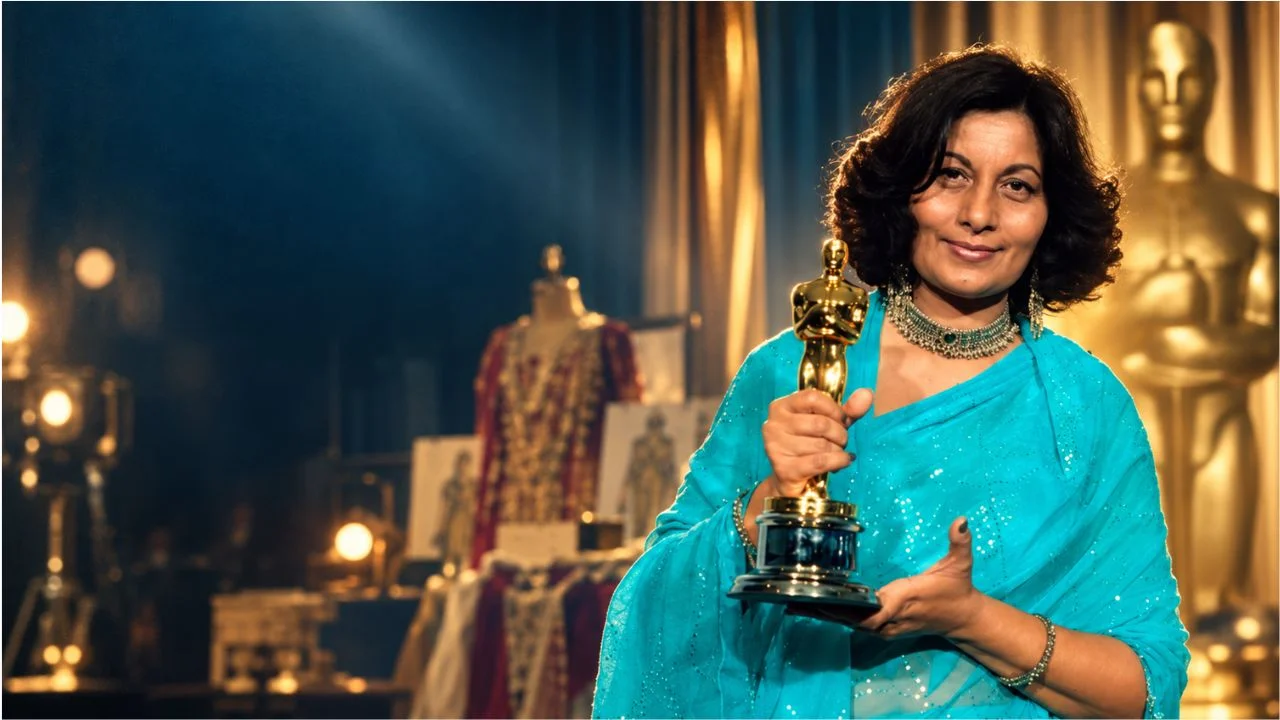
Bhanu Athaiya Won the First Oscar Ever Given to an Indian and Almost Nobody Can Name a Single Other Film She Worked On — Here Is the Complete Account of Why That Ignorance Is the Most Eloquent Statement About How Indian Film Culture Treats Its Costume Designers
Bhanu Athaiya designed the costumes for Gandhi (1982) and won the Academy Award for Costume Design — the first Oscar ever awarded to an Indian citizen. She returned it in 2012, saying she wanted it to be preserved with the Academy rather than potentially lost or damaged after her death. Between the winning and the returning, she designed the costumes for over one hundred Indian films across five decades, and the creative contribution those costumes made to the films they appeared in has never been seriously examined. This is the examination.
The costume designer's contribution to a film is the most completely invisible of any major creative role — invisible in the specific sense that when it is done well it is not noticed, and when it is not noticed it is not discussed.
This invisibility is not accidental. It is produced by a specific understanding of what costume design is for — the belief that costumes should support and extend the film's world rather than draw attention to themselves, that a costume that the viewer notices as a costume has failed its primary function. The costume that succeeds is the one that makes a character completely themselves — that makes Mahatma Gandhi look exactly like the historical figure without the viewer thinking about the design decisions that produced that accuracy, that makes a character in a contemporary drama look like the specific person they are meant to be without the viewer thinking about who chose their clothes.
This invisibility, when the designer has achieved it through serious creative and research work, is a form of craft mastery that the more visible creative roles — the camera movements, the production design, the performances — are not asked to achieve in the same way.
Bhanu Athaiya understood this completely and made it the governing principle of her practice.
The Gandhi costumes — what they required and what they achieved
The Gandhi commission was the most demanding assignment in Athaiya's career — and in the history of Indian costume design — for reasons that are specific and worth understanding in detail.
The film required costume accuracy across a period of sixty years, multiple geographic and cultural contexts, and the representation of historical figures whose appearance is documented in extensive photographic and film record. Gandhi's transformation from the Western-dressed barrister of his South African period to the dhoti-wearing ascetic of his Indian period was not simply a costume change. It was the film's central visual argument — the most important character development in the narrative made visible through clothing.
Athaiya spent years before production researching the specific fabrics, specific tailoring traditions, specific regional variations in dress that would make the film's representation of Indian life across six decades historically accurate. She traveled across India sourcing specific fabrics. She worked with weavers to reproduce specific textile traditions. She studied the photographic and film record of the historical period with the same attention that a scholar brings to archival research.
The dhoti that Athaiya designed for Ben Kingsley's Gandhi is not a generic dhoti. It is a specific dhoti — the specific weight and texture of the khadi cloth that Gandhi insisted on wearing as a political statement, the specific way of wearing it that corresponded to the historical record, the specific visual impression that the combination of the dhoti and Kingsley's physical embodiment of Gandhi produced.
This specificity is not perfectionism for its own sake. It is the recognition that in a film about a historical figure, the accuracy of the visual representation is a form of respect for the historical record and a condition of the film's credibility.
The Hindi film work — what it reveals about Indian cinema's relationship with design
Athaiya's Indian film work — spanning from the 1950s through the 2000s — is a record of the specific challenge of costume design in a film industry that has historically treated it as a logistical rather than a creative function.
In the Bollywood of the 1950s and 1960s, costumes were primarily understood as expressions of glamour — the specific glamour of the Hindi film universe, which was simultaneously aspirational (the luxurious fabrics, the specific quality of embellishment) and fantastical (the specific visual register of the studio musical, in which the clothing was never simply realistic but always slightly heightened). Athaiya worked within this tradition for Guru Dutt — Pyaasa, Sahib Bibi Aur Ghulam, Kaagaz Ke Phool — creating costumes that understood both the glamour requirement and the specific emotional registers of Dutt's films.
Her work for Guru Dutt is the most interesting period of her Indian career because Dutt's films demanded something from costume design that most Bollywood films did not — a specific relationship between a character's clothing and their psychological state. In Sahib Bibi Aur Ghulam the costumes of the Choti Bahu are not simply period-accurate representations of nineteenth-century Indian aristocratic dress. They are the physical expression of a woman's specific relationship with a world that is destroying her — increasingly elaborate, increasingly disconnected from the practical realities of the character's life, increasingly a form of armour against a reality that the armour cannot keep out.
What Bhanu Athaiya represents beyond her individual work
Athaiya represents something beyond her individual creative achievement — the existence of a tradition of serious costume design in Indian cinema that has been systematically undervalued, underdiscussed, and professionally undercompensated.
The costume designers who work in Indian cinema today are among the least recognised creative professionals in an industry that under-recognises most of its creative professionals outside the star system. Their names are rarely mentioned in critical coverage. Their specific contributions are rarely examined. The awards infrastructure for costume design at major Indian film ceremonies is minimal compared to the recognition given to the more visible creative roles.
This is not simply a matter of institutional fairness. It is a matter of critical honesty about what makes a film the visual and emotional experience it is. A film's world is constituted by every visual element within it — including the specific clothes on the specific bodies of every person who appears on screen. The creative intelligence that determines those choices is as responsible for the film's reality as the cinematographer's choices about light, the production designer's choices about space, or the director's choices about camera.
Bhanu Athaiya returned her Oscar because she wanted it preserved. The preservation she was worried about was physical — the deterioration of the object. The preservation that Indian film culture has failed to achieve is intellectual — the preservation and transmission of the knowledge of what she did, how she did it, and why it mattered. This piece is a small contribution to that preservation. It is not sufficient. What would be sufficient is a complete reckoning with her work — and with the work of every costume designer in Indian film history — that treats it with the analytical seriousness that any other major creative contribution to cinema receives.
💬 Discussion
0 comments