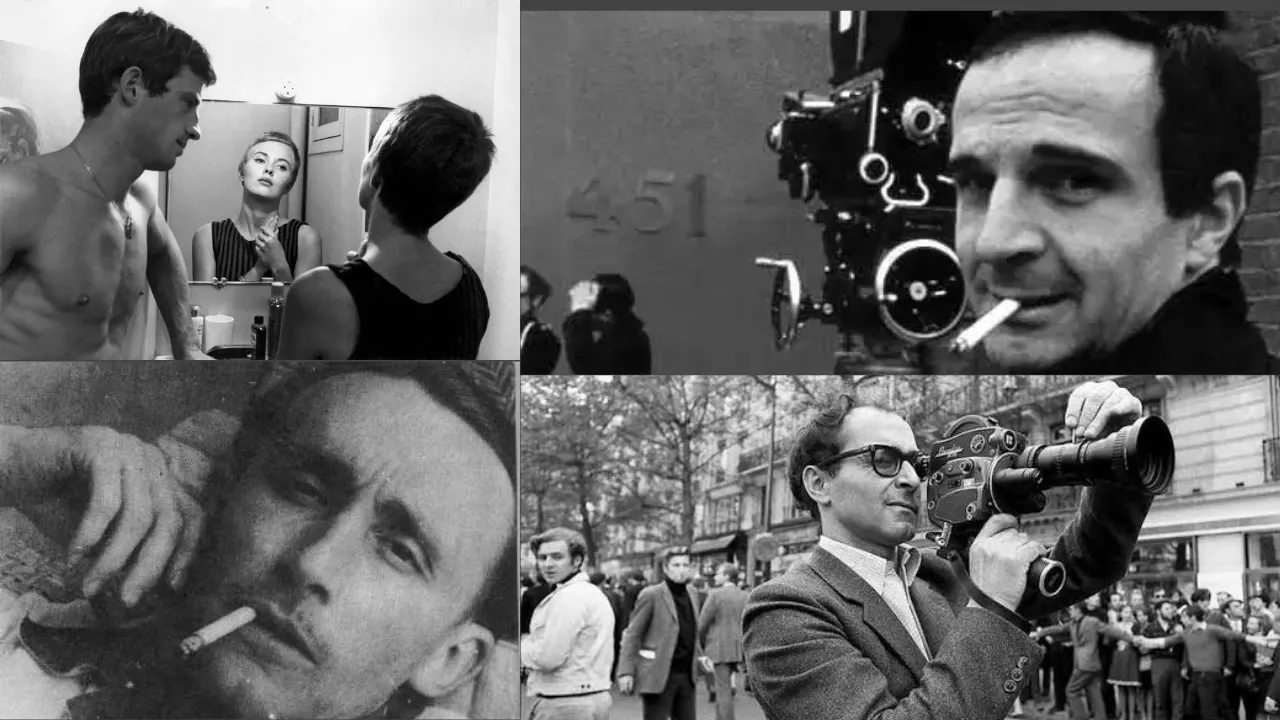
In 1959 four young men who had been writing about cinema for years without being allowed to make it finally made it. The films they made were not simply technically different from what preceded them. They were philosophically different — built on a completely different understanding of what cinema was for and what it owed its audience.
Begin with the anger. Because the French New Wave is almost always taught as an aesthetic phenomenon — handheld cameras, location shooting, jump cuts, improvised dialogue — and this is accurate and also completely misses the point. The aesthetics were the expression of an argument. To understand the aesthetics you must first understand the argument.
The argument was with the cinéma de qualité — the "quality cinema" of French film production in the late 1940s and 1950s. These were technically accomplished, lavishly produced adaptations of literary classics and original screenplays by professional screenwriters, directed by craftsmen who knew how to handle actors and compose a shot and tell a story efficiently. They were, by any conventional standard, good films.
François Truffaut, writing in Cahiers du Cinéma in 1954, called them dead. His essay — A Certain Tendency of French Cinema — is the founding document of the New Wave and it is an act of generational violence dressed as film criticism. Truffaut argued that the quality cinema was a cinema of scripts rather than a cinema of filmmakers — that the writers who supplied it with its stories had more authority than the directors who filmed them, and that this inversion of the proper hierarchy was the source of its deadness. A film, Truffaut argued, should express the personal vision of its director the way a novel expresses the personal vision of its author. The director should be the auteur — the author — of their film. The quality cinema prevented this. Its directors were skilled employees in service of someone else's vision.
This was the argument. The films were the evidence.
What the jump cut actually meant
Godard's Breathless opens with Michel Poiccard — Jean-Paul Belmondo — stealing a car and driving from Marseille to Paris. In the middle of this drive Godard cuts. Not to a new scene. Not to a different location. He cuts within the same shot — removing several seconds of the middle of a continuous action, creating a visual discontinuity that the grammar of classical Hollywood editing considered a technical error.
This cut — which every film student subsequently learned to call a jump cut — was not accidental and it was not simply a stylistic choice. It was a declaration.
Classical Hollywood editing is built on a principle called the continuity system — a set of rules designed to make cuts invisible, to create the impression that the space on screen is continuous and coherent, to prevent the viewer from becoming conscious of the edit. The 180-degree rule, the eyeline match, the shot-reverse-shot — all of these techniques exist to sustain the illusion that you are watching a window onto a real world rather than a series of separate photographs assembled in an editing room.
The jump cut breaks that illusion deliberately. It makes the edit visible. It reminds you that you are watching a construction. It says: this is a film. Someone made it. The someone is telling you something and the form of the telling is part of what is being told.
For Godard this was not a technical experiment. It was a philosophical position about what cinema's relationship with its audience should be. Classical Hollywood editing tells the audience where to look and how to feel, makes the construction invisible so that the viewer experiences the film as reality rather than as film. Godard believed this was a form of dishonesty — that the viewer had a right to know they were watching a construction, and that a cinema which concealed its own constructedness was a cinema that was, in a specific and important sense, lying.
Truffaut and the personal film
Where Godard's films are philosophical arguments, Truffaut's are emotional confessions. The 400 Blows — his debut feature, made when he was twenty-seven — is the most transparently autobiographical film made by a major filmmaker since cinema began. Its protagonist, Antoine Doinel, is Truffaut — his childhood, his reform school, his escape. The film does not fictionalise or distance this material. It uses it directly, with a rawness that the quality cinema, with its professional scripts and controlled performances, could not have produced.
The 400 Blows is also a film built around a performance — by Jean-Pierre Léaud as Antoine — that could only have been obtained through a method the quality cinema did not use. Truffaut filmed Léaud's final interview sequence — where Antoine answers questions from a social worker — without scripting the questions. He told Léaud to answer as himself, as Antoine, and filmed his responses. The sequence is the most real thing in a film full of real things, and its reality is inseparable from the method that produced it.
This is what Truffaut meant by the auteur theory in practice — not that the director's personal vision should dominate over the writer's, but that the director's personal experience, personal emotion, personal relationship with the material should be present in the film in a way that the quality cinema, with its professional distance and institutional craft, could never accommodate.
What the New Wave left behind
The French New Wave as a definable movement lasted approximately five years — from The 400 Blows and Breathless in 1959 to roughly 1964, when the initial energy had either been absorbed into mainstream cinema or exhausted itself. But its influence has never stopped.
Every contemporary film that uses a handheld camera to create intimacy rather than chaos inherits from the New Wave. Every film whose director appears in it — acknowledging the film's construction — inherits from the New Wave. Every film that refuses the conventional three-act structure in favour of a more personal, more digressive, more self-aware organisation inherits from the New Wave.
More importantly, every film that treats its director as an author — as someone with a personal vision that the film expresses rather than a craftsman executing someone else's design — inherits the auteur theory that Truffaut articulated in 1954 and that the New Wave demonstrated in practice.
The anger that produced it has long since dissipated. The quality cinema it was angry at no longer exists in the form that provoked Truffaut's polemic. But the question the New Wave was asking — what does a filmmaker owe their audience, and is honesty about the film's own constructedness part of that obligation — is a question that every serious filmmaker still answers every time they decide whether to make the edit visible or invisible, whether to acknowledge the camera or pretend it is not there. The New Wave made that question unavoidable. Cinema has been answering it ever since.
By Republic of Cinema · Movements & Waves · Cinema Studies · World Cinema · Republic of Cinema
💬 Discussion
0 comments