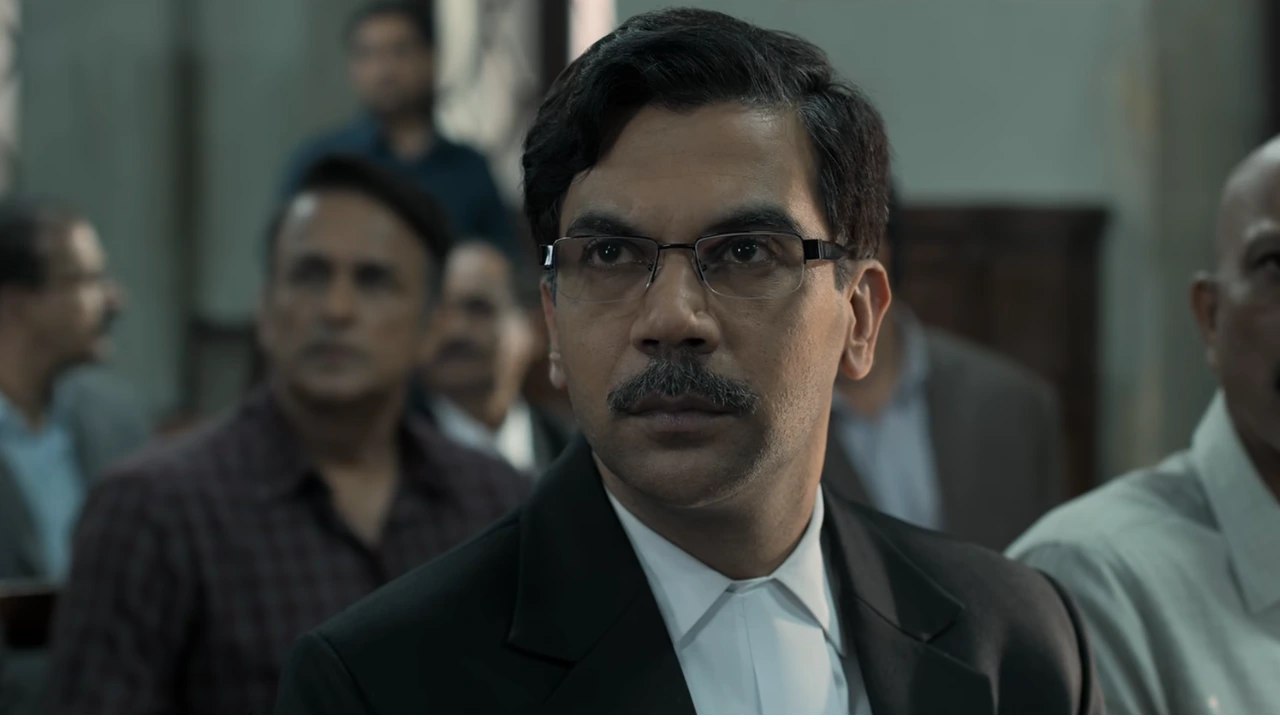
Rating: ★★★ (out of 4)
Director: Avinash Arun Producer: Dinesh Vijan Studio: Maddock Films Story and Dialogue: Sumit RoyCinematography: Avinash Arun Editor: Charu Shree Roy Music: Pritam, Alokananda Dasgupta Cast: Rajkummar Rao (Ujjwal Nikam), Lalit Prabhakar (Ajmal Kasab), Wamiqa Gabbi (Jyoti Nikam), Jaideep Ahlawat (Zulfikar), Sikandar Kher (Abbas Kazmi), Ashish Vidyarthi (Judge M.L. Tahaliyani), Ritvik Sahore (Aniket Nikam) Certificate: UA 16+Runtime: 141 minutes Language: Hindi Release Date: 16 October 2026 (theatrical)
After the interval, a little girl takes the witness stand. She is asked what she saw. Everything in "Prahaar: The Untold Story of Ujjwal Nikam" has been leading to this moment, in which a child must look across a courtroom at the man who shot her, lift her arm, and point.
In life her name was Devika Rotawan. She was nine years old on the night of November 26, 2008, when she was shot in the leg at the Chhatrapati Shivaji Maharaj Terminus in Mumbai, and she became the youngest witness in the trial that followed. Years later she remembered that the accused simply stood there, without expression, as she pointed at him. The whole country already knew his face. Newspapers had printed the photograph of a young man in cargo trousers, a backpack on his shoulders and an assault rifle in his hands, crossing the station concourse. There was no mystery about who he was or what he had done. So why did the state need more than a year, hundreds of witnesses and one small girl to prove it?
That question is the spine of Avinash Arun's film, and its answer is a line Rajkummar Rao delivers like an article of faith: "Justice hurried is justice buried." It is a sly turn on the old maxim about justice delayed, and it puts the film quietly at odds with its own title. Prahaar means a strike, a blow. This is a movie about a man whose job is to hold back the blow until the law has earned the right to land it.
The title has a history. In 1991 Nana Patekar made his debut as a director with a film also called "Prahaar," about an army major who, when the people of a Bombay neighbourhood will not stand up to the gangsters tormenting them, kills the gangsters himself. Thirty-five years later the same word returns, attached to the opposite argument.
There is an older Indian name for what is at stake. Kautilya's Arthashastra calls the power to punish danda, the rod, and warns that the rod applied after careful deliberation sustains a people, while the rod swung in anger or contempt turns even the hermits of the forest against the king. Nikam, as the film imagines him, is a man trying to keep a furious nation from swinging the rod in anger. That he is also the man asking for a death sentence is not a contradiction. It is the job.
The attacks themselves have been dramatised many times, in Ram Gopal Varma's "The Attacks of 26/11," in "Hotel Mumbai," in "Major," in the series "Mumbai Diaries 26/11." Those were stories about the night: the gunfire, the hotel corridors, the courage of people who had no time to think. "Prahaar" is about the morning after, which lasted four years.
We meet Nikam as a plain-spoken lawyer from Jalgaon, already known for prosecuting the 1993 Bombay bombings case. Then come the attacks. Arun stages the massacre at the terminus not as spectacle but through the people caught inside it, and then, a little too hastily, moves to where his film really lives, among the wooden benches and towering sarkari files of a special court. Here is Ajmal Kasab (Lalit Prabhakar). Here is his court-appointed counsel, Abbas Kazmi (Sikandar Kher), and the watchful Judge M.L. Tahaliyani (Ashish Vidyarthi). There are the slow, unglamorous battles, among them the defence's claim that Kasab was a juvenile and could not be tried as an adult. And there is Zulfikar (Jaideep Ahlawat), a prosecutor from across the border, whose presence lets the film look past the boy in the dock toward the machinery that made him.
Arun came to directing from behind the camera. He trained as a cinematographer at the Film and Television Institute of India in Pune and shot "Masaan" and "Drishyam" before making "Killa" (2014), a small, aching Marathi film about a boy who moves to a coastal town after his father's death; it won the Crystal Bear at Berlin. He followed it with "Three of Us" and the streaming series "Paatal Lok." Here, credited as his own cinematographer, he brings a cameraman's patience to rooms full of talk. The courtroom scenes are not staged as arias for the audience to applaud. They feel like hours: the shuffle of papers, the tedium of procedure, and then, without warning, a question that changes the air in the room.
Rajkummar Rao has built a career on disappearing into men who are not, at first sight, movie stars. His Nikam has two voices. At home he is soft, a little reedy, almost fussy. Before the bench he finds a register that fills the room. Nikam has said that Rao studied many videos of his court appearances, and the mannerisms are there, but they are not the performance. The performance is in the preparation. This is a hero whose weapon is having read the file more carefully than anyone else.
There is a curious symmetry in the casting. Rao won a National Award for "Shahid" (2013), Hansal Mehta's film about Shahid Azmi, a lawyer who defended men accused of terrorism and who was shot dead in his Mumbai office in February 2010, while he was representing one of the co-accused in this very trial. Rao has now stood on both sides of the same courtroom. Watching him here, I kept thinking about how differently the two men are remembered, and how the republic needed both of them.
The film's real discovery, for Hindi audiences, is Lalit Prabhakar, a Marathi actor admired for "Anandi Gopal," who won the role of Kasab through an audition. He does not play a monster, which would have been easy. He plays something more unsettling: a young man who has been taught that he is a martyr and is waiting for the world to agree. He is smug, then sly, then, in brief flashes, a frightened boy from a village in Pakistani Punjab who is very far from home. Kasab was 21 when he was captured. Prabhakar lets us feel how little of those 21 years had ever belonged to him.
Sikandar Kher brings real gravity to the thankless role of Kazmi, and the film takes a civilised interest in the respect that can exist between opposing counsel. History was less tidy. The real Kazmi did not see the trial through; Judge Tahaliyani removed him in November 2009, saying he was dragging out the proceedings, and Kazmi later went to the High Court to clear his name. Jaideep Ahlawat lends Zulfikar a quiet conviction, and through him the film declines the easy comfort of hating an entire country. Ashish Vidyarthi, as the judge, watches everything, which is what judges in good courtroom movies do.
Outside the courtroom, the film's grip loosens. To keep Nikam from becoming a plaster saint, the screenplay gives him a family who pay for his devotion: a wife, Jyoti (Wamiqa Gabbi), whose illness he is too preoccupied to take seriously, and a son, Aniket (Ritvik Sahore), who serves as his junior and eventually walks away. The intention is honourable. The execution is borrowed from a hundred movies about workaholic fathers, and each time we left the courtroom I found myself waiting to go back. At 141 minutes, "Prahaar" is perhaps twenty minutes longer than its argument.
I was troubled, too, that in its hurry to reach the trial the film passes so lightly over Assistant Sub-Inspector Tukaram Omble, the unarmed policeman at Girgaum Chowpatty who seized the barrel of Kasab's rifle and held on while the bullets went into him. Omble was awarded the Ashoka Chakra after his death. Without him there is no living Kasab, and without a living Kasab there is no trial, no prosecutor, and no movie.
Then there is the man himself. The real Ujjwal Nikam, who now sits in the Rajya Sabha, has said he warned the filmmakers that a lawyer's life contains no filmy masala, and asked them not to glorify anyone. It is good advice, and the film mostly follows it. But Nikam is a more complicated figure than the one on the screen. In 2015 he admitted that he had invented the story, repeated for years afterward by politicians, that Kasab demanded mutton biryani in jail. He said he made it up to break a wave of public sympathy after reporters noticed the prisoner looking tearful on Raksha Bandhan. A prosecutor who understood that a trial is also argued in the court of public feeling would make a fascinating subject. It is the most revealing thing we know about him, and the fairest test of any film that promises his untold story. Some critics have questioned the timing of a heroic biopic about a public figure now in politics; others take the film simply as a portrait of a working lawyer. Viewers can weigh that for themselves.
Audiences have approached it cautiously. "Prahaar" opened on October 16 to about ₹2.35 crore net, behind Yami Gautam's horror comedy "Nayyi Navelli" and in the long shadow of Rajinikanth's "Jailer 2," then climbed by roughly a third on Saturday to about ₹3.15 crore. That kind of second-day rise usually means people are telling their friends.
Kasab was hanged in Yerawada Central Jail in Pune on November 21, 2012, five days short of the fourth anniversary of the attacks. History supplies that ending. But the image I carried out of the theatre was smaller: a child's arm rising in a courtroom, a finger pointing, and the whole patient machinery of a constitutional republic waiting on a nine-year-old to say what she saw. That is the real prahaar in this film. It does not land like a blow. It lands like a fact.
💬 Discussion
0 comments