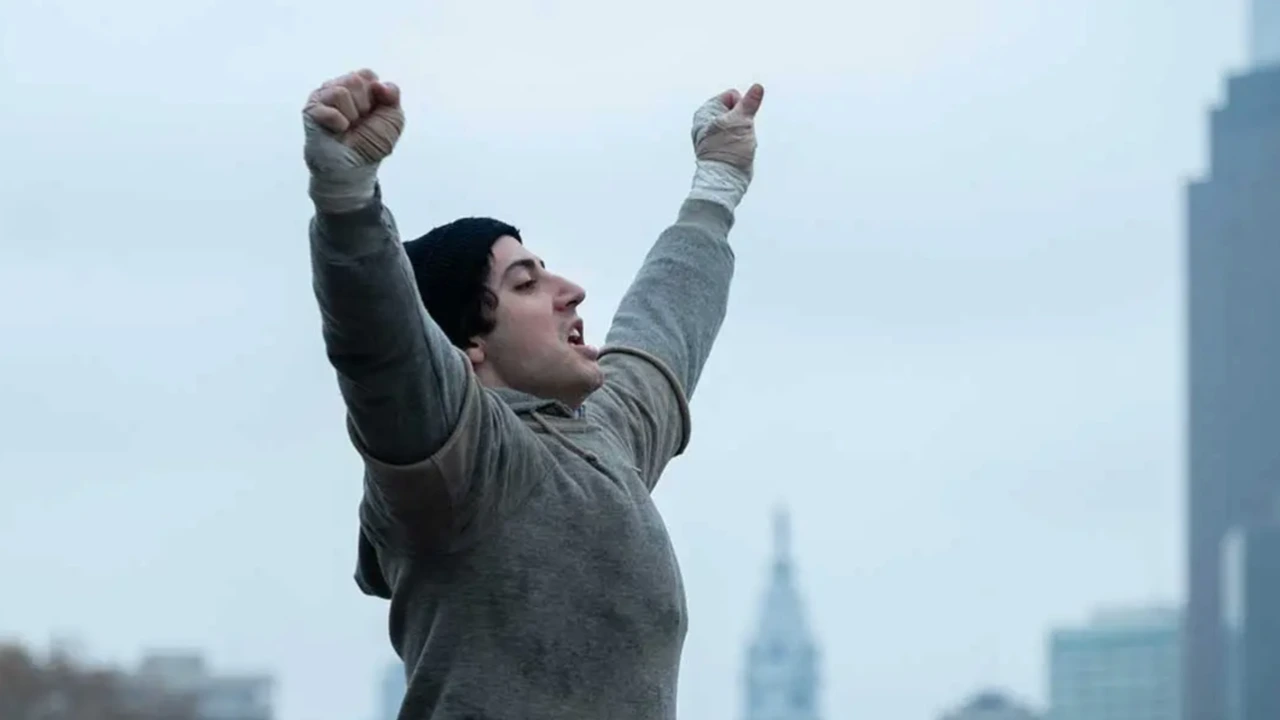
I Play Rocky: Somebody Always Runs the Steps First
Republic of Cinema · First Look
Rating: ★★★½ (out of 4)
| Directed by | Peter Farrelly |
| Written by | Peter Gamble |
| Produced by | Peter Farrelly, Toby Emmerich, Christian Baha |
| Cinematography | Sean Porter |
| Editing | Sam Seig |
| Production design | Anthony Gasparro |
| Music | Dave Palmer; original songs by Andrew Bird |
| Cast | Anthony Ippolito (Sylvester Stallone), AnnaSophia Robb (Sasha Czack), Matt Dillon (Frank Stallone Sr.), Jay Duplass (John G. Avildsen), Tracy Letts (Sandy Maddox), P.J. Byrne (Irwin Winkler), Toby Kebbell (Robert Chartoff), Stephan James (Carl Weathers), Kiki Seto (Talia Shire), Robert Morgan (Burgess Meredith), Scot Teller (Burt Young), Michael Fuchs (Garrett Brown) |
| Studio | Amazon MGM Studios (India: PVR INOX Pictures) |
| Rated | PG-13 (US); A (India) |
| Runtime | 128 minutes |
| Release | World premiere, Toronto International Film Festival, September 2026; US limited 6 November 2026, wide 20 November 2026; India 13 November 2026 |
Early in "I Play Rocky," a young actor sits alone with a tape recorder. He reads a few lines into it, rewinds, and listens. Then he does it again. He is not admiring himself. He is studying the evidence, the way a fighter studies footage of a fight he lost. The voice on the tape is thick and sluggish, the words arriving half a beat late, because a nerve in his face was damaged at birth and part of his mouth never fully obeyed him. Casting directors hear that voice and send him home. Within two years, the same voice will be making shy small talk across the counter of a Philadelphia pet shop, and audiences around the world will lean in to listen.
The young man is Sylvester Stallone, though at the start of Peter Farrelly's film hardly anyone calls him that. In New York in 1974 he goes by Mike. He lives in a Times Square flophouse until he is thrown out of it, auditions for parts that have numbers instead of names, and takes work in a softcore picture called "The Party at Kitty and Stud's" because the rent does not care about his dignity. He sells a dog he can no longer feed. A stray named Butkus finds him anyway. At a small cinema where he tears tickets he meets Sasha Czack (AnnaSophia Robb), and Sasha gives him two pieces of advice. Use your real name. Write yourself a part you would want to play. They turn out to be the same advice.
"I Play Rocky" arrives fifty years, almost to the week, after "Rocky" (1976) opened in New York. It tells how a broke actor with a slurred voice wrote the most beloved underdog story in American movies and then refused, at nearly ruinous cost, to let anyone else star in it. The title is his mantra. He says it to producers, to a studio boss, to his father, to anyone who will listen and many who will not. I play Rocky. Not "I would like to." Not "I could." There is no conditional anywhere in that sentence.
There is a verse in the Bhagavad Gita that I kept returning to as I watched: śreyān sva-dharmo viguṇaḥ para-dharmāt sv-anuṣṭhitāt (3.35). Better one's own dharma, imperfectly performed, than the dharma of another performed well. Krishna is speaking to a warrior who wants to lay down his bow, not to an actor trying to pick up a role, but the principle travels. The studio would have preferred a proven star such as Ryan O'Neal or Burt Reynolds, and by every business measure it was right; either man could have played Rocky Balboa competently. Stallone's position, which the film states again and again, is that competence was beside the point. Another actor might have played the part well. Only he could play it truly, slur and all, because the part had come out of him.
The first hour is the stronger half of the film, and it is very good. Peter Gamble's screenplay moves the couple to Los Angeles, where Stallone parks cars outside a restaurant and writes at night in longhand while Sasha types up the pages. In March 1975 he watches Chuck Wepner, a journeyman heavyweight nobody gave a chance, knock Muhammad Ali to the canvas and survive into the fifteenth round. The film takes that fight as the spark, a version of events Stallone himself has told in different ways over the years, and Farrelly stages the three days of writing that follow in the style of a "Rocky" training montage. It is a witty idea and exactly the right one. Writing was his roadwork.
Then comes the business. The producers Irwin Winkler (P.J. Byrne) and Robert Chartoff (Toby Kebbell) are interested in a different Stallone script, "Paradise Alley" (he would direct it himself two years later), so he slips "Rocky" into their pile. They love it. Sandy Maddox, a studio executive who is a composite of several United Artists men and whom Tracy Letts plays with profane, room-filling menace, will buy it. He will pay more. He will pay a great deal more, the offers climbing past $300,000 for a man who had recently sold his dog. Each time, Stallone says the sentence. Farrelly made "Dumb and Dumber" and "There's Something About Mary" long before "Green Book" won Best Picture, and he knows how to play a negotiation as comedy. These scenes have the rhythm of a good fight, jab and clinch and jab, with one man who simply will not go down. Letts, for my money, steals every scene he is in.
The studio finally says yes on terms that look designed to make him fail: roughly a million dollars, not one day over schedule, not one dollar over budget. The story is moved from Hell's Kitchen to Philadelphia, which the film presents as a way to save money and stay clear of New York's unions. And so we arrive at the second half, the making of the picture, where "I Play Rocky" becomes more fun and less deep at the same time.
For a cinephile, and especially for anyone who has tried to make a film without money, these sequences are a seminar disguised as a crowd-pleaser. Shots are stolen in public parks. Jay Duplass plays John G. Avildsen as an abrasive pragmatist whose great virtue is that he delivers on time and on budget, and Duplass is a delight. Stallone breaks his knuckles on frozen sides of beef. On the day of the ice-rink scene, somebody discovers that neither he nor Talia Shire (Kiki Seto) can skate. Stallone and Carl Weathers (Stephan James), a former Oakland Raiders linebacker rather than a boxer, have to work out the fight choreography themselves. And Garrett Brown (Michael Fuchs) arrives with a contraption strapped to his body that lets a camera float. He calls it the Steadicam. Remarkably, this is the first time Brown has been portrayed on screen.
What the film understands, and what young filmmakers should take from it, is how many of these crises became the movie. In the finished "Rocky," Adrian skates while Rocky walks beside her on the ice in his street shoes, talking nervously the whole time, and it remains one of the tenderest courtships in American film. The beef became an icon. The fight two non-boxers worked out between themselves became the most imitated slugfest in the genre. Poverty did not merely limit "Rocky"; it shaped it. Satyajit Ray pawned his wife's jewellery and sold his gramophone records to keep "Pather Panchali" (1955) alive. Every great first film is a negotiation with scarcity, and the honest ones wear the scars as style.
But the scene that justifies the whole enterprise has nothing to do with logistics. Matt Dillon plays Frank Stallone Sr., a barber who once dreamed of acting, and although he is buried under a prosthetic nose that does him no favours, the contempt comes through. He belittles his son at every turn, and at one point refers, almost casually, to the time he beat the boy unconscious. Farrelly does not linger. He does not need to. Later, on set, Avildsen pulls his star aside and tells him, in effect, to go deeper. The deepest thing in Stallone is his father. In the scene where Mickey (Robert Morgan, as Burgess Meredith) comes to Rocky's apartment and offers, years too late, to manage him, Stallone lets go, and the rage Rocky aims at the old trainer who ignored him is plainly aimed at Frank. The film frames it as Stallone's own version of Brando's "I coulda been a contender" from "On the Waterfront" (1954). The comparison holds. Both speeches belong to men who were not believed in by the one person who should have believed.
This is what the film is really about, and it is why I think it matters more than its formula suggests. We like to imagine that artists invent things. The great ones mostly excavate. Rocky Balboa was not made up out of nothing. He was dug out of a man who had been told he talked funny, who had been beaten by his father, who had sold his dog, who had a wife at a typewriter believing in him when there was no evidence to justify it. What art draws out of you, if you are honest enough to let it, is exceptional precisely because it could not have come from anyone else. That is why the studio's money never stood a chance. They were not offering to buy a script. They were offering to buy him.
Anthony Ippolito, who played Al Pacino in "The Offer," a series about the making of "The Godfather," is becoming something of a specialist in young men who made famous films, and his Stallone is uncanny. He has the look, the voice and the mannerisms, but the impersonation is the least of it. What he finds is the insecurity under the bravado, the comedian hiding inside the brooder, and in the second half a real physical transformation, as a skinny hustler turns into a plausible heavyweight. Some critics have found the performance an impression. I found it a portrait. Ippolito is 27, a year or two younger than Stallone was when he wrote the script, and he seems to understand from the inside what it means to bet everything on a single chance.
The film has real limitations, and I would be doing it no favours to pretend otherwise. Once production begins, the second hour turns into something like a guided tour of famous anecdotes, each one ticked off with a nudge, and it leans on our love for the 1976 film to do much of the emotional lifting. Sasha, who carried the first hour, nearly vanishes once the cameras roll. That is a loss, and an ironic one: the real Sasha Czack became the set photographer on "Rocky" and documented the production, yet the film forgets her the moment it no longer needs her. Sean Porter's photography is clean and serviceable but rarely suggests the grain and grit of 1975, and there are moments when the period dressing looks like a theme party. Dave Palmer's score, with new songs by Andrew Bird, pours on the sweetness in the tender scenes. And this is, unavoidably, a flattering portrait. Stallone had nothing to do with the film and said so publicly, and parts of its version of events sit uneasily beside the account he gave in the Netflix documentary "Sly." The making of "Rocky" was hard, but probably not quite as perilous as Farrelly needs it to be.
The film closes with the premiere and the Academy Awards, and there is a small irony it does not dwell on. "Rocky" won Best Picture, Best Director and Best Film Editing. Stallone was nominated for both Best Actor and Best Original Screenplay, only the third man, after Charlie Chaplin and Orson Welles, to be nominated in both categories for the same film. He lost both, to "Network." Rocky Balboa loses the fight and keeps his self-respect. Sylvester Stallone, that night, did something similar. The picture won. The man went home without a statuette, and with a career.
Who should see it? If you love "Rocky," you will love this; it is a bonus feature in the best sense. If you are a cinephile, it is a lively, imperfect chapter of New Hollywood history, the same season that produced "Taxi Driver" and "Network," seen from the cheap seats. And if you are a young filmmaker with a script in a drawer and a voice the industry does not want to hear, see it twice. It will not tell you that you will win. It will tell you that it is better to lose as yourself.
There is one moment I will remember longest, and it does not involve Stallone at all. When Garrett Brown screens his test reel for the production, we see a woman running up the steps of the Philadelphia Museum of Art while the camera glides along behind her, smooth as breath. That footage is real. Farrelly uses Brown's actual test, shot half a century ago, and the woman is Brown's wife. In Farrelly's telling, the run up those steps was not even in the original script; it was added after the filmmakers saw what the new camera could do. So the most famous climb in the history of cinema began as a test, performed by someone whose name is on no poster, so that a machine could learn how to follow a human being upward. Somebody always runs the steps first.
💬 Discussion
0 comments