Ravana has ten heads, and in Nitesh Tiwari's "Ramayana: Part 1" they talk to him. They are not decorations. The film treats them as the quarrelling parts of a single mind: the scholar, the devotee of Shiva, the king, the warrior, and under all of them the appetite that will eventually overrule the rest. Yash plays the man who must listen to every voice at once, and for long stretches of this enormous film he is the only figure on the screen whose inner life seems as large as the sets around him.
That is the first curious thing to report about a film that sets out to tell the story of Rama. Its best idea belongs to the demon king. It would not be the first retelling to find him more compelling than the prince. Indian tradition has always allowed Ravana a terrible grandeur, and Kamban's Tamil Ramayana, composed in the twelfth century, gives him lines worthy of a tragic hero. But Valmiki called his poem the Ramayana, the going of Rama, and any film that carries the name must make us feel why that journey has been recited, sung, painted and danced across Asia for more than two thousand years.
Indian cinema has been answering that question almost from its first decade. In 1917 Dadasaheb Phalke made "Lanka Dahan," in which one young actor, Anna Salunke, played both Rama and Sita, because a respectable woman would not then appear before a camera. In 1987 Ramanand Sagar's "Ramayan" began its run on Doordarshan, and on Sunday mornings the streets of Indian towns emptied as families gathered around whatever television they could find. The Rama of that series was Arun Govil. He is in this film too, in a role I will come back to. And in 2023 there was "Adipurush," whose synthetic Lanka and street-corner dialogue provoked such a backlash that its lines were rewritten within days of release. Tiwari's film arrives carrying all of that history, the reverence and the embarrassment alike.
Tiwari is an unexpected choice, and an interesting one. His "Dangal" (2016) became one of the most successful Indian films ever made, and "Chhichhore" (2019) won the National Award for best Hindi film. His gift has been for families: fathers and daughters, college friends, the warmth of people who share a roof and get on each other's nerves. Here he is handed a production of almost unprecedented size, mounted by Namit Malhotra's Prime Focus Studios and the visual effects house DNEG, shot for IMAX, scored by Hans Zimmer and A.R. Rahman, its fights shaped by Terry Notary, who taught actors to move like apes in the "Planet of the Apes" films, and Guy Norris, who coordinated the stunts on "Mad Max: Fury Road." The Hindi version runs 195 minutes. The English version is about half an hour shorter.
The film covers the first half of the epic: Ayodhya and the court of King Dasharatha, the swayamvara at Mithila where Rama wins Sita's hand, Queen Kaikeyi calling in the two boons that send Rama into fourteen years of exile, the life in the forest with Sita and his brother Lakshmana, the fateful visit of Surpanakha, and the abduction. Intercut throughout is the rise of Ravana in Lanka, including his bond with his mother, which goes some way toward explaining the man he becomes. It ends where a first part must, on a loss, and with an arrival in its final moments that I will leave unspoiled, although anyone who knows the epic can guess who comes next.
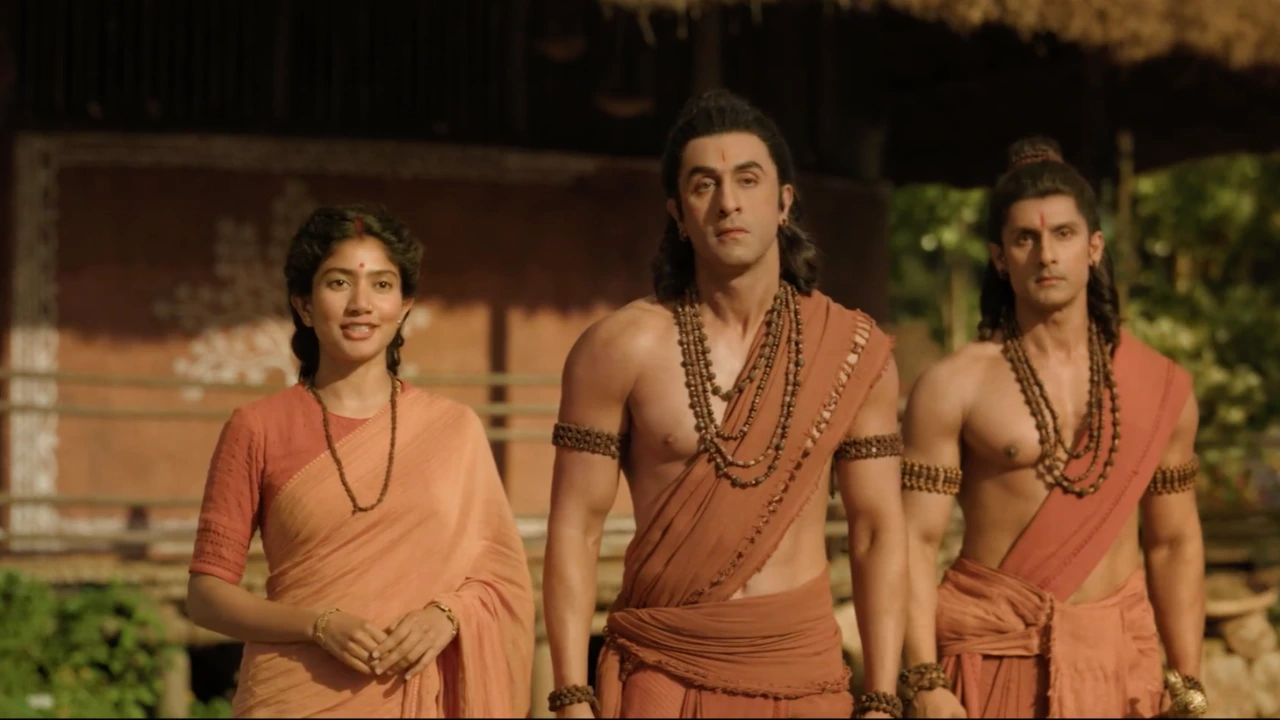
Ranbir Kapoor is 44, and his last great success was "Animal" (2023), a film about a man who cannot stop hurting people. Now he plays Maryada Purushottam, the ideal man, whose greatness lies in what he refuses to do. It may be the hardest role in Indian storytelling, because Rama's virtue is stillness, and stillness on a screen can read as serenity or as absence. Kapoor has always been an actor of interior weather; in "Rockstar" and "Barfi!" we could watch feelings cross his face like clouds over a field. As Rama he is at his best without words, in long looks at a father he cannot disobey and a wife he cannot protect. When he speaks, in a plain, contemporary Hindi the screenplay seems to have chosen for accessibility, the god sometimes sounds less certain than the man should. Some viewers will find a human Rama in that uncertainty. I wanted the film to show us more clearly that the turbulence is there and is being mastered, because the mastering is the whole point of him.
Sai Pallavi, who is 34, first came to wide attention as the teacher Malar in the Malayalam film "Premam" (2015), and she has built a career on declining the glossy artifice of the Indian star, heavy makeup included. Her Sita is no passive companion. She has courage and resolve, and the film lets her defend herself. That is welcome. The trouble is how little time the film gives Sita and Rama simply to talk. Valmiki's couple are companions in thought as well as in love; here, songs stand in for the conversations that might have shown us why this marriage is the axis on which the whole epic turns. The Lakshman Rekha, the protective line drawn around the forest hut, is staged as one more familiar fixture. Curiously, it does not appear in Valmiki at all; it entered the story through later tellings. A film this interested in Sita's agency might have paused to ask what it means to draw a line around a woman for her own good.
Ravie Dubey's Lakshmana brings warmth and a lighter touch, a younger brother who would walk into fire before he let anything reach Rama. Lara Dutta's Kaikeyi has the makings of the film's most complex figure, a queen whose love for her own son hardens into the decision that breaks a kingdom, but her turn comes too abruptly to be understood. Rakul Preet Singh's Surpanakha and Vivek Oberoi's Vidyutjihva add color to Lanka. The real loss is Bharata (Adinath Kothare). In the epic, Rama's younger brother refuses the throne his mother schemed to win for him, places Rama's sandals upon it, and governs as a regent from a village outside the capital, waiting fourteen years for his brother to come home. It is one of the most beautiful acts in Indian literature, a lesson in dharma that needs no arrow and no explosion. The film gives it almost no room.
What the film does have, in abundance, is spectacle, and at its best the spectacle is astonishing. Its palaces and forests are built on a scale that Indian mythological cinema has rarely managed convincingly, and certain sequences have the sweep that has sent early audiences reaching for "The Lord of the Rings." The comparison is not foolish. Not everything works. Some of the asuras look more animated than embodied, the violence of the opening stretches is heavier than a family audience might expect, and the second half, constrained by where the story must stop, stretches its action set pieces past the point of meaning. The score is a meeting of Zimmer's thunder and Rahman's devotion, and when the two agree the effect is overwhelming. When they do not, the music sounds like two great composers being polite to each other.
Here is the deeper difficulty, and it goes back to the poem's first moment. Valmiki, walking beside a river, saw a hunter's arrow strike one of a pair of krauncha birds in the middle of their courtship. The cry of the survivor moved him to speak a curse, and he found as he spoke that his grief had come out in metre: shoka had become shloka, sorrow had become verse. The Ramayana was born from a cry of compassion, and the ninth-century Kashmiri theorist Anandavardhana held that karuna, the rasa of pathos and compassion, is its governing flavor. Tiwari's film is rich in vira, the heroic, and adbhuta, the marvelous; Yash supplies raudra, the furious, by the ton. What the film rations is karuna. There are moments of sorrow, but it keeps hurrying past them toward the next marvel, as if afraid that grief might slow the spectacle down.
The comparison with Peter Jackson is instructive here. What people remember from "The Fellowship of the Ring" (2001) is not the cave troll or the Balrog. It is Boromir dying with arrows in his chest, and Frodo stepping into a boat to go on alone. Jackson understood that a first part must end on grief, because grief is the engine that carries an audience into the second. Tiwari's story hands him exactly that ending: the empty hut, the missing wife, a prince who has kept every promise and lost everything anyway. Part 2 arrives next Diwali. If it can stay inside that grief long enough for us to feel it, the whole may yet be greater than this half.
I said I would come back to Arun Govil. He plays Dasharatha, the old king bound by his word to send his eldest son into the forest, who in Valmiki dies of grief soon after. Govil is past seventy now. His face is weathered, the same face a generation first saw as Rama's on those Sunday mornings in 1987. Thirty-nine years ago he was the prince who walked into the forest. Here he is the father who must stay behind and watch another actor go. For as long as he is on screen, the whole history of how India has told itself this story stands in a single frame, and no visual effects house in the world could have built it.
💬 Discussion
1 comment