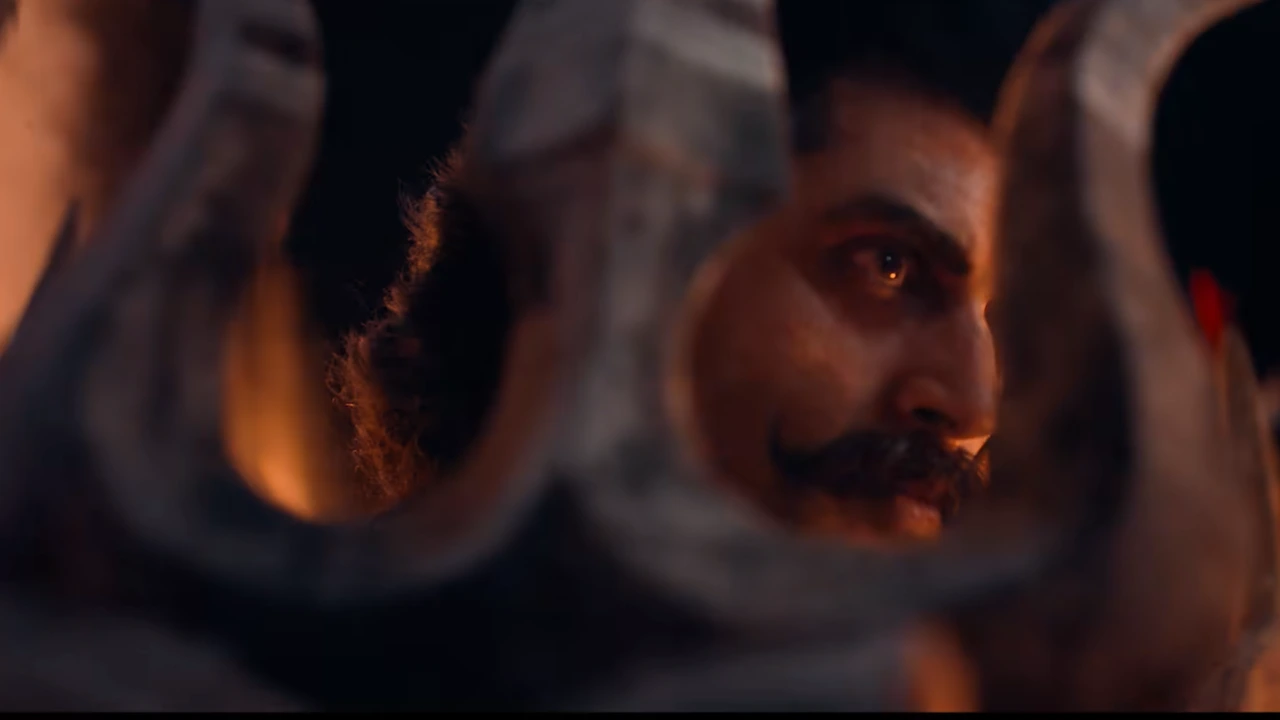
Ranabaali (2026) peaks in a cave. The fight that opens its second half is the film at full stretch: Vijay Deverakonda throwing his entire body into the choreography, the camerawork of Jishnu Bhattacharjee and Nirav Shah at its most assured, the violence finally as visceral as everything before it has promised. It is also the last moment, for a long while, that Rahul Sankrityan's film seems to know where it is going. Everything that makes Ranabaali worth watching, and everything that keeps it from greatness, can be measured from that cave.
The film arrives on Netflix in Telugu, Hindi, Tamil, Kannada and Malayalam four weeks after a theatrical release that divided critics over its length. It is set in Rayalaseema during the Great Famine of 1876–1878, and Deverakonda plays Singanamala Bobbili Ranabaali, a village warrior who turns on a colonial administration that keeps shipping grain out of a starving land. Sankrityan has described the film as alternate history rather than reconstruction, and the label fits: this is a mythic revenge saga raised on top of a real catastrophe, built for fury rather than fidelity. Its failures are failures of the edit, not of conviction. On a streaming service, where a long middle can be paused rather than endured, those failures cost it far less than they did in a single theatrical sitting.
A Star Remade in Rage
Deverakonda sheds the urban, romantic persona that made him a star. His Ranabaali is rugged, dialect-heavy and driven by something closer to primal rage than conventional heroism, and the commitment is total; this is a performance of the body before it is anything else. In the first half that rage is the film's engine. In the second, struck at the same pitch scene after scene, it begins to flatten — less because Deverakonda runs out of range than because the screenplay gives him nowhere new to take it.
Rashmika Mandanna is the film's counterweight as Jayamma, Ranabaali's wife. This is the pair's third film together, after Geetha Govindam (2018) and Dear Comrade (2019) — their first since they married in February — and Sankrityan puts the familiarity to work. Their scenes carry a mature, lived-in ease far removed from the youthful romances of their earlier collaborations, and Mandanna's warmth grounds the film's quieter stretches before the narrative commits itself entirely to war. That warmth is the emotional heartbeat a blood-soaked revenge saga needs, and the film is noticeably poorer whenever it recedes.
Arnold Vosloo, the Imhotep of The Mummy (1999), makes his Telugu debut as Sir Theodore Hector, the colonial commissioner. The part is written as textbook imperial villainy, and nothing in the screenplay complicates it. Vosloo's commanding presence does the work the writing will not: his stillness and towering frame lend Hector a menace the dialogue never earns, and the central conflict gains a weight it would otherwise lack.
A Land You Can Feel
Much of the film's argument is carried by its craft. Bhattacharjee and Shah photograph nineteenth-century Rayalaseema in dusty, sun-scorched tones that make the drought something felt rather than stated; the land itself looks spent. Ajay-Atul's rustic, percussive score does what the duo's music does best, lifting the hero-elevation beats that Telugu audiences call mass moments. The seams show in the Madras port episode, where patchy visual effects puncture the spell the photography casts everywhere else.
The Long Middle
At 178 minutes, Ranabaali is a good film trapped inside a long one. After the cave fight, the screenplay circles a single conflict for far too long, and the middle of the second half turns repetitive and predictable. The sag is not fatal — a fiery, crowd-pleasing climax pulls the film back together — but it is the clearest reason Ranabaali falls short of the epic it so plainly wants to be. Streaming does not shorten the film. It does let a viewer take it in two sittings, and taken that way, the long middle reads as a lull rather than an ordeal.
Why It Earns the Stream
What Ranabaali has that its genre rarely offers is a subject. Indian cinema's colonial dramas tend to gather around the familiar milestones of the freedom struggle. This film reaches back decades before them, to a famine during which, under Lord Lytton's viceroyalty, a record 6.4 million hundredweight of wheat was exported to England while millions in the south starved. The rebellion on screen is Sankrityan's invention; the grain ships were not. A localised uprising against famine policy is a grittier, lesser-told chapter of colonial history than the ones mainstream cinema keeps returning to, and the film deserves credit for choosing it.
The world-building is the other reason. The village deity Bhadra Mallanna, and the mythology Sankrityan threads through his hero's story, place the film in the folklore-soaked lineage of RRR (2022) and Kantara (2022), and its unapologetically raw action choreography suits the material. Viewers who responded to those films will find this one made in their image. With dubbed tracks in five languages, it is also as close to a pan-Indian proposition as a film this rooted in one region can be.
Ranabaali is not a flawless historical epic; a tighter edit would have turned a good film into a great one. But a star vehicle that puts a forgotten famine at its centre, anchors it in a lead performance of real physical conviction and stages a cave fight this accomplished has earned its ambition, if not its length. Take the middle in instalments. The rest is well worth the stream.
💬 Discussion
0 comments