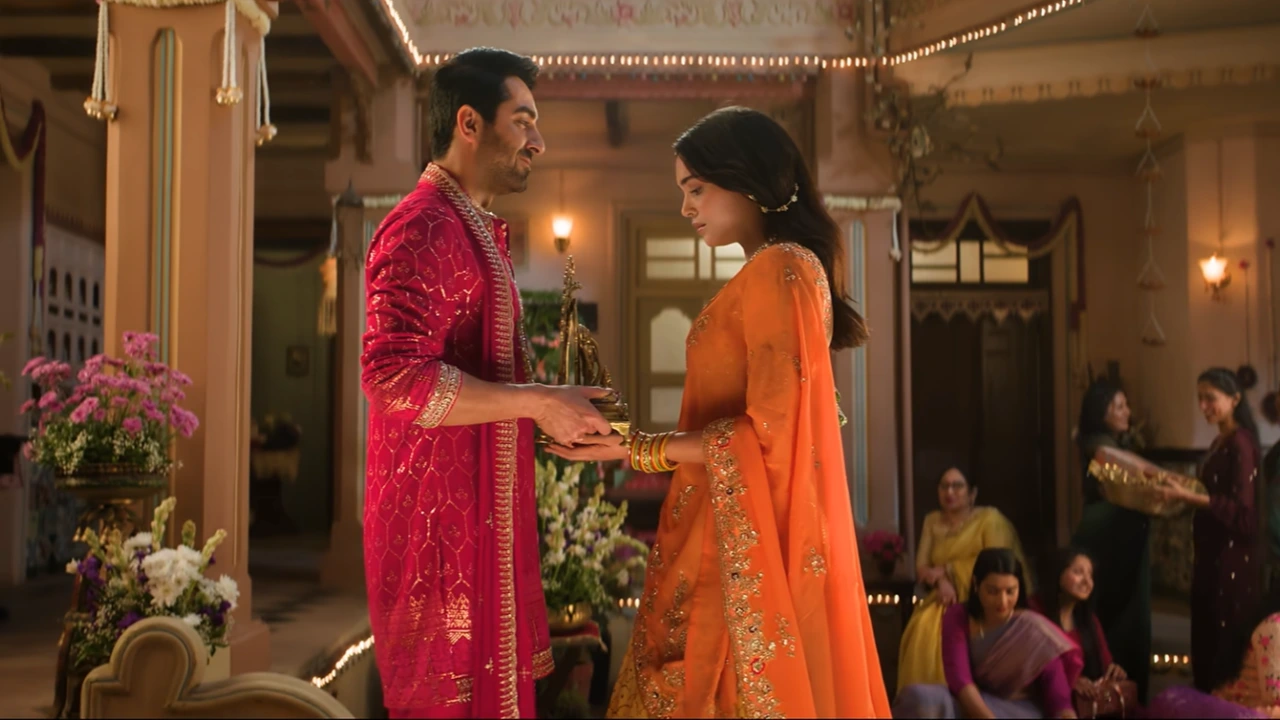
Purva Solanki is the kind of woman who will hold a Mumbai local at the platform so that the vegetable sellers can get their baskets aboard. The railway police would have views on this. Sooraj R. Barjatya does not. In his films a good deed is a form of introduction, and the young man watching from the crowd, a musician from Patna named Prem Mishra, is in love with her before he knows her surname.
He is the first Prem in eleven years. Barjatya has been naming his heroes Prem since Maine Pyar Kiya (1989), and the name has passed from Salman Khan to Hrithik Roshan to Shahid Kapoor and back to Salman for Prem Ratan Dhan Payo(2015). By now it is less a character than an office, like a parish priest: whoever holds it must be gentle, musical, devoted to his elders and incapable of raising his voice to a woman. Ayushmann Khurrana is the new incumbent. He is 42. Sharvari, who plays Purva, is 29.
Khurrana has played a Prem before. In Sharat Katariya's Dum Laga Ke Haisha (2015) he was a sulking dropout who minded a cassette shop in Haridwar and was ashamed of the wife his family had chosen for him. That film ended with him carrying her on his back in a race. The Prem of Yeh Prem Mol Liya has a heavier load. He must carry her household.
Purva will not marry him, and she has her reasons. She is a journalist, and she is also the one who holds together a family of women: two grandmothers (Seema Pahwa and Supriya Pathak), aunts, among them a widow Purva would like to see remarried, and a young girl in her care. If she marries in the usual way, she leaves. If she leaves, the house falls. Prem's answer is the idea the whole film rests on. They will marry, and his family will move into hers.
So the Mishras arrive. There is Ved, the father (Swanand Kirkire), proud and quick to take offence; Gayatri, the mother (Geeta Agrawal Sharma), who has her superstitions and her firm ideas about whose house a woman belongs in; Prem's younger brother; and the grandfather (Anupam Kher), the only one of them who seems to think this is a sensible arrangement. They take up residence in a yellow bungalow that Mumbai's builders have somehow not yet turned into a tower, and they begin, almost at once, to disagree about everything: whether the bhindi should be stuffed or chopped, who controls the remote, how the bills are to be split.
There is a word for a man who lives in his wife's family home. The word is ghar jamai, and in the Hindi heartland it has rarely been said without a smirk. It describes a man who has given something up: his name on the door, his father's authority, the ordinary dignity of being the one who is visited. Barjatya's title, which means roughly "This love, I have bought," asks what the price was and who paid it. I hear in it an echo of Meera, who sang Mai ri main to liyo Govind mol, "Mother, I have bought my Govind," and insisted she had paid the price in the open, to the beat of a drum. Barjatya has borrowed from Meera before; Prem Ratan Dhan Payo takes its title from her Payo ji maine Ram ratan dhan payo. This time the price is paid by the man, in the currency he was raised to value most.
It is worth remembering what Barjatya's cinema has always been built around. Rajshri Productions, the company his grandfather Tarachand Barjatya founded in 1947, has spent nearly eight decades making films about households. Hum Aapke Hain Koun..! (1994), Sooraj's second film and one of the biggest hits Hindi cinema has ever known, was itself a reimagining of Rajshri's own Nadiya Ke Paar (1982). The emotional peak of a Barjatya wedding, and of a hundred wedding videos made in its image since, is the bidaai: the daughter leaves her father's house, and everyone weeps. Yeh Prem Mol Liya turns the bidaai around. The bride stays put. It is the groom's family that packs its trunks.
Purva's reason for staying has an old name too. The classical householder was said to carry ṛṇa, debts: to the gods, to the sages, to the ancestors who made him. Those debts were traditionally a son's to repay. Purva carries them as a daughter, to the women who raised her, and the film's best and most modern idea is that marriage should not be the thing that cancels them. Her hesitation is not played as stubbornness. It is played as responsibility, which is what it is.
Sharvari is the reason that works. She has an unhurried firmness, and she does not raise her voice to make a point; when Purva says no, it lands as a fact rather than a tantrum. Khurrana, who has spent more than a decade as the face of Hindi cinema's social comedies, from Vicky Donor to Badhaai Ho, is an easy fit for a man who is almost too good to be true. He is best in the scenes where Prem absorbs an insult and decides not to answer it. The humiliation stays on his face and out of his mouth.
The supporting cast has the density of a real house. Swanand Kirkire, better known as the lyricist who wrote "Bande Mein Tha Dum" and "Behti Hawa Sa Tha Woh," plays the father as a man whose pride is a wound he keeps reopening. Supriya Pathak is sharp and funny as one of the grandmothers. And there is Anupam Kher, who was not yet 30 when he played a grieving retired schoolteacher in Rajshri's Saaransh (1984), and who now, at 71, plays the grandfather without needing the makeup. He has been part of this family's films for more than forty years. He looks at home.
Himesh Reshammiya, working with Barjatya for the first time since Prem Ratan Dhan Payo, supplies a score that knows what this kind of film needs, including a Chhath song, "Bulaye Chhathi Maa," to remind us that the Mishras' roots are in Bihar. At the music launch, Barjatya spoke of missing the old pleasure of filming songs long enough to run three antaras. He has made a film with room for them.
Now the trouble. At 173 minutes this is the third-longest film Barjatya has directed, and only the second, after Main Prem Ki Diwani Hoon (2003), to be given a U/A certificate instead of his customary clean U. The length tells after the interval, when the house settles into a cycle of grievance, apology and reconciliation that repeats more often than it develops. The romance is quick and idealised; Prem falls for a good deed and Purva for a good man, and neither is given much time to be wrong about the other. Ved behaves badly for most of the film and is let off lightly at the end. And when the quarrels finally escalate into something involving lawyers, they resolve with the smoothness of a family in which everyone, eventually, listens. Barjatya has always believed in that family. Whether you do will decide a good deal of how you feel about the last hour.
Is it, as its admirers will want to call it, a Hum Aapke Hain Koun..! for 2026? Not quite, and that is to its credit. The 1994 film had almost no plot and no villain; its pleasure was simply being inside the house. Yeh Prem Mol Liya has an argument, and an argument is a harder thing to sing and dance around. The old title asked, "Who am I to you?" The new film asks a blunter question, the one every Indian marriage eventually has to answer: whose house is it?
Barjatya's answer is the yellow bungalow. In a city where every old house is a tower waiting to happen, he has found one the developers missed, and he has filled it past capacity with two families who would each rather be somewhere else, and who stay. That has always been his idea of love. This time he has asked the man to carry the luggage.
💬 Discussion
0 comments