Two of the year’s biggest Hindi hits reach streaming on the same Friday, and they could hardly have travelled by more different roads. Drishyam: The Conclusion (2026), widely known as Drishyam 3, is the closing chapter of a franchise whose audience was waiting for it before a single frame was shot. Hanuman Ansh (2026) is a devotional film made on a reported ₹2 crore that struggled to draw audiences when it opened in August, and was carried by word of mouth to more than ₹340 crore at the Indian box office. Watched side by side, they make a surprisingly sharp pair. Both are films about belief. One admires a man who manufactures it; the other asks its viewer to accept it on trust.
Drishyam: The Conclusion on Netflix
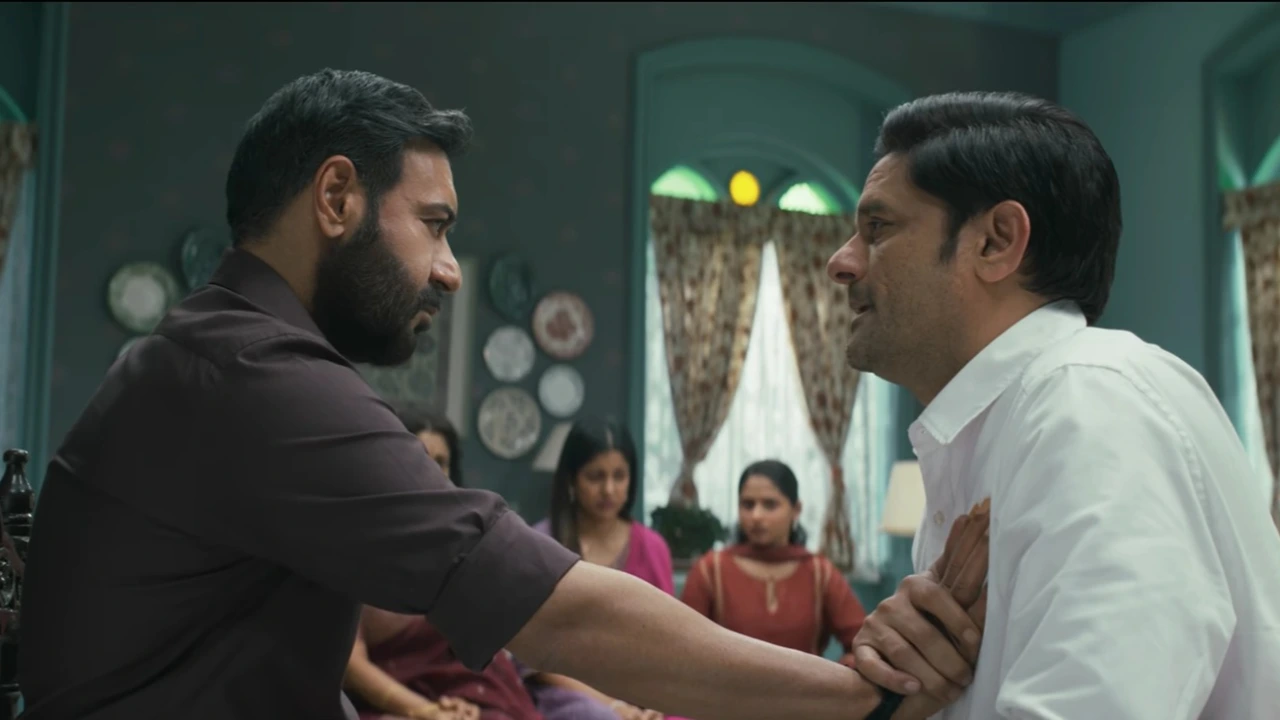
The Drishyam films have always been, at bottom, about watching. Vijay Salgaonkar, the Goa cable-television operator Ajay Devgn has now played across three films, learned everything he knows from the movies, and in Drishyam (2015) he used that education to stage his family’s alibi — bills, tickets, the memories of witnesses — the way a director stages a scene. The title means “visual”, and the franchise’s enduring pleasure is watching a self-taught student of cinema outwit professionals at the business of reading evidence.
The Conclusion, directed by Abhishek Pathak, opened in cinemas on October 2, a knowing wink: that date is the hinge of Vijay’s alibi in the first film. It is also the first Hindi instalment to tell its own story. Where Drishyam and Drishyam 2 (2022) remade Jeethu Joseph’s Malayalam originals, The Conclusion was written fresh by Pathak with Aamil Keeyan Khan and Parvez Sheikh, and runs on a separate track from Joseph’s own Malayalam Drishyam 3 (2026), released in May. The gamble paid: it became the biggest film of Devgn’s career.
What keeps the series honest is that it never lets the audience’s loyalty settle. Vijay is a father protecting his family, and he is also a man burying the truth about a death. Tabu’s Meera Deshmukh is the antagonist, and she is also a grieving mother whose demand for the truth is entirely just. This final chapter adds Jaideep Ahlawat as SP Rajveer Singh Tomar, a new investigator arriving with new evidence, and the pressure he places on Vijay’s carefully constructed story is the film’s engine. Shriya Saran returns as Vijay’s wife, Nandini. The suspense is controlled rather than frantic; it makes the viewer lean forward and test every character’s next move against everything already known.
That is precisely why the film suits the small screen. Drishyam’s twists have always been earned rather than merely shocking — each is planted in plain sight — and streaming hands the viewer the one tool the cinema withheld: the ability to go back and check. Those who saw it in theatres will find a second viewing rewarding for exactly that reason. Newcomers should go in without spoilers, and ideally after the two earlier films.
Hanuman Ansh on SonyLIV
Hanuman Ansh is the year’s least likely blockbuster. Directed by Vishal Chaturvedi and drawn from the life and teachings of Neem Karoli Baba — the saint his devotees call Maharaj-ji, and whom many of them regard as a living part of Hanuman, which is what the title means — it opened on August 7 to thin houses. Shobhinaw Satyaa plays the saint. The audience that eventually found the film did the rest, recommending it to one another until a modest devotional drama became one of the most profitable Indian films of the year.
Its strength is sincerity, which is harder to film than it sounds. At a moment when Indian cinema’s grandest bets on the sacred are measured in visual-effects budgets, Hanuman Ansh declines spectacle. Faith, service, humility and compassion are not ornaments hung on a plot; they are the film’s emotional substance, and its warmth comes from that conviction rather than from any engineered climax. It asks for an open mind, not a shared creed. A viewer need not hold every belief presented on screen for its argument about human goodness to land.
Its route home is as unusual as its box-office run. The Hindi version arrives on SonyLIV sixteen weeks after its theatrical release — twice the window Drishyam: The Conclusion took to reach Netflix — following a cinema run of more than eighty days. On Sunday, November 29, Netflix India adds versions in Telugu, Tamil, Kannada, Malayalam and Gujarati. A film that found its public one cinema at a time now reaches it through two platforms and six languages.
Two Kinds of Belief
The pairing is an accident of the calendar, but an instructive one. Drishyam: The Conclusion is about the power of a constructed story: what people saw can be rewritten by someone who understands how seeing works. Hanuman Ansh is about belief that cannot be constructed, only offered. Pathak’s film makes its audience complicit in a deception it wants to succeed; Chaturvedi’s asks its audience to trust what it cannot verify. One leaves the viewer gripping the armrest, the other leaves a quieter residue of warmth, and both are, in their different registers, studies of what people choose to believe.
Final Word
Few streaming weekends offer two films of such opposite temperament at once, and the choice between them is a matter of mood rather than merit. For controlled, intelligent suspense, start with Drishyam: The Conclusion on Netflix. For something reflective and quietly uplifting, Hanuman Ansh on SonyLIV — or on Netflix from Sunday, in five more languages — is the better evening. The ideal weekend makes room for both: the thriller first, for the tension, and the devotional after, for the calm.
💬 Discussion
0 comments