★★★★★ · Republic of Cinema · Reframe
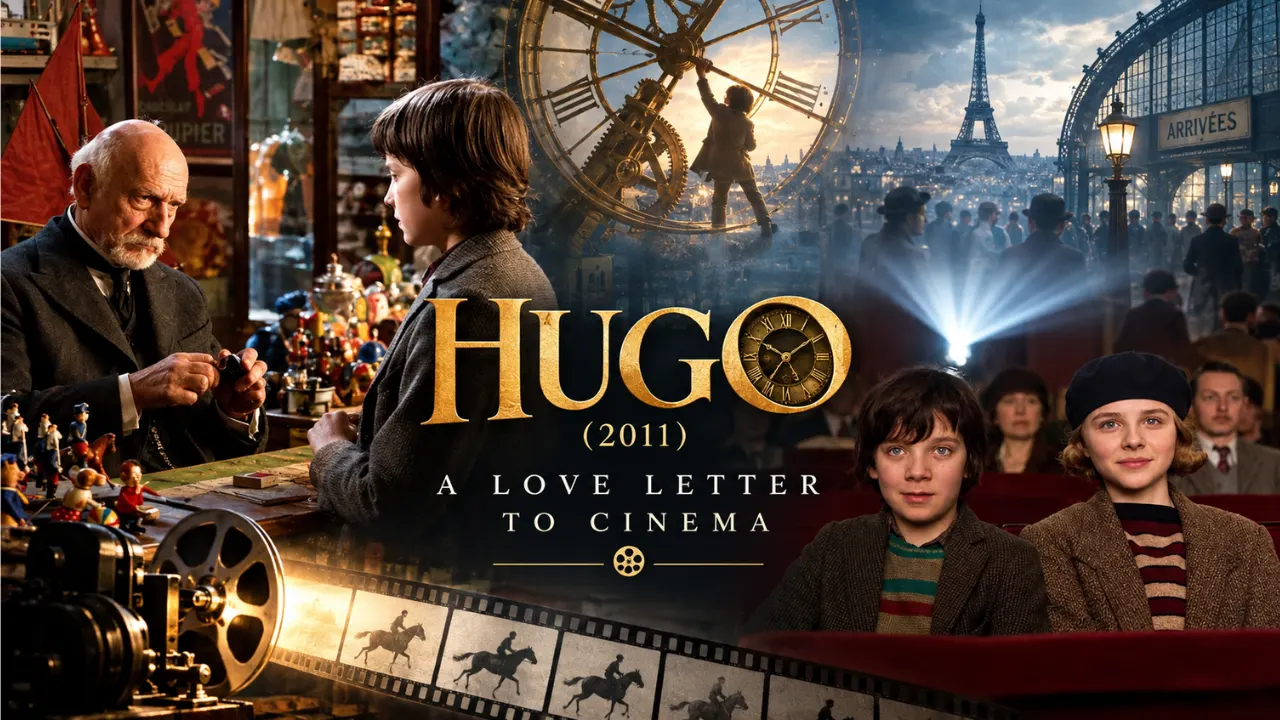
A boy's eye is watching Paris through a hole in the number four.
The shot comes early in Hugo, after the camera has fallen through a snowfall of turning gears into the streets of the city, run alongside a locomotive into the Gare Montparnasse, threaded the crowds on the platform and climbed the wall of the station to a great clock face, where one small pupil is pressed to a gap in the Roman numeral. The boy is looking out. We are looking in. For the rest of the film these two directions of looking will never quite separate.
I have come back to Hugo many times since 2011, and each time it seems less like a children's picture that Martin Scorsese happened to make and more like the film he had been circling his whole life without knowing it. It is a movie about a boy who lives inside a clock. It is also a movie about a man who has been erased, and about the machine that erased him, and about the strange fact that cinema, the medium that promised to make time permanent, has turned out to be one of the most efficient forgetting machines humanity ever built.
Hugo Cabret is twelve, orphaned, unregistered, invisible. His father died in a museum fire. His uncle, the station's drunken clock-keeper, has vanished, and the boy keeps the clocks running because if the clocks stop, someone will come looking, and if someone comes looking, he will be sent away. He steals croissants. He steals milk. He steals small mechanical parts from a toy booth in the station concourse, run by a bitter old man with white hair who catches him one day, empties his pockets, and confiscates a notebook filled with drawings of a broken automaton.
The old man's name is Georges. He is played by Ben Kingsley with a face of such closed, thunderous grief that you know before the story tells you that something enormous has been buried under it.
The automaton is the film's engine and its metaphor. Hugo's father found it abandoned in a museum attic, a seated mechanical figure with a pen in its hand, built to write. Father and son were repairing it together when the fire came. Now the boy repairs it alone, in the dark, in the walls, because he has convinced himself that when the machine writes it will deliver a message from his father. This is not a rational belief. It is the belief of a child who needs the universe to be a mechanism with intentions.
And it produces the line on which the entire film turns. Hugo tells Isabelle, the old man's goddaughter, that machines never come with extra parts. They come with exactly the parts they need. So if the whole world is a machine, he says, he cannot be an extra part. He has to be here for some reason.
That is a child's theology. Scorsese takes it seriously, which is the first sign that this is not a children's film so much as a film that has decided to speak in a child's grammar.
The automaton, when Hugo and Isabelle finally wind it, does not write. It draws. And what it draws is a bullet-shaped rocket lodged in the eye of a scowling moon.
It is drawing Le Voyage dans la Lune. It is drawing Georges Méliès.
Here the film performs its central act of transference. The boy has been searching for his father and finds instead a stranger's abandoned life. The message from the dead turns out to be a message about a man who is still alive and pretending not to be. Everything Hugo believed about broken machines applies, it turns out, to broken people, and specifically to the white-haired man in the toy booth who has spent twenty years insisting that he was never anybody.
To understand why this rearrangement is so moving, and why Scorsese of all directors was compelled to stage it, you have to know something about the man in the booth.
Marie-Georges-Jean Méliès was born in Paris in December 1861, the third son of a prosperous manufacturer of quality footwear. He was expected to inherit a share of the boot factory. He drew caricatures instead, built puppet theatres as a child, and fell in love with stage magic, which in nineteenth-century Paris was not a children's diversion but a species of engineering: cabinets, trapdoors, mirrors, clockwork, mechanical automata that poured tea and wrote verses for astonished audiences.
In 1888, when his father retired, Méliès sold his interest in the family business to his brothers and took over the Théâtre Robert-Houdin on the Boulevard des Italiens, a small jewel of a house founded by the great illusionist Jean-Eugène Robert-Houdin. Two hundred seats. Trapdoors and levitations. Méliès wrote the illusions, designed them, built them and performed them. He also, in these years, drew political caricature for a short-lived weekly run by his cousin, and helped found an academy to give conjurers professional standing so the authorities would stop classifying them with peddlers and vagrants. He was, before he ever touched a camera, a man who manufactured astonishment and then organised it.
In the last days of December 1895 he was in the room when the Lumière brothers showed their Cinématographe in Paris. The sources disagree on the precise evening; the first paying public programme at the Salon Indien of the Grand Café is dated 28 December, and there was a demonstration for invited guests the day before. Méliès's own account places him among the astonished. He said afterwards that he and the others sat with their mouths open. He offered ten thousand francs on the spot for one of the machines. The Lumières turned him down. The story that has hardened into legend is that they told him the invention had no future; whether or not those exact words were spoken, the refusal was real.
So Méliès went to London, bought a projector from the instrument-maker Robert W. Paul, took it apart, and rebuilt it into a camera. By spring 1896 he was showing films at the Robert-Houdin. By the end of that year his first catalogue listed forty-five titles, most of them already built around tricks. In 1897 he built a studio at Montreuil, on the family property, with walls and a roof of glass, so that the sun could light his stage the way gas had lit his theatre.
The founding anecdote of his art, which he told himself in later years and which every history repeats, is that his camera jammed while he was filming traffic near the Place de l'Opéra; when he screened the result, an omnibus had transformed into a hearse. This is the substitution splice, ancestor of every effects shot ever made. It is worth saying plainly that this is Méliès's own retrospective account, tidied by memory into a parable, and historians treat it with the affection one reserves for a good story that may also be true. What is not in doubt is what he did with the discovery. He multiplied it. He built an entire vocabulary out of it: stop-substitution, multiple exposure, dissolves, superimposition, miniatures, forced perspective, matte work, pyrotechnics, and hand-colouring applied frame by frame by teams of women with fine brushes and aniline dyes.
Between 1896 and 1913 he made something in the region of five hundred films. He wrote them, directed them, designed the sets, built the machines, worked on the costumes, and very often acted the leading role himself, the magician in the frock coat gesturing at his own illusions like a conjurer working a room.
Le Voyage dans la Lune, in 1902, was the one that circled the earth. Six astronomers in academic robes are fired at the moon from a cannon; the capsule lands in the eye of a face that winces; they meet the Selenites, who burst in puffs of smoke when struck; they tumble back into the sea and are fished out and paraded home. Fourteen minutes. It is the birth certificate of science-fiction cinema and one of the most pirated objects of its era, duplicated and sold across America by operators who paid Méliès nothing.
Then the world moved. Longer narratives arrived; Pathé and Gaumont industrialised; Feuillade's poetic realism and Griffith's editing changed what an audience wanted a film to be. Méliès never converted his workshop into a corporation, and by around 1907 the decline had begun. His last films, made for Pathé in 1912, failed. His first wife died in 1913. In 1917 the French army requisitioned some four hundred of his prints; the silver was recovered and the celluloid melted down, and the account that has come down to us, with a cruelty almost too neat for fiction, says the material was reprocessed into heels for soldiers' boots.
The son of a bootmaker watched his films become boots.
In 1923 the Théâtre Robert-Houdin was demolished for the rebuilding of the boulevard. Pathé took over the Star Film company and the Montreuil studio. And Méliès, in a rage that historians still find difficult to write about calmly, burned what remained: negatives, sets, costumes, the accumulated apparatus of seventeen years.
By the mid-1920s he was in his sixties and selling sweets and toys from a kiosk in the concourse of the Gare Montparnasse, alongside Jehanne d'Alcy, the actress who had vanished in his illusions thirty years earlier and whom he married in 1925.
He was found there. Not by a boy with an automaton, but by Léon Druhot, the editor of Ciné-Journal, who recognised the old man behind the counter in the late 1920s and began to write about him; and by Maurice Noverre, the first serious historian of French cinema, who visited Montreuil, recorded what Méliès remembered of his studios, and helped organise what followed. On 16 December 1929, at the Salle Pleyel, a gala of rediscovered Méliès films was held in his honour. His granddaughter Madeleine, six and a half years old, was in the audience watching her grandfather's films for the first time.
On 22 October 1931 he was made a Chevalier of the Legion of Honour at a banquet for eight hundred guests at the Claridge. The decoration was presented by Louis Lumière.
In 1932 the industry's mutual society gave him and his wife an apartment at the Château d'Orly, a retirement home for people of the cinema. He died there of cancer on 21 January 1938 and is buried at Père Lachaise. Of the roughly five hundred films, something under two hundred survive.
Now consider the other man.
Martin Scorsese was born in Flushing in November 1942. When the family lost its footing they moved back to Elizabeth Street, into the buildings his parents had been born in, and the boy who arrived there was asthmatic from the age of three and could not run with the other children. He has said it himself, many times: he could not participate, so he observed. He watched from windows, which is one explanation offered for the high, hovering camera positions that recur across fifty years of his work.
Two rooms took him in. One was Old St Patrick's on Mulberry Street, with its candles and its Latin and its promise that a life could be judged. The other was the movie theatre, where his father took him, where he saw Sunset Boulevard and Ace in the Hole and westerns that turned out to be about psychosis, and where the dark did the same work as the church: ritual, transformation, and the sense that something larger than Elizabeth Street existed and could be entered.
He tried the priesthood and did not last. He went to NYU, found Haig Manoogian, and became a filmmaker instead, which for him has never been an entirely different vocation. The films that made his name are about guilt and grace and men who cannot stop themselves, and they were made by someone who had been taught early that images can be sacred objects.
What matters for Hugo is the second career that ran alongside the first. Scorsese became the cinema's most persistent rememberer. He hoarded prints, championed dead directors, harangued studios, and in 1990 founded The Film Foundation with a group of colleagues who had the leverage to be listened to. The foundation has now helped restore well over nine hundred films, by some counts more than a thousand. In 2007 he extended the work outward through the World Cinema Project, on the reasoning that the archives of Senegal and the Philippines and Bengal and Mexico had no Hollywood studio to underwrite their memory. That project has now rescued dozens of films from countries whose cinema the West had never bothered to file.
The numbers that drove him are grim and worth repeating whenever anyone calls preservation a hobby. More than half of all American films made before 1950 are gone. Of American films made before 1929, roughly one in ten survives. This is not metaphor. It is inventory.
So when Scorsese, at sixty-eight, made a 3D family film about a French magician whose negatives were burned and whose prints were melted into boot heels, he was not taking a holiday from his real subject. He had arrived at it.
The temptation is to line the two men up and call them the same man. They were not. Méliès was a showman-engineer who invented a language and then could not survive the industry that language created. Scorsese is a working artist who has spent his career inside that industry, sometimes at war with it, and who has used his standing to build an institution. One was destroyed by forgetting; the other has organised his life around preventing it.
But the parallel Hugo actually proposes is stranger and better. Méliès discovered that cinema could be magic. Scorsese discovered that cinema could be memory. Both discoveries are about the same property of the medium: film takes a thing that happened and detaches it from time. If you can detach an event from time, you can rearrange it, and rearrangement is magic. You can also keep it, and keeping is memory. Méliès took the first road. Scorsese took the second. They are two directions along a single street.
And both men are alive to the machinery. It is not incidental that Méliès built his own camera, or that Scorsese can tell you which laboratory did which restoration and what the emulsion was doing when it decayed. Hugo is full of gears not because gears look handsome in stereoscopic depth, though they do, but because both of its subjects understood that wonder is manufactured. Someone builds it. Someone maintains it. When nobody maintains it, it stops.
Is Hugo Scorsese imagining himself as Méliès's heir? I think it is something more modest and more affecting than that. It is Scorsese imagining himself as the boy. The film's own emotional logic points there: the sickly, watching child who could not join the street, who found in a screen a place where he was permitted to exist, and who grew up to spend his adult life repairing the broken machine he found there. Scorsese has spoken about his feeling for a young character unable to participate, and about how directly that came out of his own childhood. Hugo Cabret keeps the clocks running in secret so that nobody will notice the caretaker is a child. That is not a bad description of a preservationist.
Every film history opens with an opposition: the Lumières recorded the world, Méliès invented worlds. Workers leaving a factory on one side, a rocket in the moon's eye on the other. Documentary and fantasy, born as twins.
It is a useful lie, and Hugo half believes it, as popular histories must. The truth is muddier and more interesting. The Lumière operators composed their views with real care, staged some of them, and dispatched cameramen across the globe to bring back spectacle. Méliès, for his part, made actualités reconstituées, reconstructed news events staged in his studio and sold as records of things that had happened: an eruption, a coronation, an execution. Audiences of 1900 did not sort these into categories the way our textbooks do. The boundary between recording and invention was porous from the first week, which is exactly why the medium has been able to lie so beautifully ever since.
What Hugo does, rather than adjudicate, is inhabit both traditions at once. Its Paris is a fabrication of astonishing thoroughness, a studio city of brass and steam and blue winter light, and it is populated by a station's worth of small realist observation: the flower seller, the café proprietor, the widow with the dachshund, the wounded gendarme whose leg brace squeals, a whole minor society going about its afternoons. Scorsese cuts between the mechanisms behind the clock face and the human traffic in front of it. The film is a fantasy that keeps checking on ordinary people. That is a Lumière instinct inside a Méliès machine.
Twice, Hugo brings a train into a station and lets it come at us.
The first is a nightmare. Hugo dreams that a locomotive fails to stop, bursts through the buffers, crosses the concourse, tears through the wall and falls into the street below in a cascade of glass and iron. It is staged with the full weight of the modern effects arsenal, and it quotes a real catastrophe: in 1895, at that very station, a train overran the platform and went through the facade of the Gare Montparnasse, leaving a photograph so famous it has become a kind of found surrealism.
The second is the memory of the movies themselves. In the film's reconstruction of an early screening, an audience watches the Lumières' L'Arrivée d'un train en gare de La Ciotat and recoils as the locomotive advances.
We should be careful here, and Scorsese's film is not. The story that spectators screamed and fled from the Lumière train is the founding myth of cinema, and it is very probably a myth. The film itself is generally dated to 1895 or early 1896 and does not appear to have been part of that first Paris programme in December. More importantly, the German historian Martin Loiperdinger, in an essay whose title says the thing outright, showed that there are no contemporary reports of panic. The earliest accounts of a fleeing audience appear decades later and are then copied from writer to writer. The room at the Grand Café was small, packed, and turning over hundreds of people every half hour; a stampede would have injured somebody, and the press, which covered these screenings in loving detail, would have reported it.
What the contemporary record does show is astonishment. There are French accounts from the period of viewers marvelling at the power of the illusion, of a vehicle seeming to come toward them, of a woman beside the writer starting up from her seat. And Maxim Gorky, watching in Nizhny Novgorod in 1896, wrote a famous and frightened piece about a kingdom of shadows in which the train seems to rush straight at the spectator. Astonishment, yes. Vertigo, yes. Pandemonium, no.
So why does Scorsese stage the legend as though it were fact?
Because he is not making a documentary about 1896. He is making a film about what it felt like, and the legend is the only surviving witness to feeling. The panic story endures because it encodes something true that the archival record cannot: that there was a moment, briefly, when a projected image had not yet been assigned its category. The audience of 1896 possessed no habit of spectatorship. They had to invent, in real time, the ability to be moved by something they knew was not there. That invention is the birth of the modern viewer, and it happened in a few weeks, in the dark, without anyone writing it down properly.
For a director who has spent his life arguing that films are cultural memory, the temptation to dramatise this is obvious, and I would only ask that the film had found one small gesture to mark the difference between the event and the story about the event. It does not. It plays the legend straight. Call it the one place where Hugo, a film about preservation, prefers the beautiful copy to the original.
And then there is the 3D, which is where the film's argument becomes an experience.
Hugo was Scorsese's first stereoscopic film, and he approached it not as a gimmick to be tolerated but as a property to be studied. He said at the time that 3D changed the actors, that their slightest movements and intentions registered more precisely. Watching it properly projected, what strikes you is that the depth is almost never used to throw things at the audience. It is used to build volume: the cavernous interior of the station, the layered smoke and steam, falling snow that sits in the air between you and the screen, clockwork corridors where the boy moves among gears the size of dining tables.
There is one exception, and it is a joke of the highest order. When the film shows us the train arriving at La Ciotat, it shows it to us in depth. The oldest trick in the cinema, staged with the newest one. Scorsese is telling us that the technology of 1896 and the technology of 2011 are doing the same job. The apparatus changes; the object of the apparatus does not. It has always been about making an image feel present.
There is a genuine irony in a film about Méliès costing between $150 and $170 million, some fifteen of which went to the stereoscopic process. Méliès built his effects out of glass, paint, and the interval between two exposures. Scorsese needed five visual effects houses. But the irony is only on the surface. Méliès used the most advanced instrument of his day to produce astonishment, and his rivals thought him extravagant too. The lineage runs cleanly from a jammed camera at the Place de l'Opéra to a rendered locomotive in a rendered station. Trick, effect, visual effect, dimension. The names change every generation. The purpose is always the same: to make an audience lean forward.
What distinguishes Hugo from the 3D spectacle that surrounded it in 2011 is that its technology is pointed at tenderness. The depth is used most beautifully not in the train crash but in the moment an old man's hand comes to rest on a boy's shoulder, or where dust hangs in the light of a projector beam. Scorsese took the year's loudest format and turned it into an instrument for looking closely at faces.
The film's climax is where a good children's picture becomes something else entirely.
Consider the structure Scorsese and John Logan have built. For an hour and a half we have followed a boy trying to fix a machine so that his dead father can speak to him. And the film simply declines to give him that. The automaton does not deliver a message from the dead. There is no reunion, no vision, no whispered word from beyond. What the machine produces is somebody else's signature.
Hugo's quest is answered by being redirected. He asked to be told that he was not an extra part, and the answer he receives is that another person, a stranger, has been discarded and needs him.
The rescue is staged as a screening. René Tabard, a film scholar who as a boy once visited the Montreuil studio, has kept a print of Le Voyage dans la Lune. He is a fiction. The gathering the film invents around him is a compression of the real rediscovery: Druhot recognising the old man at the kiosk, Noverre reconstructing the studio from memory, the gala at the Salle Pleyel. What Scorsese keeps from the history is the essential shape of the event, which is that a forgotten man was made to sit in a room and watch his own work with people who loved it.
So the projector starts, and the rocket enters the eye of the moon, and Ben Kingsley's face does the work the whole film has been building toward. It is not simple joy. There is something closer to terror in it, the terror of a man who has spent twenty years constructing an argument that his life did not happen, watching the evidence run at twenty-four frames a second in front of witnesses. Then the argument collapses, and what comes through is grief, and then relief, and then a kind of exhausted grace.
And then he says: come into the light. He is speaking to the boy. He is also speaking to himself.
Scorsese ends on a formal celebration: a gala, an announcement that some eighty of Méliès's films have been found and restored, an old man in a tailcoat before an audience. And then the film does something I find almost unbearably fine. It gives Méliès his stage back. He steps up as a showman, gestures, and the crowd turns from the screen to look at the living man who made what they have just seen.
Four rescues occur in the same twenty minutes, folded into one another.
Hugo is saved from vanishing into an orphanage. Méliès is saved from obscurity. The films themselves are saved from disappearance. And cinema's memory of its own beginning is saved from the ordinary indifference that lets a medium eat its own founders.
That is why the climax lands with a force out of all proportion to its material. It is not a plot resolution. It is a restoration in the technical sense the word carries in an archive: the recovery of something whose original elements were damaged, using every available means, in the belief that the object is worth the labour. Scorsese restores a person the way his foundation restores a negative. Dignity, authorship, identity, the right to have been someone. These turn out to be preservable, and the film argues that they are preserved by a single act: showing the work to an audience.
A film that is never screened is not saved. A person who is never recognised is not either.
Underneath all this runs the metaphor of the orphan, and Scorsese uses it with a rigour the genre does not require.
Hugo is an orphan in the literal sense. Isabelle is one too. So, we learn, is the station inspector, raised in an orphanage, whose absurd cruelty toward stray children is the reflex of a man persecuting his own past. Even the automaton is an orphan: a machine whose maker abandoned it, found in an attic, its purpose unknown until somebody bothers to wind it.
And Méliès is the orphan of cinema. Not a child who lost a father but a father who lost his children: an artist severed from a medium he helped invent, whose works were physically destroyed, whose name survived for a while only as a footnote. There is a term of art in the archives for films whose rights-holders cannot be traced. They are called orphan works, and they are among the hardest things to save, because nobody has standing to save them. Méliès in his kiosk is an orphan work.
So does Hugo save Méliès, or does Méliès save Hugo?
The film's answer, and the reason it is more than sentimental, is that neither rescue could occur alone. Hugo cannot start the automaton without the heart-shaped key Isabelle wears, which came from Méliès's household. Méliès cannot be restored without the drawing the machine produces. The boy needs someone to be useful to; the old man needs someone to be remembered by. Purpose, in this film, is not a property a person carries inside himself. It is something that exists only between two people, which is why the boy's theory of machines is both true and incomplete. A spare part is only spare until it finds the mechanism it belongs to.
At this point it becomes impossible to separate the film from the man who made it, and I do not think Scorsese wanted us to.
The destruction of Méliès's films is not simply a sad fact in a biography. In a Scorsese picture it is the fundamental crime. Nitrate decomposes; it shrinks, goes sticky, turns to brown powder, and in the right conditions burns with an enthusiasm no fire door will hold. Colour stock fades. Studios junked negatives to save storage costs. Archives lacked funds. War requisitioned silver. And the industry, for most of its history, regarded last year's product as waste.
The result is the arithmetic quoted earlier: the majority of American films before 1950 gone, nine-tenths of the pre-1929 silents gone. Not lost in the sense of misplaced. Gone in the sense of chemically no longer existing.
Hugo asks the question directly, though it never phrases it as a question: if a film disappears, does a part of human memory disappear with it?
I think the honest answer is yes, and that the loss is of a specific and irreplaceable kind. A film is not only a story. It is a recording of faces that no longer exist, of streets that were demolished, of gestures and postures and manners of speech that belonged to a decade and then stopped. When the last print of a 1913 film decays, we do not merely lose a narrative we could reconstruct from a synopsis. We lose the only remaining evidence of how certain people moved.
This is the argument Scorsese has been making in speeches and letters and interviews for four decades, and here he makes it in the only language that reaches everyone. He puts it in a story about a boy and a broken toy, and he lets a family audience discover, somewhere around the ninety-minute mark, that they have been watching a manifesto.
There is a coincidence attached to all this that I still find hard to credit. In the same year Hugo was released, the hand-coloured print of Le Voyage dans la Lune had its restored premiere at Cannes. A colour copy had turned up in 1993 in Barcelona, donated to the Filmoteca de Catalunya, decomposed into a solid mass that experts judged beyond repair. Lobster Films acquired it, spent two years peeling and digitising fragments, then left the data on a hard drive for eight years because the technology to finish the job did not yet exist. When it did, a team reassembled 13,375 individual frames, and in May 2011, a hundred and fifty years after Méliès was born, an audience on the Croisette watched the rocket hit the moon in the colours the women of Montreuil had painted on by hand.
So the year Scorsese released a film about the rescue of Méliès, Méliès was actually rescued. Hugo is not describing a hypothetical. It is a dramatisation of something that was happening in the same months, in a laboratory, without a boy or an automaton, performed by archivists.
The craft deserves its own paragraph, because Hugo is one of the most beautifully made films of its decade, and it won five Academy Awards in exactly the departments that carried its argument: cinematography, art direction, sound editing, sound mixing, visual effects.
Robert Richardson lights the station like a cathedral with a timetable, cutting hard shafts of white through the smoke, and gives the interior of the clock tower a hot amber glow that makes the boy's hiding places feel like the inside of a lantern. Dante Ferretti and Francesca Lo Schiavo build a Paris that never was and make you believe every rivet of it; the skyline glimpsed from the clock face is composed as a deliberate echo of René Clair's Sous les toits de Paris. Thelma Schoonmaker cuts the chases in the rhythm of silent slapstick, all forward propulsion and geometry, then slows to something almost motionless for the scenes of Kingsley's face. Howard Shore writes a score full of clockwork and accordion. Sandy Powell dresses the flashbacks in the greens and golds of a hand-tinted frame.
The homages are not decoration. When Hugo escapes along the minute hand of the station clock, he is re-enacting Harold Lloyd in Safety Last!, a clip of which the children have just watched in a cinema. The dream of the runaway locomotive nods both to the 1895 photograph and to Renoir's La Bête humaine. Clips from The Kid, The General and Les Vampiresrun in a library scene, played to a 2011 multiplex audience that in many cases had never seen them. Scorsese smuggled a silent-film survey into a Thanksgiving release.
Best of all is the extended flashback to Montreuil. The glass studio is rebuilt, the sun pours through it, and we watch Méliès at work: painted backdrops, giant puppets, mermaids, trapdoors, frame-by-frame colouring, the man in the frock coat conducting his own chaos. Scorsese reconstructs shots from the actual films and intercuts genuine Méliès material, so that recreation and original sit in the same sequence. He does not explain early cinema to us. He builds it in front of us and lets us feel the labour and the joy in it at once. Very few films have shown filmmaking as work and as delight simultaneously, and none has done it about a filmmaker this far back.
The historical liberties should be named. Méliès's real family is largely absent: his first wife Eugénie, who was married to him throughout the filmmaking years and died in 1913; his children Georgette and André; his brother Gaston, who ran the American arm of Star Film. The film shows Jehanne d'Alcy as his wife during the studio era, though they married only in 1925. Tabard is invented. The decline is compressed into the Great War, when in truth it began around 1907, in a shift of industry and taste. These are the ordinary compressions of biographical fiction, and most of them cost us nothing. The one that costs something is the family, because Méliès's real life contained more people who loved him than the film's lonely-magician structure can accommodate.
What is Hugo finally about?
It is about the human need to be necessary. That is the boy's theory of machines, and the film tests it in every direction. A machine with a broken part is not a broken machine; it is a machine waiting. A man who has been discarded has not stopped being what he was; he is a mechanism whose purpose is temporarily unavailable. Purpose, the film argues, is not discovered by introspection. It is discovered by being needed by somebody, and it can be lost, and it can be given back.
Set against that is the film's clear-eyed understanding of what time does. Clocks are everywhere in Hugo, and they are not friendly. They are the machinery of forgetting, ticking in the walls, requiring constant maintenance by an unseen child so the station will keep believing in its own order. Nitrate decays. Theatres are demolished. Boulevards are rebuilt. The films become boot heels. The default state of the past is disappearance, and the only force opposing it is somebody's stubborn, unpaid, mostly invisible labour.
That is the deepest thing the film knows, and it is why the metaphor of the caretaker matters even more than the metaphor of the orphan. Hugo winds the clocks because if he stops, the machine stops. Scorsese has spent thirty-five years winding the clocks of an art form that would otherwise have let a good portion of itself rot. He is not sentimental about this. He has said often that preservation is a race, and that in places without archives or money it is being lost.
There is a persistent view that Hugo is an anomaly in Scorsese's filmography, the one where the poet of violence made a PG picture with a child hero and a friendly dog. I have never understood this view. It is the least characteristic Scorsese film on the surface and one of the most characteristic underneath.
His subject has always been men consumed by a devotion that will not release them. Priests, boxers, gangsters, gamblers, Jesuits in Japan, a comedian who wants to be loved on television. Faith and obsession are the same substance in his work, differing only in what they attach themselves to. Hugo simply names the object of his own devotion and puts it in the middle of the frame.
It also contains, quietly, the most personal image he has ever staged. A frail boy who cannot go outside watches the world from a high window and learns to look. Everything Scorsese has said about his asthma and his childhood is in that shot, and the film's central act of love, an adult rescuing an old artist from erasure, is a self-portrait of the sixty-eight-year-old man behind the camera.
Hugo lost money. It took about $185 million worldwide against a budget of $150 million or more, and its production company absorbed a serious loss. Eleven Academy Award nominations and five wins did not make it a hit, and a certain kind of commentary has treated the failure as evidence that the film misjudged its audience. I would put it differently. The commercial failure is part of the subject. This is a picture about how the marketplace disposes of things it can no longer sell, made by a man who knows precisely how that happens, and it was duly disposed of. In fifteen years it has been quietly reassessed by exactly the constituency it was made for, which is what happens to work that outlives its opening weekend.
So why does Hugo matter?
Not because it is a children's adventure, though children love it. Not because it is a reliable history of early cinema, since it is only intermittently that, and it prefers the legend of the train to the record of the train. Not even because it is a tribute to Georges Méliès, though it is the most loving one anyone has made.
It matters because it is the only major film I know that treats the memory of cinema as a moral obligation and then makes that obligation felt as pleasure. It converts an archivist's argument into an emotion a twelve-year-old can have. That is an extraordinarily difficult thing to do, and almost nobody has tried.
Think of the geometry of it. In 1896, a train arrives at La Ciotat, and something that has never happened in human history happens: an audience sits in the dark and watches time that has already passed. In 1902, a man who was supposed to make boots fires a rocket into the eye of the moon and discovers that this new machine will also lie beautifully. In 1917, four hundred prints go into a vat and come out as footwear. In the late 1920s, an old man at a station kiosk is recognised by a journalist. In 1938, he dies. In 1993, a decomposed reel of colour turns up in Barcelona. In 2011, it is reassembled frame by frame and shown at Cannes; and in the same year, a boy in a clock tower on a screen in a multiplex watches a rocket hit the moon and goes looking for the man who put it there.
And on the far side of all of it, an asthmatic child from Elizabeth Street who was taken to the movies because he could not play in the street sits in a chair at a studio outside London and directs the reconstruction of a glass workshop in Montreuil.
The last image Hugo leaves me with is not the gala or the automaton or the train. It is the beam. Dust turning in a shaft of light between a projector and a screen, in a room where a very old man is watching something he made when the world was new, and everyone in the room is watching him watch it.
When Scorsese looks back at Méliès, he is not looking at the past. He is looking down the length of that beam at the origin of the light he has stood in his whole life, and telling us, with all the machinery at his disposal, that somebody has to keep the projector running.
Credits
★★★★★ · Republic of Cinema · Reframe
Hugo (2011). Directed by Martin Scorsese. Screenplay by John Logan, based on the novel The Invention of Hugo Cabretby Brian Selznick. Produced by Graham King, Timothy Headington, Martin Scorsese and Johnny Depp. Cinematography by Robert Richardson. Production design by Dante Ferretti. Set decoration by Francesca Lo Schiavo. Costume design by Sandy Powell. Edited by Thelma Schoonmaker. Music by Howard Shore. Visual effects supervised by Rob Legato and Ben Grossmann; special effects by Joss Williams.
With Asa Butterfield (Hugo Cabret), Ben Kingsley (Georges Méliès), Chloë Grace Moretz (Isabelle), Sacha Baron Cohen (Station Inspector), Helen McCrory (Mama Jeanne), Michael Stuhlbarg (René Tabard), Ray Winstone (Uncle Claude), Emily Mortimer (Lisette), Christopher Lee (Monsieur Labisse), Frances de la Tour (Madame Emilie), Richard Griffiths (Monsieur Frick) and Jude Law (Hugo's Father).
Production companies: GK Films, Infinitum Nihil. Distributed by Paramount Pictures. Rated PG. 126 minutes. Premiered at the New York Film Festival, 10 October 2011; released in the United States, 23 November 2011.
Eleven Academy Award nominations; five wins — Cinematography, Art Direction, Sound Editing, Sound Mixing, Visual Effects.
💬 Discussion
0 comments