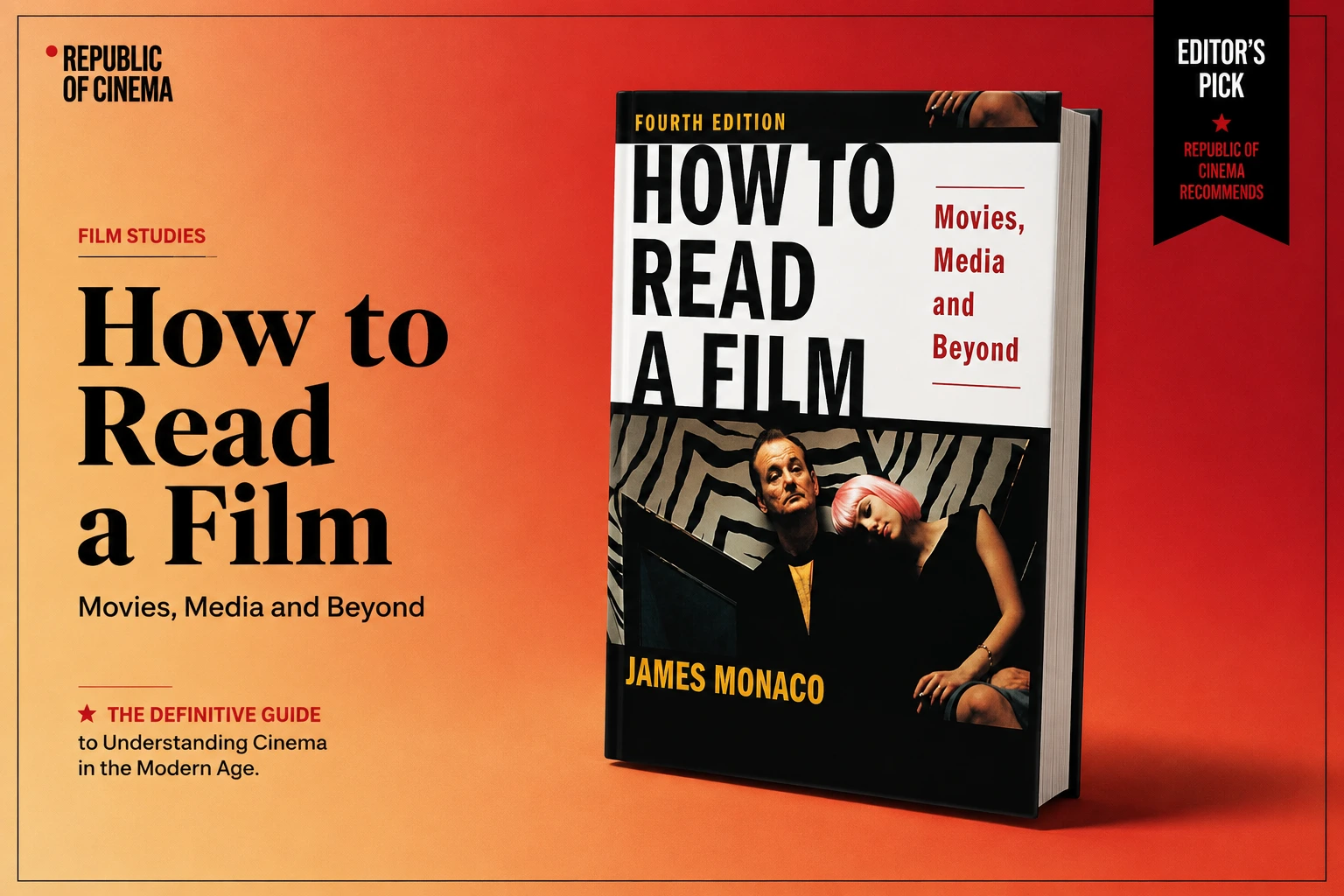
A Book That Teaches You How to See
When James Monaco published How to Read a Film in 1977, he did something that, in hindsight, looks almost obvious — and yet, before he did it, no one had quite pulled it off in the same way. He took the entire universe of cinema, with all its technical machinery, its theoretical debates, its history, its grammar, and its cultural weight, and folded it into a single book aimed at the ordinary, intelligent reader. It was a textbook that didn’t behave like a textbook, a work of theory that refused to be jargon-bound, an introduction that doubled as a serious intellectual statement.
The title itself was a quiet provocation. We read literature. We read paintings. We read music with our ears. But for most of the twentieth century, audiences sat in cinemas, watched moving images, and never really paused to ask whether what they were doing might be a form of reading too. Monaco’s argument, woven through every page of the book, is that watching a film is far more active, far more interpretive, and far more language-like than most viewers realize. When a close-up cuts to a wide shot, when music swells beneath a silence, when a character is framed in shadow or light, when a camera holds a beat longer than it should — meaning is being made. Not by accident. By design.
To read a film, Monaco insists, is to recognize that design, to follow it, to push back against it, to understand the choices that have shaped what we see. To watch without reading is to consume; to read is to think. That single shift in attitude is what has made How to Read a Film one of the most important introductions to film language ever written.
Who Is James Monaco?
James Monaco came to film writing from a slightly unusual angle. He was not, strictly, a European-style academic theorist. He was a critic, historian, and entrepreneur — a polymath who founded the media company Baseline, edited important works of film reference, and devoted his career to building bridges between scholarly thinking about cinema and the everyday viewer who simply wanted to understand what they had just watched. Among his other books are American Film Now, a major study of New Hollywood, Alain Resnais, The Encyclopedia of Film, and The Connoisseur’s Guide to the Movies.
What runs through all of Monaco’s work, and what makes How to Read a Film so distinctive, is a refusal to accept the false divide between popular criticism and serious theory. He writes as though he believes — and clearly does believe — that thinking carefully about cinema is something any curious adult can do, given the right tools. The book reflects that conviction on every page. It is rigorous without being austere, ambitious without being intimidating, and learned without becoming a name-dropping performance. It is the work of a teacher who genuinely wants you to come away with something.
Cinema as a Language
The intellectual spine of How to Read a Film is the careful, patient argument that cinema is a language, but a peculiar kind of language. Monaco is precise here. He is not claiming that film is a language in the strict linguistic sense, with a fixed vocabulary and a rigid grammar. Cinema has no equivalent to the noun or the verb in any tidy way. What it does have, Monaco argues, is a system of codes — visual, aural, cultural, technological — that filmmakers manipulate and that viewers learn, mostly unconsciously, to interpret.
He returns to a useful distinction. Spoken and written language are arbitrary systems, where the connection between the word “tree” and the object it refers to is purely conventional. Cinema is not arbitrary in the same way. When we see a tree on screen, we see a tree. The image is iconic — it resembles its referent. This makes film, in some ways, easier to read than language. But it also makes the cinematic experience deceptively transparent. We assume we understand what we are seeing because the image looks like the world. We forget that someone chose the angle, the lens, the duration, the cut, the sound. Cinema’s resemblance to life is what disguises its artifice. Monaco’s project, more than anything else, is to undo that disguise.
Film Language and Cinematic Grammar
From this central idea grows a sustained, beautifully patient discussion of the grammar of cinema. Monaco walks the reader through the elemental vocabulary — the shot, the scene, the sequence — and then through the choices that animate them. The framing of an image, the lens chosen, the depth of field, the height and angle of the camera, the movement or stillness of the apparatus, the duration of the take. Each decision is a unit of meaning. The close-up implies intimacy or scrutiny. The high-angle shot can dwarf its subject. The long take asks the viewer to stay, to inhabit, to feel time pass. The cut accelerates, condenses, juxtaposes.
What makes Monaco’s treatment of cinematic grammar so effective is that he never reduces these techniques to a checklist. He resists the temptation to give the reader a formula. Instead, he reads films across genres, periods, and national cinemas to show how technique becomes expression. A shot is not simply low-angle, so the character looks powerful. It is low-angle in this film, at this moment, against this score, after this cut, in this story. Meaning is always contextual, always relational. He teaches the grammar without ever pretending that grammar alone produces art.
Signs, Symbols, and Semiotics
One of the most demanding and most rewarding stretches of the book is the chapter on signs and semiotics. For many readers, this is their first encounter with names like Ferdinand de Saussure, Charles Sanders Peirce, Christian Metz, and Roland Barthes. Monaco does not pretend the material is easy, but he is unusually good at translating it. He distinguishes the iconic sign, which resembles its referent, from the indexical sign, which is physically connected to it — a footprint, a shadow — from the symbolic sign, which is purely conventional, like a national flag. Cinema, Monaco shows, draws on all three. A photograph of a tree is iconic. The bullet hole left by a gunshot is indexical. The hammer and sickle is symbolic. A great film weaves them together.
The most powerful idea Monaco lifts from semiotics is the distinction between denotation — what an image literally shows — and connotation — what it culturally and emotionally implies. A man in a long black coat walking through an empty street denotes only those literal things. But the connotation — loneliness, threat, mystery, romance — depends on the codes the viewer brings to the image. Cinema is meaning made at the meeting point of image and viewer. This is the book’s quiet philosophical heart: a film is never finished on the screen. It is finished, again and again, in the audience’s mind.
Editing and Montage
When Monaco arrives at editing, he is on territory where film studies has always been at its most intense. He summarizes the historic argument between mise-en-scène and montage — the long-take realism associated with André Bazin and Jean Renoir, set against the radical cutting of Sergei Eisenstein and the Soviet montage school. He shows how the Kuleshov effect, that famous experiment in which the same shot of a face takes on completely different meanings depending on what is intercut with it, is not a parlour trick but a foundational discovery about how cinema generates meaning.
Editing, for Monaco, is the place where film becomes most clearly its own art. A novel cannot cut. A photograph cannot cut. A painting cannot cut. The juxtaposition of two images to create a third meaning that exists in neither — this is cinema’s unique gift. Monaco walks through continuity, discontinuity, parallel cutting, the jump cut, and the long take, but always with the same underlying question: what is the cut doing to the viewer? What relationship is it forging between images, between characters, between time and feeling?
Cinematography, Sound, and the Audiovisual Whole
A common mistake among beginner cinephiles is to think of cinema as a visual medium. Monaco takes care to dismantle that assumption. Cinema is audiovisual. Image and sound are not two parallel streams; they are a single, fused experience. Music can transform a neutral image into tragedy. Silence can make an ordinary moment unbearable. The texture of a voice, the ambient hum of a room, the foley of a footstep on gravel — all of it is part of what we read when we watch.
The cinematography chapters are similarly attentive. Monaco shows how lighting is not decoration but argument, how the choice of a wide-angle lens distorts space and emotion, how color and black-and-white are not neutral choices but ideological ones. The visual storytelling thread woven through the whole book never lets the reader forget that every frame is a decision, every decision a position taken.
Narrative and Structure
Monaco devotes serious thought to how films tell stories. He distinguishes the underlying story from the way it is told — what Russian formalists called fabula and syuzhet — and shows how filmmakers structure time, withhold information, manipulate point of view, and build, or refuse to build, suspense. He is generous to the classical Hollywood narrative model while showing how European modernism, documentary, and experimental cinema have broken, bent, and rebuilt those rules. The discussion of narrative is one of the places where Monaco’s range pays off most clearly: he can speak of Hitchcock and Resnais on the same page without flattening either.
Technology and the Evolving Medium
What makes How to Read a Film so unusually durable is its insistence that cinema cannot be understood apart from the technology that produces it. Monaco was always, from the first edition, deeply attentive to the apparatus — film stock, lenses, sound recording, projection, exhibition. He explains the chemistry of celluloid, the physics of the camera, the engineering of sound, with the care of someone who believes that the material conditions of an art are part of its meaning.
This is also why successive editions have been so important. Each major revision has expanded the treatment of new technologies: the arrival of video, then digital cinema, then computer-generated imagery, then high-definition television, then streaming, then mobile screens and social platforms. Monaco rewrote and extended the relevant chapters again and again, refusing to let the book ossify. The most recent editions feel less like updates and more like extensions of the original argument — cinema is a living medium because the technology that makes it is alive.
Cinema, Television, and the Digital Continuum
One of the most underrated achievements of the book is its insistence on treating film, television, and digital media as parts of a single continuum rather than as rival arts. The chapter often titled “Media” or “Multimedia” places cinema in the long history of communication forms — print, theater, painting, photography, music, recording, broadcasting, the computer. Monaco refuses the snobbery that elevates cinema over television, or cinema over YouTube, or cinema over the streaming platform. Each medium has its own grammar, its own economy, its own sociology. Each can be read.
For anyone working today as a YouTuber, an essayist, a video creator, or a streaming-platform filmmaker, this part of the book lands with surprising relevance. The cinematic literacy Monaco builds is not confined to the multiplex. It is a way of seeing that travels into every screen we now look at.
Film Criticism and Interpretation
The chapters on film theory and criticism are a tour through a contested intellectual landscape: formalism, realism, auteurism, structuralism, post-structuralism, feminist film theory, ideological criticism, and cognitive approaches. Monaco does not pretend to be neutral, but he is fair. He gives each tradition its proper weight, shows the questions it can answer, and indicates the questions it cannot. The reader emerges with a working map of the field — not enough to write a dissertation, but enough to read a serious film essay and know what is being argued and why.
Cinema, Culture, Politics, and Society
Cinema, for Monaco, is never only art. It is industry, ideology, and culture. A film is a commodity produced under specific economic conditions, distributed through specific systems, watched in specific places, by specific audiences who carry specific histories. The book is unflinching about this. It traces how Hollywood became Hollywood, how national cinemas have negotiated American dominance, and how representation on screen shapes — and is shaped by — political reality.
The treatment of race, gender, class, and nation is not the sharpest in the literature, and later writers have gone deeper, but Monaco’s basic insistence that no film is innocent of its context remains one of the book’s most valuable lessons. To watch a film and not see the country, the studio, the decade, the money, and the politics around it, he suggests, is to read only half of what is in front of you.
Why the Book Became Foundational
There are several reasons How to Read a Film has remained, decade after decade, a fixture in film school syllabi around the world. The first is sheer scope. Few books even attempt to cover technology, theory, history, criticism, and aesthetics within one cover. Fewer still succeed. The second is accessibility. The prose is clear, even when the ideas are demanding. The third is generosity. Monaco respects the reader. He never plays the gatekeeper, never makes the field feel like an exclusive club. The fourth is durability. The book has been revised, expanded, illustrated, and translated into many languages. It has become, in the truest sense, a basic library item for anyone serious about cinema.
Monaco’s Style and Teaching Approach
There is a particular kind of pleasure in Monaco’s writing that is hard to describe and easy to recognize. He is a teacher who thinks out loud. He digresses, but the digressions land. He brings in painting, music, philosophy, and politics, but never to show off. The illustrations — often hand-drawn diagrams, comparative film stills, charts of camera movements and lens angles — are the work of a writer who knows that some ideas can only be shown. The chapters build on each other but do not punish the reader for jumping around. You can dip into the semiotics section, then read the technology chapter, then return to the editing material, and feel that the book is patient enough to wait for you.
Strengths
The greatest strength of How to Read a Film is that it changes how you watch. After working through it, the reader cannot un-see what they have learned. A close-up is no longer just a close-up. A cut is no longer just a cut. A swell of music is no longer just emotion delivered to you; it is a choice made on your behalf, which you can now accept or resist. The book builds, in the best sense, a cinematic eye and a cinematic ear. It develops what one might call visual intelligence — the capacity to think with and against the image, rather than simply absorbing it. For anyone who wants to direct, write, produce, edit, critique, or simply love films more deeply, this is an unmatched foundation.
Limitations
It would be dishonest to pretend the book is without difficulties. The semiotics chapter, in particular, can be heavy going for a complete beginner, and some readers will need to slow down or read it twice. Certain passages, especially in the older editions, show their age — some references to technology have inevitably been overtaken, and some critical frameworks have shifted under the weight of decades of newer scholarship. Readers looking for the cutting edge of feminist film theory, postcolonial cinema studies, or platform studies will need to supplement Monaco with more recent work. The book is a foundation, not a finish line. It is also, frankly, long. Reading it cover to cover is a commitment. But it rewards that commitment as few film books do.
Why Every Filmmaker and Cinephile Should Read It
For the aspiring filmmaker, this is a book that teaches you the materials you are working with. You cannot write a script intelligently if you do not understand how the eventual cut will read it back to an audience. You cannot direct if you do not know what the camera is doing to your scene. You cannot produce wisely if you do not understand the industrial and technological context in which your film will live. For the critic and the YouTuber, the book gives you a vocabulary, a set of questions, and a sense of intellectual humility. For the cinephile, it deepens love into understanding. To put it plainly: How to Read a Film is the kind of book that, once read, ruins all lazy ways of watching.
Final Verdict
James Monaco’s How to Read a Film is not merely a book. It is a curriculum, a manifesto, and a quiet act of faith in the seriousness of cinema and the intelligence of its audience. It is essential reading for anyone who wants to make films, write about films, or think about why moving images matter so much in the modern world. In an era of infinite scroll, algorithmic feeds, vertical video, and disposable spectacle, the book’s central plea is more urgent than ever: pay attention, learn the language, become a literate viewer.
If Republic of Cinema is a library, How to Read a Film sits at the front of the first shelf. It is the kind of book you return to — the kind that, decades after the first reading, still has something to teach you. And that, perhaps, is the highest compliment one can pay to a book about cinema. Like the best films themselves, it gives more on every viewing.
Buy Now: https://link.amazon/B0gSlIRbv
💬 Discussion
0 comments