Rating: ★★ (out of 4)
Director: Balaji Mohan Producers: Aanand L. Rai, Himanshu Sharma Studio: Colour Yellow, Amazon MGM StudiosWriters: Himanshu Sharma, Divy Nidhi Sharma Music: G.V. Prakash Kumar Cast: Yami Gautam Dhar (Mohini), Addinath M. Kothare (Raja Awasthi), Anurag Thakur (Bantu Awasthi), Mita Vashisht, Sunita Rajwar, Aaditya Kulshreshth, Sushmita Mukherjee Certificate: UA 16+ Runtime: 138 minutes Language: Hindi Release Date: 16 October 2026 (theatrical)
Bantu Awasthi (Anurag Thakur) has called a family meeting. He has evidence. He has kept a record of the last few months: every small miracle since his brother's new wife arrived, every unexplained stroke of good luck, and the night he saw her alone in the forest, performing a puja. The family laughs, then grows a little uneasy, then laughs again. Bantu's conclusion is simple. The new bride, Mohini (Yami Gautam Dhar), is not an ordinary woman. She is a daayan, a witch. It is the best scene in "Nayyi Navelli," because inside it is a genuinely interesting question.
The question is this: why does a woman who has everything under control invite suspicion? Mohini runs the India operations of a multinational company. She marries into the noisy, disordered joint household of the Awasthis of Meerut, and within days things begin to improve: the accounts, the tempers, the family's luck. In Indian homes a bride like that is called Lakshmi, the goddess of fortune who has walked in through the front door. Bantu calls her a witch. Both words describe the same woman. The only difference is whether the person using them is grateful or afraid. That is the seed of a genuinely daring horror comedy.
Suspicion of the woman in the house is not new to Indian cinema. In 1993, Fazil's Malayalam film "Manichitrathazhu" took the story of a young wife who seems possessed in her husband's ancestral home and turned it into a question of psychology; Shobana won the National Award for playing her. Priyadarshan remade it in Hindi in 2007 as "Bhool Bhulaiyaa." And in the real India, "daayan" is not a punchline. In several states women are still beaten and killed after being branded witches; Bihar passed a law against the practice in 1999, and Jharkhand followed. "Nayyi Navelli" is not unaware of this darkness. Before the film begins, a long disclaimer warns against superstition and the exploitation of faith. The real question is what the film does once the disclaimer ends.
Balaji Mohan comes from Tamil cinema, where he made the light romantic comedy "Kadhalil Sodhappuvadhu Yeppadi" and directed Dhanush in "Maari" and "Maari 2." This is his first Hindi film, written by Himanshu Sharma and Divy Nidhi Sharma. Sharma, who wrote "Tanu Weds Manu" and "Raanjhanaa," knows the speech and squabbles of small-town North India as well as anyone working in Hindi film, and in the first half it shows. The Awasthi house is full of noise, taunts and arguments nobody finishes. Rahul Desai of The Hollywood Reporter India compared the first half to the web series "Gullak," and the comparison fits: we seem to have wandered into a familiar middle-class home where something supernatural has quietly moved in.
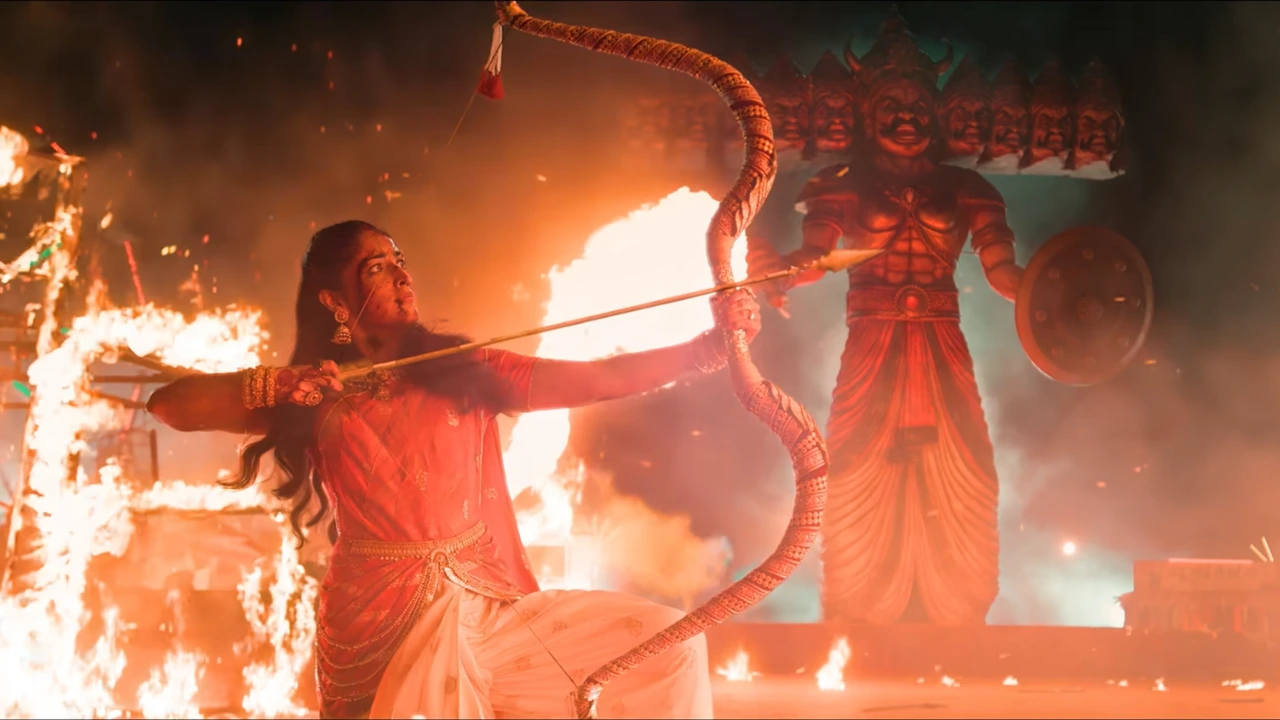
Then comes the interval, and the film leaves home. The second half replays several scenes from the first at a different angle, so that we feel a little ashamed for having believed Bantu, and then the story turns toward the Treta Yuga, the Ramayana, and a mysterious object connected to Ravana. Mohini's husband, Raja (Addinath M. Kothare), begins to change into something not quite human, and the horror comedy turns, before our eyes, into a loud mythological action drama.
Indian aesthetics has a name for this problem. In the ninth century, Anandavardhana argued in the "Dhvanyaloka" that a long work may contain many rasas, many emotional flavours, but a poet who wants it to excel must make one of them the angi, the principal rasa, and let the others serve it as limbs. A horror comedy is already a marriage of two rasas, hasya and bhayanaka, laughter and fear. The marriage is difficult but not impossible; "Stree" managed it because laughter always led and fear followed. "Nayyi Navelli" has no principal rasa. The first half is hasya. The second is adbhuta and vira, wonder and heroism, with devotion sprinkled over the top. Bhayanaka, the fear promised on the poster, never takes root. The film touches every flavour and settles on none.
Its use of the Ramayana is part of the same problem. For long stretches of the second half, Mohini becomes a lecturer on Valmiki, instructing her in-laws with the calm of someone who has already read the ending. Myth is wonderful raw material for cinema, provided it dissolves into the story. Valmiki's Ravana is no cardboard villain; he is a scholar and a devotee of Shiva, and his fall means something because his greatness cannot save him from his pride. Here he is reduced to a device for moving the plot along. Hitchcock had a word for such a thing: the MacGuffin, the object everyone chases and nobody needs to understand. Some viewers have enjoyed the film's homegrown mythological flavour, and some critics have found its religiosity heavy-handed. My complaint is simpler. Reverence is not a substitute for story.
Through all of this, Yami Gautam Dhar is the film's most dependable asset. From "Vicky Donor" to "Article 370" and "Haq," she has built a career on restraint, and her recent National Award recognises that journey. As Mohini she brings a strange, almost unsettling calm. In the first half she is so persuasively otherworldly that we side with Bantu, and that is the best trick the film plays. In the second half she is handed sermons, and no actor can turn a sermon into a character.
Most of the comedy rests on Anurag Thakur, and as Bantu he earns the loudest laughs: suspicious, stubborn, tangled in his own conspiracy theories. His timing is good, though over a long running time the character begins to repeat himself. Addinath M. Kothare, whom Hindi audiences saw as Dilip Vengsarkar in "83," gives Raja a gentle warmth and gets what he can out of the transformation, though the visual effects make it more artificial than frightening. The real regret is Mita Vashisht and Sunita Rajwar. Mita Vashisht is the actress who played the thumri singer Siddheshwari Devi in Mani Kaul's "Siddheshwari"; Sunita Rajwar is known across the country as Kranti Devi in "Panchayat." Here both are part of the crowd in a crowded house. There are many people in this home, and very few characters.
G.V. Prakash Kumar is one of the most successful composers in Tamil cinema, but here his background score keeps climbing on top of the scenes, as if the job of frightening us were his alone. None of the songs follows you out of the theatre. And the visual effects, on which the whole second-half spectacle depends, never earn the belief that fantasy requires.
The Dussehra holidays and the genre's popularity have helped at the box office. "Nayyi Navelli" opened on October 16 to about ₹3.25 crore net in India, ahead of Rajkummar Rao's "Prahaar," released the same day. On Saturday it rose about 23 percent to ₹4 crore, taking its two-day domestic total to ₹7.25 crore net and its worldwide gross past ₹10 crore. At festival time families want something light, and the film is riding on that wish.
In many Indian homes, a new bride enters her husband's house by gently tipping over a pot of rice with her foot at the threshold. At that moment she is called Lakshmi. "Nayyi Navelli" had the chance to ask when, and why, the same Lakshmi becomes a daayan, and the answer may be as simple as this: on the day she stops being what the household wanted. The film walks up to that door and stands on the threshold. Then, instead of looking inside, it turns toward the Treta Yuga. The pot has tipped, the rice lies scattered across the doorstep, and the film steps over it and moves on.
Our review of "Prahaar: The Untold Story of Ujjwal Nikam," released the same day, is also on Republic of Cinema.
💬 Discussion
0 comments