Director: Vishal Chaturvedi | Cast: Shobhinaw Satyaa, Vihaan Shedge, Chandan Anand, Purnima Tiwari | Runtime: 150 mins | Hindi, subtitled in Braj and Bundeli | India | Availability: Theatrical (Cinépolis India) | Rating: ★★★★★ (out of 5)
There is a shot early in "Hanuman Ansh" of a boy walking alone down a dirt path out of his village, carrying nothing, looking back only once. It is not a dramatic shot. The camera does not push in, the music does not swell to tell us this is the moment that matters. It simply watches him go. I kept thinking of that shot long after the film ended, because it tells you everything about what Vishal Chaturvedi is trying to do here, and it tells you something about the man the film is trying to honor.
Neem Karoli Baba, born Lakshmi Narayan Sharma in a village in Uttar Pradesh, is one of those figures whose influence spread not through doctrine or institution but through the quiet accumulation of testimony. He never wrote a philosophical treatise. He left no organized order demanding allegiance. What he left instead was a handful of instructions, repeated to whoever came to him, poor or famous, skeptical or devout: love everyone, serve everyone, feed everyone, and remember Ram. That fourfold teaching, simple enough to fit on a wall calendar and deep enough to occupy a lifetime, is the actual subject of Chaturvedi's film, far more than any single incident in the Baba's biography. The film is not really asking us to marvel at miracles. It is asking us to sit with the idea that a life built entirely on service to others might be its own kind of miracle, slower and less photogenic than the ones we are used to seeing dramatized.
This first installment of a planned trilogy covers only the early years, and wisely so. The boy who will become Neem Karoli Baba loses his mother and cannot make peace with the loss, and so he does what the saints of this tradition have always done: he walks away from home to go looking for God directly, rather than settling for the God he has been told about. Along the way he meets wandering ascetics, village elders, and animals who seem to understand him better than the people around him do, each offering some fragment of instruction. None of it adds up to a plot in the conventional sense, and I do not think it is meant to. Some films are engines, built to generate and resolve tension. This one is a river. It moves because that is what devotion does. It does not need a villain to keep flowing.
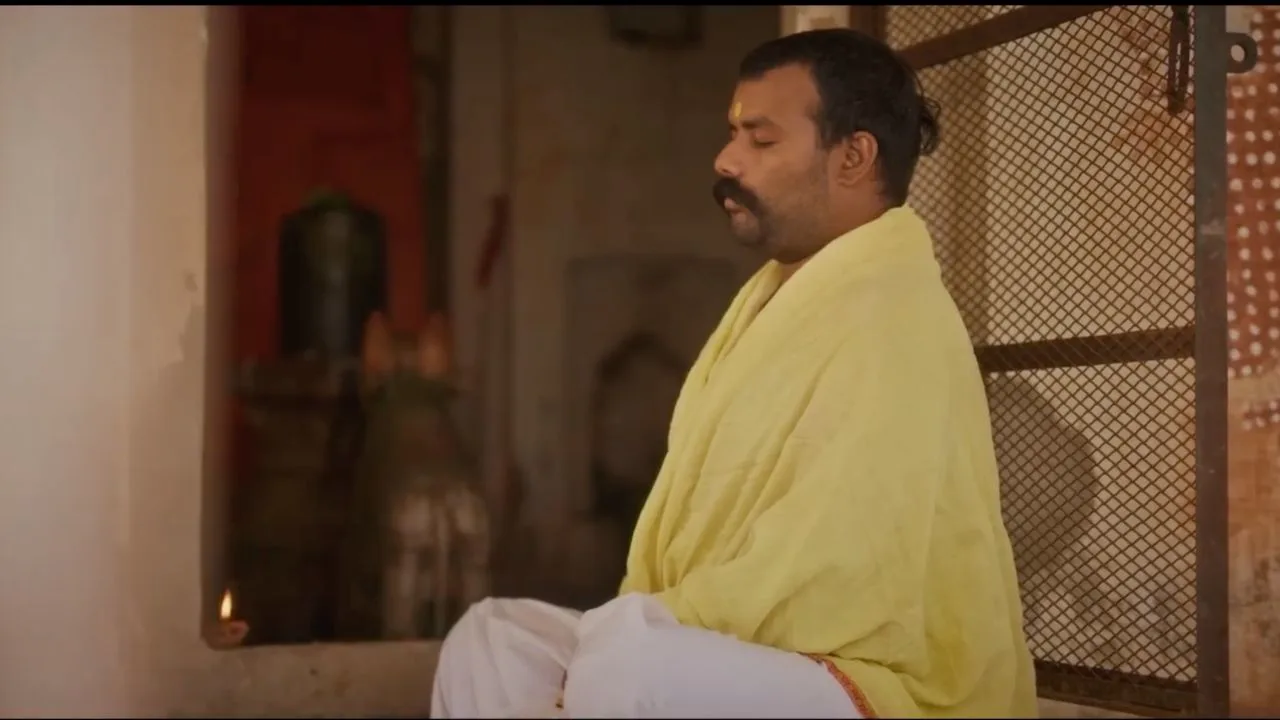
Vishal Bawa's cinematography does not disguise the fact that this was made on a fraction of what a studio biopic would spend, and there is an odd grace in that honesty. He leans on what the production actually has: the real riverbanks and ashram grounds around Chitrakoot, the particular green of that stretch of Uttar Pradesh, photographed mostly in natural light. The camera holds still far more often than it moves, content to let the landscape carry the reverence that the budget cannot manufacture through spectacle. This suits the material. A film about a man whose central teaching was selfless service should probably not be showing off. Where the film does reach for visual effects, in the handful of moments meant to gesture at Baba's clairvoyant powers, the seams show, and I found myself wishing Chaturvedi had trusted his own restraint all the way through rather than reaching, briefly, for a kind of spectacle the film does not need and cannot quite afford.
Shankh Rajyadhyaksha's editing holds the episodic structure together longer than I expected, though the second half does test its patience; a life built from small accumulated moments risks feeling like scattered anecdotes rather than a gathering current, and there are stretches where that risk becomes real. Dhirendra Mulkalwar's score carries much of the film's devotional atmosphere, filling emotional space that the dialogue, deliberately plain and unadorned, leaves open by design. There is a version of this film that drowns its subject in swelling bhajans and slow-motion piety. Chaturvedi mostly avoids that trap, and the film is better for it.
Shobhinaw Satyaa, who was reportedly serving as the film's second assistant director before an illness on set pushed him into the leading role, plays Baba with a stillness that reads as genuine conviction rather than performance. He does not act holy. He occupies holiness the way a person occupies a familiar room, without announcement. Vihaan Shedge, playing the character in his early teenage years, brings a looser, more unforced naturalism to a handful of scenes, the kind of presence that cannot be coached into existence.
What moved me most, watching this, was not any single scene but the cumulative sense of a philosophy being lived rather than explained. Love all. Serve all. Feed all. Remember Ram. Four instructions, repeated quietly across two and a half hours, until they start to feel less like a slogan and more like a way of surviving the world's difficulties without hardening against them. That is a genuinely difficult thing to dramatize, and I respect that Chaturvedi does not cheat his way to it. He does not turn Baba into a superhero performing miracles for our entertainment. He lets the ordinariness of daily kindness sit there, trusting that patient accumulation will eventually reveal its own grandeur.
"Hanuman Ansh" will not convert the unconvinced, and I suspect it has no interest in trying. It is a film made in a spirit of faith, for audiences already inclined toward that faith, and offered to everyone else as an invitation rather than an argument. Measured on those terms, it succeeds more often than its budget has any right to allow. Measured as pure cinema, it is uneven, sometimes slow, and often moving precisely because it never stops believing in the man at its center.
💬 Discussion
0 comments