Satyajit Ray is the most important filmmaker India has ever produced and the one most consistently watched wrong.
Watched wrong means watched in isolation — a film here, a film there, chosen by availability rather than by the logic of a developing artistic vision. Ray's work is not a collection of individual masterpieces. It is a sustained argument about time, about Bengal, about modernity and tradition, about what cinema can do that no other art form can do. Watching one Ray film is like reading one chapter of a novel. The full argument requires the complete work.
What follows is a guide to every Ray film currently accessible on Indian streaming, organised in the order that makes the argument most visible.
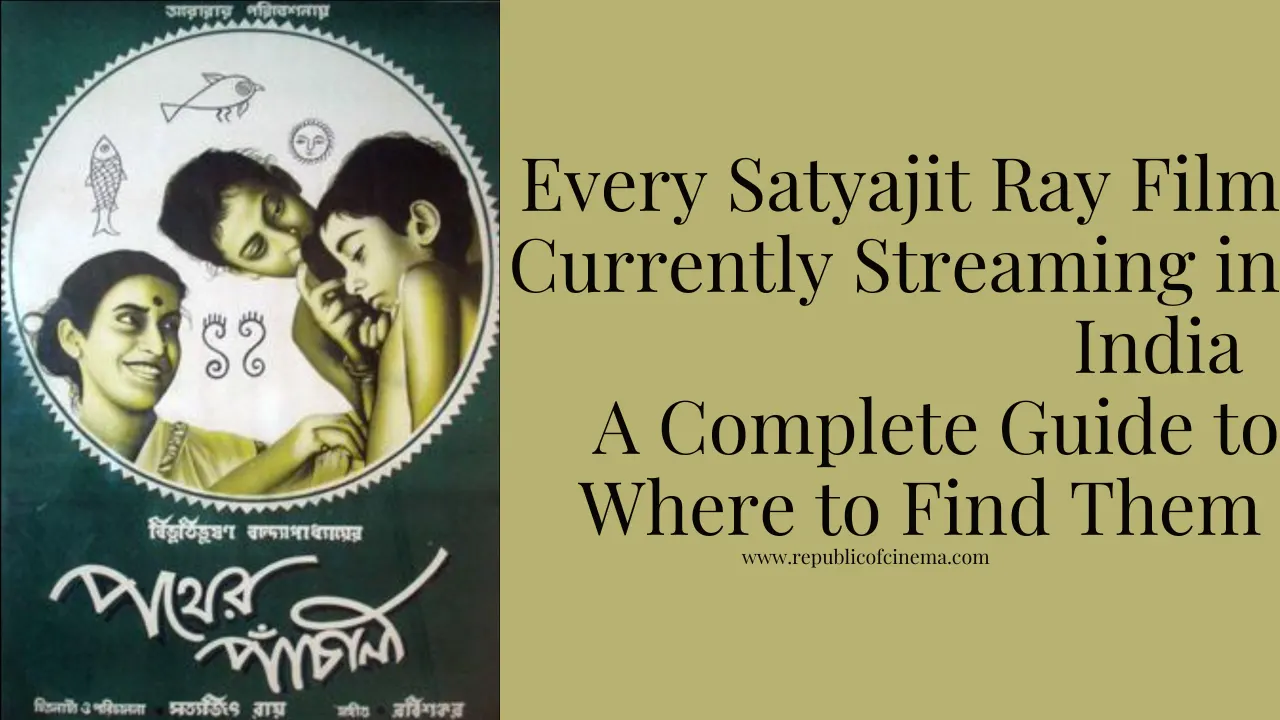
WHERE TO BEGIN — The Apu Trilogy Pather Panchali (1955) · Aparajito (1956) · Apur Sansar (1959) All three: Sony LIV
Begin here. Always begin here. Not because these are Ray's greatest films — though Pather Panchali may be — but because they establish the complete vocabulary of his cinema before he begins to extend and complicate it.
Pather Panchali is the film that announced that Indian cinema could look at the world with the same unsparing, compassionate honesty as the Italian Neorealists. The death of Durga — a child dying in the rain while her father is away — is the single most devastating scene in Indian cinema. Not because it is dramatic. Because it refuses to be dramatic. Ray shoots it with the same camera position, the same quality of light, the same unhurried attention he has given to every other scene in the film. Death here is not a climax. It is something that happens, the way things happen, without the universe acknowledging that it has happened.
Watch the three films on consecutive days if you can. The experience of following Apu from childhood through the death of his parents to his own young manhood is one of the great cumulative experiences available in cinema.
THE MASTERPIECES — The Calcutta Trilogy and Charulata The Adversary (1970) · Company Limited (1971) · The Middleman (1975) Charulata (1964) All four: MUBI India
Ray's Calcutta Trilogy is his most politically engaged work — three films about educated young men navigating a city in crisis, the corruption of the job market, the erosion of idealism. Made between 1970 and 1975, the trilogy is Ray's most direct engagement with the Bengal of his moment. The Adversary is the most formally experimental film he made — fragmented, restless, occasionally using the grammar of the French New Wave in ways that Ray elsewhere rejected.
Charulata, made between the Apu Trilogy and the Calcutta Trilogy, is the film Ray himself considered his most perfect. A lonely, intellectually gifted woman in nineteenth-century Bengal develops a relationship with her husband's cousin that the film neither condemns nor endorses but simply watches, with the precision of someone who understands that the most important human experiences are the ones that resist easy categorisation. Subrata Mitra's cinematography — all natural light, all interior spaces — is the most beautiful work he did for Ray.
THE LATE MASTERWORKS The Chess Players (1977) · The Home and the World (1984) · Agantuk (1991) All three: Amazon Prime Video
Ray's late period is the most intellectually ambitious phase of his career and the most underappreciated. The Chess Players, his only Hindi-language film, uses the story of two aristocrats playing chess while the British annexe Awadh to make the most complex and least comfortable argument he ever made about Indian complicity in colonial rule.
The Home and the World, adapted from Tagore, is Ray's most overtly political film — a love triangle set against the Swadeshi movement that refuses the easy nationalism the subject seems to demand. Agantuk, his final film, made when he was gravely ill and knew he was dying, is a film about a man returning to his family after thirty-five years and the question of what we owe to the people we have left behind. It is the film of a man settling his accounts with the world. It is the most personal thing Ray ever made.
THE RAY YOU HAVE NOT YET DISCOVERED Nayak (1966) · Aranyer Din Ratri (1970) Both: MUBI India
Nayak is a film about a famous film actor travelling by train to Calcutta who spends the journey in conversation with a journalist. It is the most underrated film Ray made and the one that most directly examines the relationship between celebrity and private suffering. Uttam Kumar's performance, playing a version of himself without the protection of distance, is extraordinary.
Aranyer Din Ratri — Days and Nights in the Forest — is Ray's funniest, most sensual, most formally relaxed film. Four middle-class men from Calcutta go on holiday in a forest. What they find there is themselves, which is not what they were looking for. It is the film Ray made when he was most fully in command of his craft and most willing to use that command in the service of pleasure rather than argument.
A NOTE ON WHAT IS MISSING
The films not listed here are not accessible on legal Indian streaming platforms at the time of writing. Devi, Mahanagar, Seemabaddha, Jana Aranya, Shatranj Ke Khilari — several of Ray's most important works exist in a distribution limbo that is one of the great failures of Indian cultural preservation. We will update this guide as availability changes.
For now — fourteen films. Sony LIV, MUBI India, and Amazon Prime Video. Start with Pather Panchali. Do not stop.
Guide updated July 2026 · Streaming Now · Republic of Cinema
💬 Discussion
0 comments