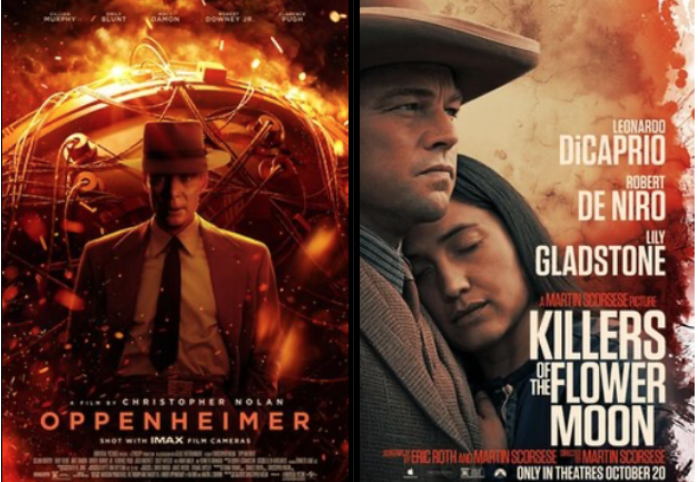
It is worth stating plainly what both films are about before examining what each one does with its subject.
Oppenheimer is about the creation of a weapon that killed over two hundred thousand people, mostly civilians, in two days. It is about the man most responsible for that weapon and his subsequent struggle with what he had done.
Killers of the Flower Moon is about the systematic murder of Osage Nation members by white Americans in the 1920s — a conspiracy to steal oil wealth that involved the FBI, local law enforcement, and the United States government, and that has been buried in American public consciousness for a century.
Both films are made by directors at the height of their powers. Both films are technically extraordinary. Both films were seen by tens of millions of people. Both films were nominated for the Academy Award for Best Picture.
The comparison is not about quality. It is about courage.
Christopher Nolan's Oppenheimer is a film about guilt that centres the person who feels guilty. J. Robert Oppenheimer is our entry point, our guide, our emotional anchor. His reckoning with what he has done is the film's dramatic spine. The Japanese victims of Hiroshima and Nagasaki appear in the film as a vision — literally a hallucination in Oppenheimer's mind — and for approximately forty-five seconds. Two hundred thousand dead people occupy forty-five seconds of a three-hour film about the man who killed them because he feels bad about it.
This is not an accident or an oversight. It is a choice. Nolan chose to make a film about the psychological cost of mass murder paid by the person who committed it. He made that choice with complete technical mastery and genuine dramatic intelligence. The film he made is a great film on its own terms. It is also a film that looks away from the people it should be looking at.
Martin Scorsese's Killers of the Flower Moon makes the opposite choice and pays for it commercially and critically in ways that reveal something important about what American audiences will and will not accept.
Scorsese's film is narrated from inside the perpetrators — Ernest Burkhart, played by Leonardo DiCaprio, is our point of entry, a weak man who participates in murder for money and the approval of his uncle. The Osage characters — most centrally Mollie Burkhart, played by Lily Gladstone — are not secondary to this story. They are its moral centre. The film insists that we understand what was done to them not through the consciousness of someone who feels guilty about it but through the lived reality of the people it was done to.
Gladstone's performance is the film's argument made visible. She is present in virtually every scene with a quality of knowing that the film never explains and never needs to explain. Mollie knows what is happening to her people and cannot stop it. She knows what her husband is and continues to love him and cannot stop that either. The performance refuses the comfort of clear moral categories. It insists on the full complexity of a person living inside a historical atrocity in real time, making human choices under conditions of terror.
The film was called too long, too slow, too demanding. It grossed significantly less than Oppenheimer despite equivalent marketing and release strategy. The difference in commercial performance is itself an argument — American audiences were more comfortable spending three hours with the psychological suffering of the man who built the atomic bomb than with the physical suffering of the Indigenous people whose murder built American wealth.
Both films are formally extraordinary. Nolan's intercutting of the Trinity test sequence with the security hearing sequence is as precise a piece of parallel editing as American cinema has produced in twenty years. Scorsese's long takes in the Osage interiors — the specific quality of light, the specific texture of domestic life — create a world so fully inhabited that its destruction feels genuinely catastrophic rather than abstractly historical.
But form is in service of argument. And the arguments are not equivalent.
Oppenheimer asks: what does it cost a great man to participate in mass murder? Killers of the Flower Moon asks: what does mass murder actually look like from inside the experience of the people being murdered?
The second question is harder to watch. It is also more important. It is the question that American cinema has been avoiding for its entire history, and Scorsese — at eighty years old, with nothing left to prove — is one of the few filmmakers with the authority and the will to ask it directly.
Both films deserve to be seen. But they should be seen together, and in this order: Oppenheimer first, then Killers of the Flower Moon. Watch how the first film makes you feel — the intellectual excitement, the moral seriousness, the genuine grief for a complicated man. Then watch how the second film makes you feel. Notice the difference. Notice what that difference reveals about whose suffering American cinema — and American audiences — have been trained to centre.
That noticing is the most important thing either film can teach you.
Oppenheimer: 8.5 / 10 · Killers of the Flower Moon: 9.5 / 10 By Republic of Cinema ·
💬 Discussion
0 comments