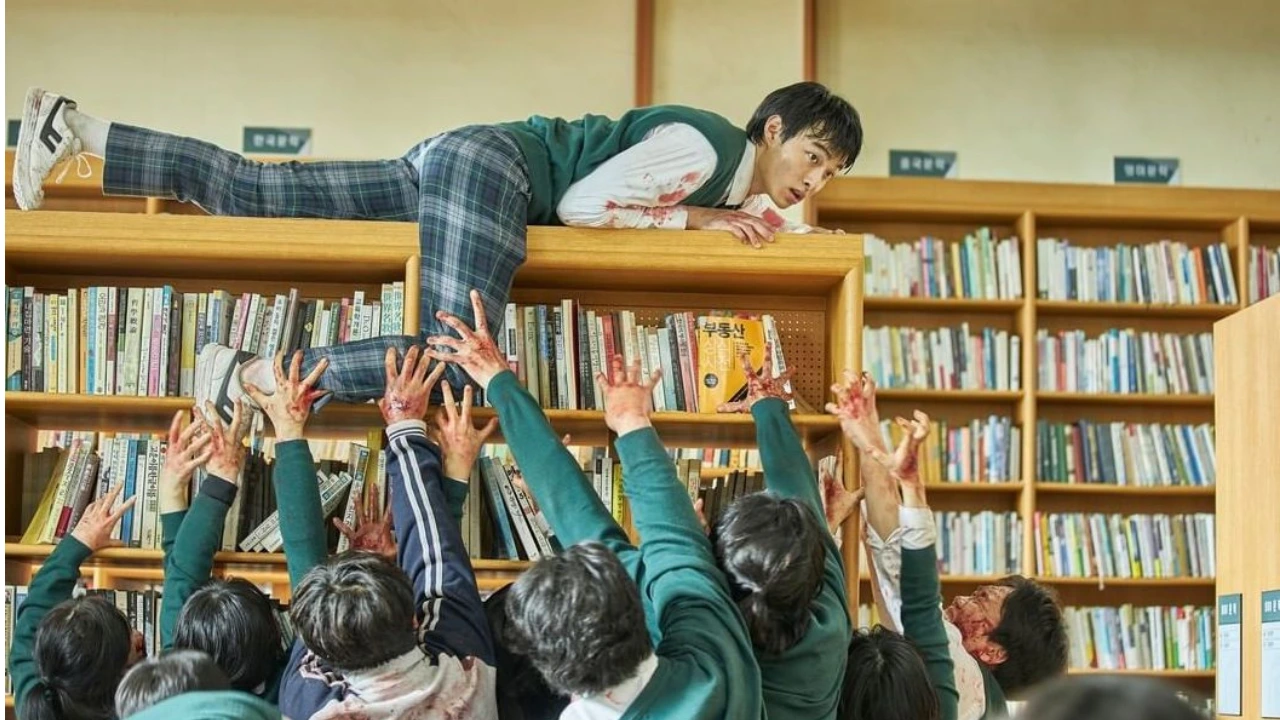
On Saturday, on the festival stage at the Oil Tank Culture Park in Seoul’s Sangam-dong, Yoon Chan-young undid the ending of All of Us Are Dead (2022) in a single sentence. “You thought I was dead,” he told the crowd, “but I, Cheong-san, am still alive.” Park Ji-hu, who plays Nam On-jo, answered him in character. Then the segment closed without a teaser, without a frame of new footage and without a date. The second season remains, in Netflix’s own billing, coming soon.
That was the sum of the news, and it was not trivial. All of Us Are Dead headlined “What Next?”, the slate showcase that closed the first day of Netflix Janchi, a two-day fan festival marking ten years since Netflix launched its service in Korea in January 2016. It was the series’ first public presentation since its four leads announced the renewal at Netflix’s Geeked Week in June 2022, and several local outlets had primed fans to expect a first look. None came. Lee Chang-dong’s Possible Love received a trailer; All of Us Are Dead received a reunion.
The Price of a Resurrection
The reveal matters because Cheong-san’s death was the moral centre of the first season. Bitten by Yoon Gwi-nam, the bully turned near-unkillable monster, he stayed behind so that his friends could escape, and was last seen falling into an elevator shaft with Gwi-nam in his grip as Hyosan High was bombed. In a series preoccupied with adults who fail the children in their care, the boy who chose to die for his classmates was its argument given a face.
Reversing that death is a franchise decision as much as a dramatic one. Multiseason television rewards characters who can come back; drama rewards consequences that hold. The second season now has to reconcile the two, and Saturday offered no clue as to how Cheong-san survived, or in what condition. When Netflix announced the cast in July 2025, it listed Yoon among the returning actors without explanation, leaving room for flashbacks or a half-infected return. That room has narrowed. It has not closed.
“Multiseason television rewards characters who can come back; drama rewards consequences that hold.”
What Is Confirmed
Netflix announced in July 2025 that production had begun, and filming ran until February 2026. Lee Jae-kyoo (credited internationally as Lee JQ) and Kim Nam-su return as directors, with Chun Sung-il again writing. Film Monster produces, with SLL, Kim Jong-hak Production and NPIO Entertainment co-producing.
The story leaves Hyosan for the capital. On-jo is now a university student in Seoul, still carrying the trauma of the outbreak, when a new infection reaches the city. On stage, Park described a crisis in which the zombies themselves have evolved, fought on a larger scale than before. Cho Yi-hyun confirmed that Nam-ra, the half-zombie of the first season’s finale, is still wandering Hyosan, while Lomon’s Su-hyeok returns as an adult.
Four newcomers join them: Lee Min-jae as Yong Ma-ru, On-jo’s university senior; Kim Si-eun as So Ju-ran, a fixture of campus life; Yoon Ga-i as fellow student Lee Jong-a; and Roh Jae-won, a veteran of the second and third seasons of Squid Game, as Han Du-seok, a team leader at the National Intelligence Service.
The direction was signalled early. In February 2022, Lee told The Korea Herald that if the first season had been about humanity’s survival, a second could turn to the survival of zombies. With Nam-ra still in Hyosan and an intelligence officer now on the cast list, the series appears to be moving from a siege narrative toward something closer to a national state of emergency. Until there is footage, that remains a reading, not a fact.
Why Four Years
Netflix renewed the series in June 2022, months after the first season logged more than 560 million viewing hours in its first 28 days, by Netflix’s own count. Cameras did not roll for another three years. Netflix has not publicly explained the gap, and this publication will not invent reasons for it. The conditions surrounding it, however, are documented.
The first is the production model. Korean broadcast drama traditionally shot later episodes while earlier ones were already on air; Netflix completes its productions before release and builds in time for post-production. Lee Sung-min, an associate professor at Korea National Open University, told Korea JoongAng Daily this week that the shift has largely ended the habit of last-minute script pages. For a series built on crowd-scale creature work and visual effects, that post-production window is long by design, and the second season is reported to be in it now.
The second is money. Korea JoongAng Daily, publishing on the eve of the festival, cited an industry source estimating that per-episode costs which once ran to around 500 million won have risen three- to fivefold, to between 2.5 and 3 billion won. The same report notes that under Netflix’s original-production model, the platform typically finances the entire budget and pays producers a fixed margin in exchange for the intellectual property, an arrangement Hanyang University professor Park Ki-soo warned can leave production companies squeezed by the very hits they make. Netflix has not disclosed the budget or rights structure of All of Us Are Dead, and these are industry-wide figures. But they describe the economy into which the second season will be released.
The third is the market itself. When the first season premiered in January 2022, it joined a small group of Korean genre series, Kingdom (2019), Sweet Home (2020) and Hellbound (2021) among them, that were proving the form could travel. Netflix now counts 210 Korean titles in its Global Top 10 between June 2021 and the end of 2025, and said this week that roughly four in five of its members have watched Korean content. The second season returns not as a pioneer but as an established title on a crowded slate, sharing Saturday’s stage with Lee Chang-dong, the fantasy series Grand Galaxy Hotel and a live-action Solo Leveling.
When It Will Arrive
Netflix has announced neither a premiere date nor a release window. According to What’s on Netflix, the series was absent from the 2026 Korean slate Netflix unveiled in January, even though Korea JoongAng Daily had listed it among the year’s expected releases earlier that month. With the year ten weeks from its end and not a frame of footage released, a 2026 premiere now looks unlikely. Trackers including What’s on Netflix and The Week expect early 2027, most likely January or February. That is projection, not schedule. The episode count is also unconfirmed, with published reports split between eight and twelve.
Everyone agrees the zombies will be bigger. The more interesting question the second season carries into 2027 is whether a series that once had the nerve to kill its gentlest character can justify bringing him back. On Saturday, the cast answered the question fans have asked for four years. The harder one now belongs to the writers.
💬 Discussion
0 comments