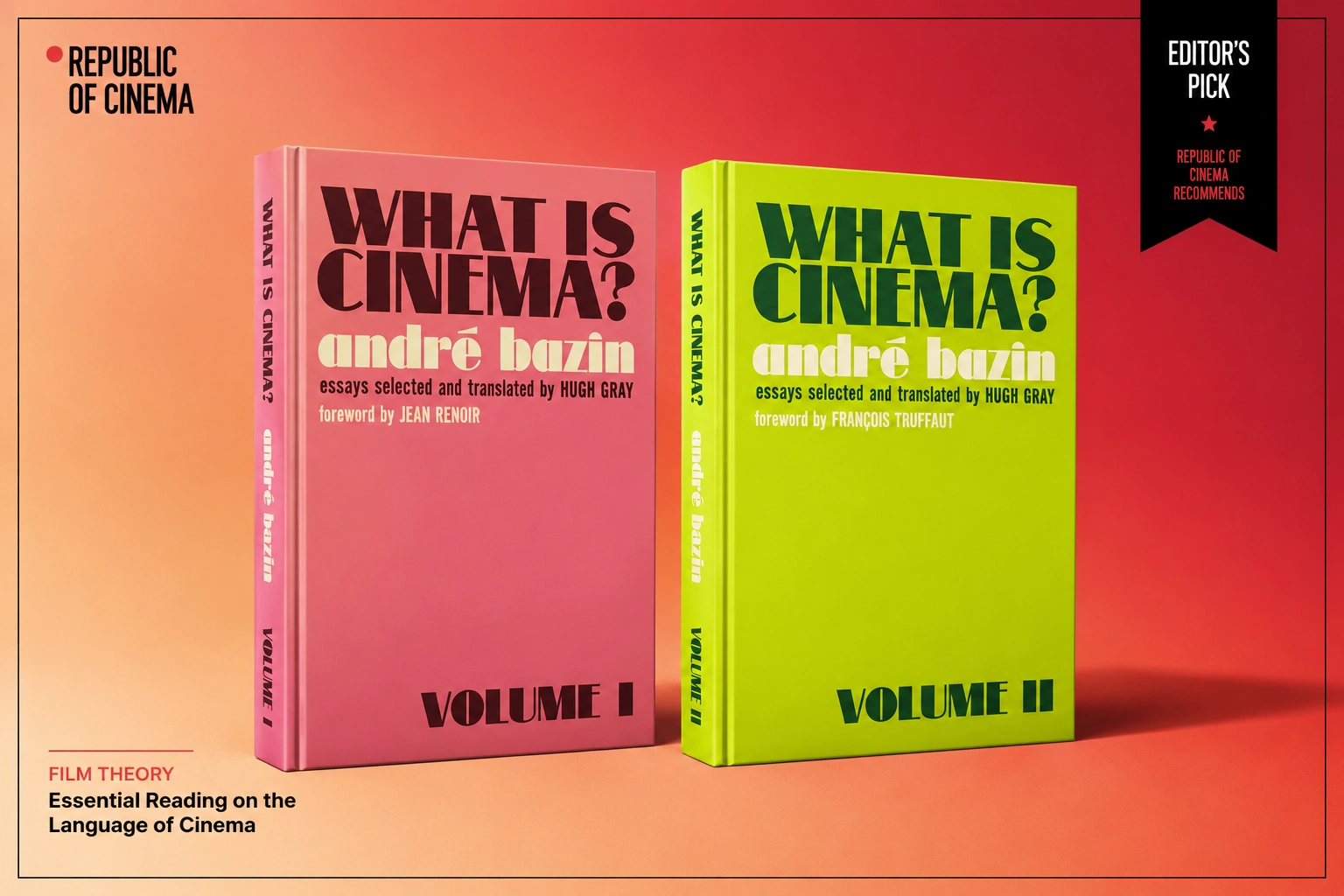
AUTHOR André Bazin (Translated by Hugh Gray)
CATEGORY Film Theory / Film Criticism / Cinema Philosophy
RATING 10 / 10 ★★★★★
DIFFICULTY Intermediate – Scholar
FIRST PUBLISHED 1958–1962 (English Translation: 1967)
READ WITH Film Art: An Introduction — David Bordwell & Kristin Thompson
WATCH WITH Bicycle Thieves (1948) — dir. Vittorio De Sica
Before you shoot a single frame, before you write a single line of dialogue, before you make a single decision as a filmmaker — you owe it to the art form to ask the question André Bazin spent his entire life answering: what is cinema, really?
This is not a book about technique. It is not a manual of directing, a guide to editing, or a taxonomy of shot types. It is a book about truth — the truth that the camera can capture, and the truth that editing can destroy — and it will shake every assumption you have ever held about how films work, why they move us, and what moral obligations a filmmaker carries simply by virtue of pointing a lens at the world. To read it is to have cinema explained to you, at the deepest level, for the very first time.
André Bazin's What Is Cinema? is not one of the important books about film. It is the foundational text — the intellectual bedrock beneath all serious thinking about the moving image. Everything in film theory that came after it is either built upon it or written in opposition to it. To engage seriously with cinema without reading Bazin is to navigate an ocean without understanding the nature of water.
— ✶ —
The Man Who Taught a Generation to See
André Bazin (1918–1958) died at forty years old of leukemia, just as the revolution he had spent his career theorising was beginning to happen. He never lived to see The 400 Blows or Breathless or Cleo from 5 to 7. He never saw what he had made possible. And yet his influence on those films — on Truffaut, Godard, Chabrol, Rivette, Rohmer, and the entire generation of directors who formed the French New Wave — was more decisive than that of any single director, producer, or studio. He shaped the conversation that created the cinema we now regard as the finest flowering of the medium.
Bazin co-founded Cahiers du Cinéma in 1951 — a critical journal that became, in the following decade, the most important film publication in the world. There, in issue after issue, he elaborated a comprehensive philosophy of cinema: its nature, its history, its ethics, its aesthetics. The essays he published in Cahiers were not reviews in any conventional sense. They were acts of philosophical investigation — inquiries into the deepest nature of the medium that frequently achieved a level of insight and originality that no philosopher of art had previously managed. That a film critic, writing in weekly columns about current releases, could produce work of lasting philosophical importance is itself a testament to the seriousness with which French intellectual culture engaged with cinema as an art form.
The two volumes of What Is Cinema? are a posthumous collection of his most important essays, assembled and translated into English by Hugh Gray. They do not read as a unified book in the conventional sense — they are the work of a mind circling and re-circling the same central questions from different angles, finding new facets with each approach. This gives the book a quality that no work of systematic philosophy possesses: the quality of a mind genuinely in motion, discovering its own positions even as it articulates them.
— ✶ —
The Ontology of the Real: Cinema's Relationship with Truth
At the philosophical centre of Bazin's project lies a claim so radical, so counterintuitive to the assumptions of both Hollywood entertainment and European art cinema, that it takes some time to appreciate its full implications: the photograph — and by extension the motion picture — has a unique and almost mystical relationship with reality that no other art form shares.
Unlike a painting, which is always an interpretation of the world — a meditation filtered entirely through human consciousness, human sensibility, human intention — a photograph is produced by the world itself. Light strikes a surface and leaves an impression without the decisive intervention of human judgment. The photographer chooses where to point the camera and when to press the shutter, but the image that results is not invented: it is extracted from reality by an automatic process. This is what Bazin means by the "ontology of the photographic image" — the specific mode of being, the peculiar existential status, that distinguishes the photograph from all other images in the history of art.
From this foundational insight — developed in the essay that gives the book its philosophical authority, "The Ontology of the Photographic Image" — Bazin builds an entire aesthetic system. If cinema's essential nature is its fidelity to reality, then the filmmaker's highest calling is not to impose meaning on the world through technique but to reveal the meaning that already exists within it. The world, properly observed, is sufficient. The camera, properly used, is a witness. And the filmmaker who understands this is not a storyteller in the conventional sense but something closer to a phenomenologist — someone whose art consists in a disciplined quality of seeing rather than a facility for construction.
"Photography does not create eternity, as art does, it embalms time, rescuing it simply from its proper corruption." — André Bazin, What Is Cinema? Volume I
This single sentence contains Bazin's entire philosophy in compressed form. He draws a distinction between what art does — which is create a timeless ideal, a distillation of beauty or meaning that transcends its particular moment — and what photography and cinema do, which is something stranger, more uncanny, and in its own way more profound: they preserve the perishable. A painting of a face is an interpretation of beauty that transcends its model. A photograph of a face is that face — captured, held, arrested in its particularity, rescued from the dissolution that time brings to everything. Cinema is the art of embalmed time. Once you hold this idea in your mind, you will never watch a film the same way again. Every shot becomes a confrontation with mortality. Every frame is a fragment of a world that no longer exists.
— ✶ —
Six Arguments That Will Change How You Think About Cinema
I. The Myth of Total Cinema
One of Bazin's most provocative and enduring ideas is that cinema was not invented — it was always already imagined. The pioneers of film technology were driven not by the desire to create a new art form but by a pre-existing dream: the complete reproduction of the world in sound, colour, and three dimensions. Bazin calls this the "myth of total cinema" — and his argument is that the entire history of film technology can be understood as the slow, incremental approximation of this ideal. Sound, colour, widescreen, 3D, digital — each development is not an invention but a step toward the total cinema that was imagined before any camera was ever built.
The implications for the filmmaker are profound. You are not pioneering the future of cinema — you are fulfilling a destiny that predates you. Every technical advance you use was dreamed before it was discovered. And the question this raises — what is the "total cinema" that we are still moving toward? — is one that cinema has never satisfactorily answered, and perhaps never will.
II. The Reality of the Shot vs. The Manipulation of the Cut
The most generative and most contested argument in the book is Bazin's diagnosis of the fundamental tension in film history between two opposing aesthetic philosophies: directors who believe in the image, and directors who believe in montage.
Directors who believe in the image — Renoir, Rossellini, Welles, Wyler — trust reality to speak for itself. They use the long take, deep focus photography, and complex staging within the frame to preserve the ambiguity, the complexity, and the genuine temporal continuity of real experience. They do not impose meaning; they create conditions in which meaning can arise. Against them, Bazin positions the montage tradition — above all the Soviet tradition of Eisenstein and Pudovkin — which constructs meaning through the collision of shots, through the forced relationship between images that have no natural connection. For Bazin, this montage tradition, however intellectually brilliant and emotionally powerful, is fundamentally a falsification: it replaces reality with rhetoric, substitutes construction for discovery, and in doing so makes cinema into something closer to propaganda — even when the propaganda serves noble ends.
This is not a comfortable argument. Eisenstein's cinema is among the most extraordinary achievements in film history, and to claim that its power derives from a kind of lie requires a philosophical courage that not all readers will share. But Bazin's challenge is genuinely productive: it forces every filmmaker to ask, of every edit, of every constructed sequence: am I revealing something, or am I manufacturing it? Am I witnessing, or am I arguing? These questions have no easy answers, but the filmmaker who has not asked them is working in the dark.
III. The Virtues and Limits of Montage
Bazin is not a wholesale opponent of editing. His argument is more precise and more interesting than that: he defines the legitimate territory of montage and insists on its boundaries. Editing is appropriate, even essential, when it creates meaning that could not otherwise exist — when the juxtaposition of two images produces something that neither image contains alone. This is the legitimate Eisensteinian insight, and Bazin acknowledges it.
What he refuses is the use of editing to substitute for reality — to replace an event that could and should have been shown in a continuous shot. His most famous example is remarkable in its simplicity: if a lion attacking a man is shown in three separate shots — the lion, the man, the lion again — the result is not truth but construction. The viewer accepts it as reality because of the power of editing convention, but it is a fabrication. If it were shown in a single continuous take — if the viewer were required to confront the actual coexistence of the lion and the man in the same frame — the result would be cinema at its most irreducibly real. This distinction — between the cut that creates and the cut that conceals — is one that every editor in the world should have carved above their door.
IV. Deep Focus and the Long Take — A Liberation of the Eye
Bazin's championing of Orson Welles and Jean Renoir rests on a precise aesthetic argument that has never been bettered. Deep focus photography — in which the entire frame, from extreme foreground to extreme background, is simultaneously in sharp focus — and the long take — in which the camera holds on a scene without cutting for extended durations — together achieve something that editing cannot: they preserve the spatial and temporal continuity of reality, and in doing so, they restore to the viewer a freedom that montage systematically denies.
When you watch the famous deep focus sequences in Citizen Kane — a young Charles Foster Kane playing in the snow, visible through a window in the background, while his parents sign him away in the foreground — you are not being told where to look. You are given a visual field of extraordinary richness and required to make your own choices. Montage directs attention: it tells you, shot by shot, what is important. Deep focus liberates attention: it gives you a world and trusts you to find the significance within it. This, Bazin argues, is not merely a stylistic preference but a moral commitment — a refusal to manipulate the viewer's perception, a respect for the complexity of reality.
V. Italian Neorealism — Cinema at Its Most Ethical
For Bazin, Italian Neorealism — Rossellini's Rome, Open City and Paisà; De Sica's Bicycle Thieves and Umberto D.; Visconti's La Terra Trema — was not merely a stylistic movement but a moral revolution in the history of the medium. By using non-professional actors, shooting on real locations rather than constructed sets, using available light, and drawing their stories from the raw, unmediated experience of contemporary social life — the rubble of postwar Italy, the poverty of the working class, the humiliations of ordinary existence — the Neorealists had brought cinema closer to its essential nature than any movement that preceded them.
What makes Bazin's analysis of Neorealism so permanently important is that he understands it not as a reaction against the aestheticism of Hollywood or the self-consciousness of European art cinema, but as a discovery of what cinema had always been capable of and had never fully achieved. De Sica and Rossellini did not invent a new form of cinema. They revealed cinema's form — the form it had always had beneath the conventions, the star systems, the narrative formulas, and the studio gloss. In Bicycle Thieves, a father and son walk through Rome searching for a stolen bicycle. Nothing more. And yet the film is devastating, is alive, is more true than almost anything else in the cinema's history, because Bazin helps us understand that this plainness is not a limitation but the fullest possible realisation of what cinema can do.
VI. The Ethics of the Filmmaker's Gaze
Beneath every aesthetic argument in Bazin's work lies a deeper conviction that the relationship between the camera and the world is not merely a technical matter but an ethical one. How you film something is inseparable from what you believe about the world, about the people in it, and about the relationship between the viewer and what they are shown.
A filmmaker who cuts away from suffering — who uses editing to sanitise, to distance, to aestheticise — is making a moral choice, whether they know it or not. A filmmaker who holds the camera on reality, who allows time to pass without the mercy of a cut, who refuses the manipulation of score or close-up to direct the viewer's emotional response — that filmmaker is making a different moral choice. Bazin does not legislate between these choices in any simple sense. But he insists that every formal decision has a moral dimension, and that the filmmaker who is unaware of this dimension is not an artist but a craftsman working in the dark.
— ✶ —
How This Book Will Change the Way You See Cinema
After reading Bazin, you will watch every film with a new and productive anxiety. Every time a director cuts, you will ask: was that cut necessary, or did it destroy something real? Did it reveal, or did it construct? Every long take you encounter — in Tarkovsky, in Kubrick, in Haneke, in Hou Hsiao-hsien, in Alfonso Cuarón — will suddenly reveal itself not as a stylistic flourish but as a philosophical statement: a refusal to manipulate, a commitment to the integrity of lived experience.
You will begin to understand why certain films feel true in a way that others, technically more impressive, do not. You will look at deep focus shots in Welles or Wyler and understand that what you are seeing is not a stylistic choice but a moral one. You will watch Rossellini's handheld camera drifting through the streets of Rome and understand that the roughness, the contingency, the lack of compositional perfection is not a failure of craft but its highest expression: the surrender of the filmmaker's ego to the authority of the real.
And you will watch the Hollywood film differently too — with a new awareness of everything it hides, everything it smooths over, every cut that spares the audience the discomfort of duration, every score that manufactures the feeling the image was not trusted to produce. You will begin to feel the weight of what is withheld by mainstream cinema, and to appreciate, with new force, why Bicycle Thieves — a film with no stars, no score worth noting, no constructed drama, no special effects, shot in the streets of postwar Rome with a stolen bicycle and a child actor — remains among the most powerful experiences the cinema has ever produced.
— ✶ —
Bazin in the Age of Streaming and Digital Spectacle
It would be easy to read Bazin as a historical figure — important, influential, but belonging to a particular moment in cinema history that the digital revolution has superseded. This reading would be catastrophically wrong.
The questions Bazin asks are more urgent today than when he wrote them, because the forces he was arguing against — the reduction of cinema to constructed spectacle, the subordination of reality to narrative convenience, the replacement of genuine perception by managed sensation — have advanced to a degree he could not have imagined. The contemporary blockbuster, with its digitally constructed universes, its aggressive editing, its noise of musical underscoring, its replacement of human faces with computer-generated imagery, is the reductio ad absurdum of everything Bazin warned against. It is the cinema that has given up entirely on the world — that has decided the world is insufficient and replaced it with a manufactured substitute.
And yet the Bazinian tradition has not disappeared. It has gone underground, or rather, it has migrated to the margins where serious cinema has always found refuge. The Romanian New Wave — Cristian Mungiu's long, unflinching takes; Corneliu Porumboiu's deadpan observation of bureaucratic reality — is deeply Bazinian in its formal commitments. The cinema of the Dardenne brothers in Belgium, with its restless handheld camera that follows its characters like a conscience, refusing to aestheticise or to judge, is Bazinian in spirit if not in explicit homage. And the films of Chantal Akerman — above all the extraordinary Jeanne Dielman — which holds its camera in fixed positions and allows duration to accumulate until the viewer feels the weight of a woman's domestic life with physical force, is perhaps the most radical realisation of Bazinian principles in the history of cinema.
These films do not reach mass audiences. They are not designed to. But they demonstrate that the cinematographic tradition Bazin identified and championed — the tradition of witness, of duration, of the ethical gaze — is still alive. It is produced, shown, discussed, and felt. And in an age of content, of algorithmic curation, of the endless distraction of the scroll, the existence of such films is not merely aesthetically significant: it is a form of resistance. Every fixed camera held on a real face for an uncomfortable length of time is an act of cultural defiance — an insistence that the world, and the people in it, deserve more than the forty-five-second attention span that the platforms are busily engineering.
— ✶ —
Who Must Read This Book
The aspiring director must read Bazin before they develop their visual style, because Bazin defines the stakes of every stylistic choice. Before you decide how to shoot a scene, you need to understand what you are choosing between — the shot and the cut, reality and construction, witness and rhetoric. Your aesthetic is not a matter of personal preference until you know the philosophy that underlies each option. Bazin will make you a more deliberate, more honest, and ultimately more powerful filmmaker.
The film critic and theorist cannot write seriously about cinema without engaging with Bazin. His ideas are the bedrock of film theory — every major theorist who came after him, from Christian Metz to Gilles Deleuze to Laura Mulvey, was either building on his foundation or constructing their argument in opposition to it. To understand the conversation of cinema theory, you must begin here.
The passionate cinephile who has always felt that some films are more real, more alive, more true than others — and who has struggled to articulate why — will find in Bazin the philosophical language they have been searching for. He will explain why a single Rossellini shot can feel more devastating than ten minutes of Hollywood spectacle, and why that feeling is not merely subjective preference but philosophically defensible. He will explain why you were right to feel what you felt.
The screenwriter will discover in Bazin a radical challenge to the received wisdom of screenwriting craft: that story structure, character arc, and narrative causality are not the natural form of cinema but a convention borrowed from theatre and literature. Bazin offers a different model of cinematic storytelling — one based on situation rather than plot, observation rather than construction, the slow accumulation of reality rather than the accelerating drive toward resolution.
— ✶ —
There are books about cinema, and then there is What Is Cinema? — a work that operates on an entirely different plane from everything else in the literature. To place it beside other works of film theory is like placing a river beside a collection of photographs of water. The photographs may be beautiful and informative. The river is alive.
Its weaknesses are real and should be acknowledged honestly. Bazin's prose is dense and his arguments sometimes circular, moving between phenomenology, theology, and aesthetics with a fluency that occasionally obscures rather than illuminates. His dismissal of Eisenstein and the Soviet montage tradition is too sweeping — it fails to account for the profound emotional and intellectual power of that tradition at its height, and it sometimes creates a false binary between realism and montage that the greatest filmmakers have always transcended. His championing of Italian Neorealism, historically important and philosophically coherent, occasionally tips into idealisation, attributing to the movement a purity of intention that the filmmakers themselves would not always have claimed.
And yet none of this diminishes the achievement. Bazin gave cinema a philosophy. He asked the deepest possible question about the medium, answered it with intellectual courage and genuine originality, and in doing so created a framework for thinking about film that has never been superseded. The fact that his arguments are still debated, still taught in every serious film school on earth, still cited in critical writing, and still capable of generating genuine disagreement is the most powerful testament to their vitality. Sixty years after his death, André Bazin is still the most important voice in the room.
"The founding text of serious cinema thought — the book that defines what it means to think about film at all."
Buy Now:- https://link.amazon/B08iA2ERW
💬 Discussion
0 comments