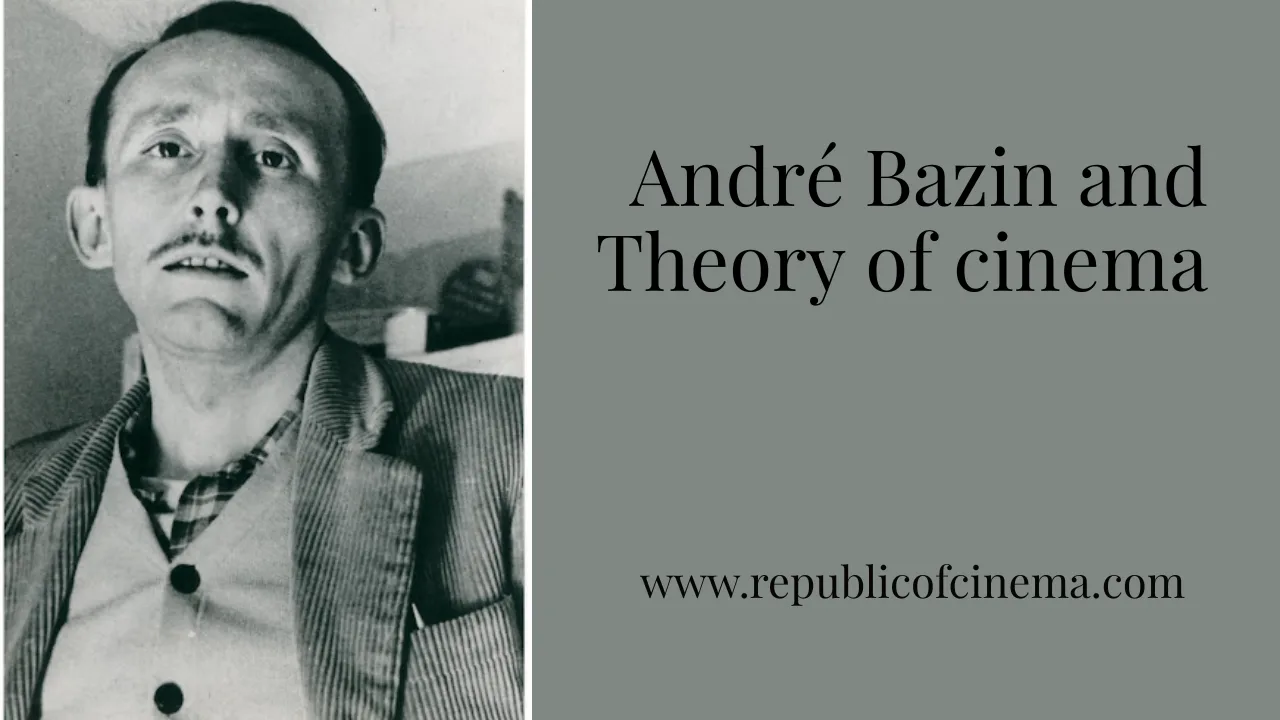
Bazin died in 1958, the day before François Truffaut began shooting The 400 Blows. He was forty years old. He had written enough to fill four volumes and to change permanently what serious people think cinema is for. Most of what is written about him misses the point. Here is the point.
André Bazin is taught in film schools as the theorist of realism — the critic who believed that cinema's greatest capacity was its ability to record the world as it actually is, and who therefore preferred the long take and deep focus photography to editing, which he saw as a manipulation of reality rather than a representation of it.
This summary is not wrong. But it is also not the interesting part.
The interesting part is why Bazin believed what he believed — the philosophical foundation beneath the critical preference — and why that foundation contains a view of cinema that is not primarily aesthetic but ontological. Bazin was not arguing about what looked better. He was arguing about what cinema is — about what kind of relationship with reality the moving image makes possible — and his argument is more urgently relevant in 2025 than it was in 1948, when he first articulated it, because the questions it raises have become the questions that define the most important arguments in contemporary cinema.
The ontology of the photographic image
Bazin's most important essay is called The Ontology of the Photographic Image, published in 1945. Its central argument is simple enough to state in one sentence and complex enough to spend a lifetime thinking about: the photograph is different from every other representational art form because it is not a human interpretation of reality but a mechanical record of it.
When a painter paints a portrait, the portrait is a human interpretation — it contains the painter's choices about what to emphasise, what to omit, how to render light, where to place the subject within the frame. The painting is a human mind's encounter with reality, not reality itself.
When a photograph is taken, the camera records light bouncing off a surface. The photograph is not a human interpretation of reality. It is a trace of reality — caused by reality in the same way that a footprint is caused by the foot that made it. The photograph is an index, not an icon. It does not resemble reality in the way a painting resembles it. It is produced by reality in a way that a painting is not.
This distinction — between resemblance and causation, between interpretation and trace — is the foundation of everything Bazin argued about cinema.
What this means for how films work
If a photograph is a trace of reality rather than an interpretation of it, then cinema — which is a sequence of photographs — has a unique relationship with time and space that no other art form has. Cinema does not represent what something looked like. It preserves what something was — a specific configuration of light and matter at a specific moment in time that will never recur.
This is why Bazin preferred the long take over editing. Editing, for Bazin, is an imposition of human meaning onto the flow of reality — a filmmaker deciding that this is what the scene means by cutting from this to that, directing the viewer's interpretation, preventing the viewer from making their own encounter with what is in the frame.
The long take, by contrast, preserves the ambiguity of reality — allows multiple things to coexist in the same frame at the same time, does not tell the viewer which of those things is most important, trusts the viewer to make their own interpretation of what they are seeing.
Bazin's famous example is William Wyler's The Best Years of Our Lives, where a single deep-focus shot shows a character in the foreground playing piano and another character in the background visible through a window, making a phone call. Both actions are happening simultaneously, both are visible to the viewer, and the meaning of the scene depends on the viewer's understanding of the relationship between the two — something that editing, by forcing you to look at one and then the other, would determine for you.
Where Bazin was right, where he was wrong, and why the argument still matters
Bazin was right that cinema has a unique relationship with reality that distinguishes it from every other art form. The photograph as index — as a trace of reality rather than an interpretation of it — remains the most important single idea in film theory and the one most necessary to understand before any other theoretical framework makes sense.
Bazin was wrong, or at least incomplete, in his preference for the long take over editing as a matter of principle. Eisenstein proved — most completely in the Odessa Steps sequence of Battleship Potemkin — that editing can create emotional and political meaning of a kind and intensity that the long take cannot. The montage that shows the baby carriage bumping down the steps does not record reality. It creates a moral reality — an argument about power and innocence and violence — that did not exist in any of its individual shots. Bazin's theory cannot fully account for this and he knew it.
But the argument Bazin and Eisenstein represent — between cinema as record and cinema as construction, between the long take and the cut, between the trust of ambiguity and the direction of meaning — is not a resolved argument. It is the argument that every serious filmmaker still navigates with every film they make.
When Tarkovsky holds a shot for seven minutes, he is choosing Bazin. When Eisenstein cuts thirty times in thirty seconds, he is choosing montage. When Alfonso Cuarón builds a four-minute unbroken take in Children of Men, he is using Bazin's formal strategy to achieve Eisenstein's moral effect — placing the viewer inside a reality they cannot escape through the cut.
The reason to understand Bazin in 2025 is not historical. It is practical. Every time you watch a film and ask why the director chose to cut here rather than hold the shot, or why the camera is moving rather than still, or why this scene is shot in one take rather than covered from multiple angles, you are navigating the argument Bazin articulated in 1945. Understanding the argument makes the navigation conscious. Conscious navigation is the difference between watching and reading. This entire section exists to make you a reader.
By Republic of Cinema · Film Theory · Cinema Studies · Republic of Cinema
💬 Discussion
0 comments