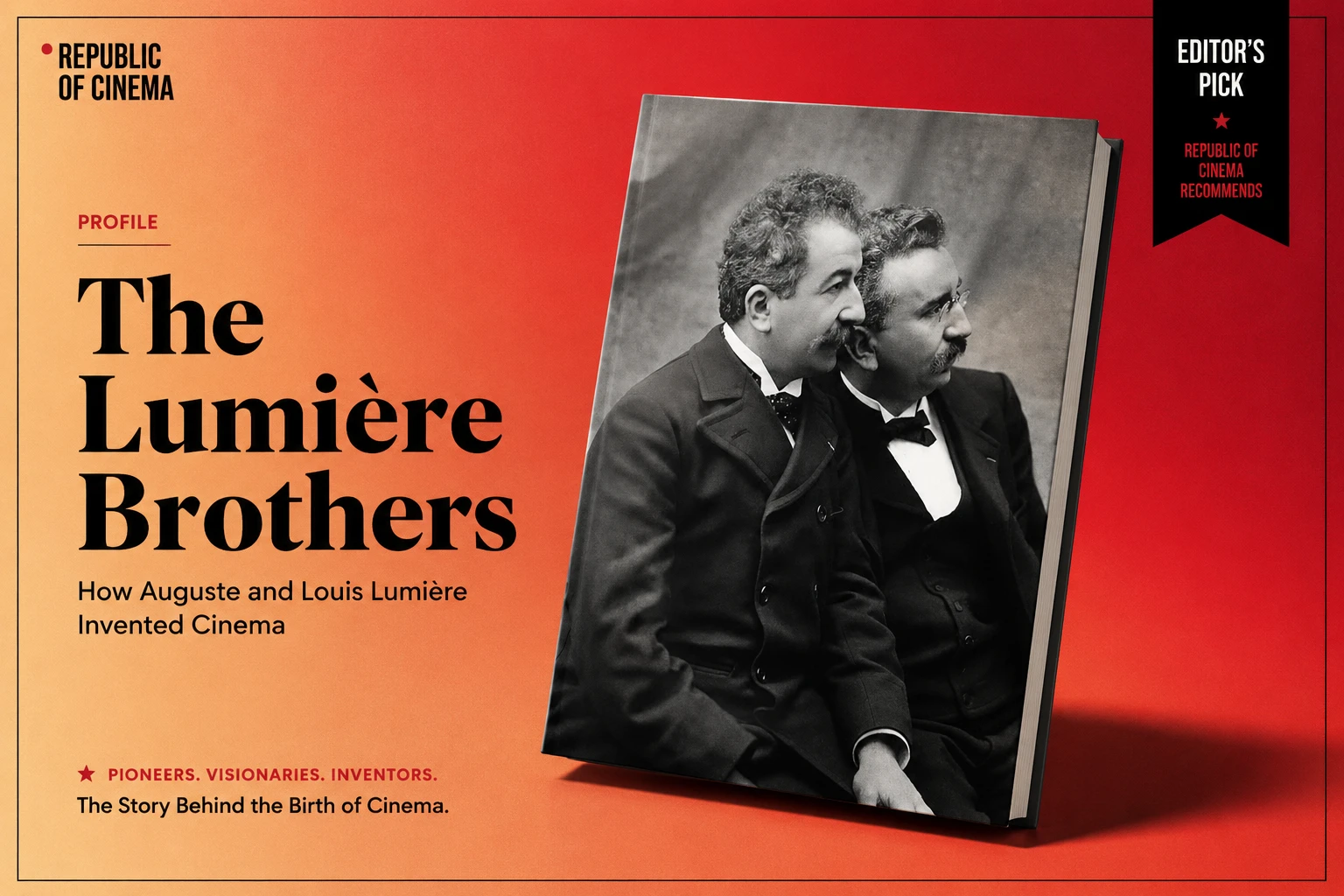
I · THE MOMENT HUMANITY LEARNED TO CAPTURE TIME
On the evening of December 28, 1895, something happened in the basement of a Paris café that had no precedent in all of human history. Thirty-three paying strangers descended the stairs of the Grand Café on the Boulevard des Capucines, settled into their chairs, and waited. A small machine , compact, wooden, almost unremarkable , was pointed at a white sheet stretched across the wall. The gas-lamps dimmed. A projector hissed. And then, on that pale rectangle of cloth, the world moved.
It was not a painting, not a magic lantern slide, not an illustration in a gazette. It was life itself , recognisable, breathing, continuous , unspooling at sixteen frames per second. Workers poured out of a factory gate in Lyon. Waves broke on a beach near Marseille. A baby sat in a garden while its parents ate lunch, and the leaves of the trees behind them trembled in an actual, recorded, irretrievable breeze from a summer afternoon years before. The audience, according to accounts that have been passed down, leaned forward. Some gasped. A few, it is said, pressed themselves back against their chairs when a train , a real, monstrous, iron train , appeared to bear down upon them from the screen.
That evening belongs to Auguste and Louis Lumière. And it belongs to all of us.
What the Lumière brothers gave the world that December night was not merely an invention, not simply a novelty, not another exhibit in an age already drunk on technological marvels. They gave the world a new relationship with time. They proved, for the first time, that a moment of existence , the glance of a woman, the posture of a laborer, the arc of water from a garden hose , could be lifted from its place in the river of passing seconds and held, preserved, replayed. Cinema, from its very first public breath, was a machine for defeating forgetting.
"The cinema is an invention without a future."
, Louis Lumière, c. 1895 , and history's most magnificently wrong prediction
Louis Lumière said this, or something very like it , and history has never allowed him to forget the irony. But perhaps the statement reveals something truer than its literal failure suggests. What he could not imagine was what cinema would become: the storytelling engine of the modern world, the grammar of collective dreams, the medium through which an entire century would understand itself. He could see what cinema was , a faithful recorder of the visible. He simply could not yet see how faithfully the visible world would be transfigured by imagination. That failure of imagination is itself one of cinema's most fascinating origin stories.
II · EUROPE BEFORE CINEMA
To understand what the Lumières created, one must first understand the world into which cinema arrived , a world, in many ways, desperate to see itself.
The late nineteenth century was an era of unprecedented acceleration. Industrialisation had transformed the European landscape within a single human lifetime: cities swelled, railways stitched the continent together, factories poured their smoke skyward over towns that had been fields within living memory. The pace of change was not merely economic , it was perceptual. People lived faster, moved farther, encountered more. And yet the technologies of representation could not keep up. Painting was slow and aristocratic. Photography had arrived in the 1830s, and by the 1890s had become a middle-class fixture , but it froze the world into stillness. It captured a moment, but not the flow between moments. Not the motion. Not the aliveness.
This gap between lived experience and its recorded image was felt acutely. Across Europe, inventors and showmen experimented obsessively with the problem of motion. Eadweard Muybridge had proven, famously and definitively, that a galloping horse lifted all four hooves simultaneously , a fact invisible to the naked eye, revealed only by a battery of cameras tripped in sequence across a track in California. His photographs, published and widely circulated, caused a minor sensation. Not because people had doubted the gallop, but because they had never truly seen it. Technology was teaching the human eye to look more carefully at the world it inhabited.
In France, Étienne-Jules Marey developed his chronophotographic gun , a device that captured multiple phases of motion onto a single rotating plate. Thomas Edison, in America, had built the Kinetoscope, a peephole machine through which one person at a time could watch looped images of acrobats and buffalo. The dream of projected, communal moving images was thick in the air. The Lumières, when they entered this field, did not arrive as dreamers. They arrived as engineers , and that precision of mind would define everything about what they made.
III · THE LUMIÈRE FAMILY AND THE WORLD OF PHOTOGRAPHY
Auguste Marie Louis Nicolas Lumière was born on October 19, 1862. Louis Jean Lumière followed two years later, on October 5, 1864. They were the sons of Antoine Lumière , a man of enterprise and visual appetite who ran a successful photographic portrait business in Besançon, and who later moved his family and operations to Lyon, where he built one of France's most productive photographic manufacturing companies. Their childhood was saturated with chemistry and light. The smell of darkroom reagents, the precision of sensitised plates, the alchemy of fixing an image in silver , these were the textures of the Lumière domestic world.
Antoine was not merely a tradesman. He was an enthusiast, the kind of driven father who transmitted his obsessions into his children with the force of vocation. By their teenage years, both Auguste and Louis were working in the family factory. Louis, the more technically brilliant of the two, showed a precocious gift for applied science. At seventeen, he reformulated the process for manufacturing dry photographic plates , the so-called étiquette bleue, the blue label plate , and the resulting product transformed the family business into a major industrial concern. Within a few years, the Lumière factory in Lyon was producing millions of photographic plates annually. They were, by any measure, the most technically accomplished photographic manufacturers in France.
The brothers complemented each other with an almost novelistic neatness. Louis was the inventor , restless, analytical, reaching always for the next technical problem. Auguste was the administrator, the businessman, the one who understood how ideas translated into enterprises. Their collaboration was the kind that history occasionally produces: two minds so different in temperament that together they form something greater than either could alone.
It was their father Antoine who, in 1894, brought back a demonstration of Edison's Kinetoscope from Paris and placed it before his sons. His words, as reported in various accounts, were direct: Fix this. Make something better. Louis, who had been ill and was convalescing at home, lay awake for much of one night thinking about the mechanism. By morning, he had conceived the essential solution to the central problem that had defeated every previous attempt at projected moving images: the intermittent claw mechanism. Within months, the Cinématographe was born.
IV · THE INVENTION OF THE CINÉMATOGRAPHE
The ingenuity of the Cinématographe was not merely mechanical , it was philosophical. Every previous motion picture device had solved only part of the problem. Edison's Kinetoscope could play images, but only one viewer at a time, and it was enormous, and it consumed film at a rate that made it impractical as anything but a novelty. Marey's chronophotography could record motion, but not reproduce it for an audience. The Lumières designed a machine that was simultaneously a camera, a film processor, and a projector , a device so compact and elegant that it could be carried in a valise, operated by hand-crank, and used on location anywhere that natural light was available.
The mechanism at its heart , the intermittent claw that seized each film frame, held it perfectly still for a fraction of a second before the shutter opened, then advanced to the next , was the critical breakthrough. Film must be still when light passes through it, or the image blurs into motion. But the frame must also move fast enough that the eye perceives continuity. Louis's claw solved both requirements with a simplicity that, like all great engineering solutions, seems obvious only in retrospect. The mechanism was inspired, some historians have noted, by the action of a sewing machine needle , a domestic object, humble and ubiquitous, that would help father a new art form.
The Cinématographe ran at sixteen frames per second , slower than the twenty-four frames that would become the standard of the sound era , which gave early Lumière footage its characteristic quality: slightly heightened, the world moving just a shade faster than life, as though existence itself were mildly excited. The film stock was perforated along one edge only, a simpler system than Edison's double-perforation, reflecting Louis's preference for elegant minimalism. The whole apparatus weighed approximately five kilograms. A cameraman could walk out of the factory, board a train to the coast, and capture the Mediterranean breaking against a harbour wall. This was not merely an engineering achievement. It was an act of liberation.
The French government, recognising the potential significance of the invention, invited the brothers to demonstrate it privately before the Société d'Encouragement pour l'Industrie Nationale on March 22, 1895 , the date generally recognised as the first projected film screening. The film shown was La Sortie de l'Usine Lumière à Lyon , Workers Leaving the Lumière Factory. The audience of scientists and industrialists watched with restrained astonishment. Private screenings followed across the summer. And then, in December, the public was invited in.
V · THE FIRST PUBLIC SCREENING AND THE SHOCK OF MOTION
The Grand Café on the Boulevard des Capucines occupies a peculiar place in the mythology of cinema , not because it was grand, though it was, but because of what it contains in retrospect: the zero point of an art form. The admission was one franc. The programme lasted approximately twenty minutes, comprising ten short films, each roughly fifty seconds in duration. The first paying audience in cinema history consisted of thirty-three people. By the end of the following week, the queue stretched around the block. Within months, the Cinématographe was travelling the world.
The legend of the train , of audiences screaming and fleeing their seats when L'Arrivée d'un Train en Gare de La Ciotat was first projected , has been disputed by film historians for decades. The film may not have been part of that first programme. The panic may be apocryphal, or at least exaggerated. But the legend persists because it contains a deeper truth about what moving images did to the nervous system of the nineteenth century viewer.
Consider what those first audiences had never experienced. They had seen photographs , still, grey, silent. They had seen theatrical performance , live bodies on a stage, obviously present, obviously fictional in their framing. They had perhaps seen magic lantern shows, hand-painted slides projected to illustrate lectures. But they had never seen a recording of real life, in continuous motion, projected at scale, of something they recognised as ordinary. The train at La Ciotat did not frighten them because they believed it was real. It frightened them , or startled them, or arrested them in ways they had no vocabulary to describe , because it occupied a space that had no category. Not real. Not fake. Not painting. Not performance. Something entirely new.
This experience of ontological disruption , the shock of confronting an image that does not fit any existing frame of understanding , is what the French call étonnement: astonishment so profound it becomes philosophical. The first cinema audiences were not naive. Paris in 1895 was one of the most culturally sophisticated cities in the world. These were people who had stood before Impressionist paintings, attended symbolist theatre, debated the nature of representation in the cafés of Montmartre. And yet moving images undid them in a way that art had not. Because moving images were not, in the end, art. They were evidence. They were proof that a moment had existed.
VI · CAPTURING EVERYDAY LIFE
What the Lumières chose to film is as significant as how they filmed it. Look at the catalogue of their early actualities , those brief, unedited recordings of the world , and what strikes you is not their drama but their absolute ordinariness. Workers leaving a factory. A train pulling into a station. A baby being fed by its parents in a garden. A gardener being tricked by a mischievous boy into spraying himself with a hose. Boats leaving a harbour. Cavalry officers on horseback. Blacksmiths at their anvil. Children playing in the sea.
There are no kings or battles in the Lumière catalogue. No theatrical tableaux, no operatic emotions. The brothers pointed their camera at the texture of daily life , at what was, in the language of their time, completely without prestige or artistic significance. And in doing so, they made one of the most radical aesthetic gestures in the history of art. They declared, without quite meaning to, that the ordinary was sufficient. That the sight of people walking, working, playing , of light falling on water, of smoke rising from a chimney , was enough to hold an audience, enough to constitute a spectacle, enough to matter.
La Sortie de l'Usine Lumière à Lyon , Workers Leaving the Lumière Factory , is often described as the first true film. Its subject could not be more prosaic: at the end of a working day, men and women stream out of a factory gate, some on bicycles, some on foot, a dog trotting casually through the frame. The gate closes. The film ends. Nothing has happened, in any narrative sense. And yet, watched today, it is extraordinarily moving. Those figures , their particular gaits, the swing of their arms, their hats and skirts and aprons , are now irrecoverable. They are gone, every one of them. But they are also, through this brief strip of film, somehow not entirely gone. They live in the record. They have crossed time.
L'Arroseur Arrosé , The Sprinkler Sprinkled , is often cited as the first staged comedy in film history, and it merits attention for several reasons. A gardener is watering his plants when a boy secretly treads on the hose, interrupting the flow. The gardener examines the nozzle in puzzlement; the boy releases the hose, drenching him; the gardener catches the boy and spanks him. It runs fifty seconds. It is, in all essentials, a knockabout pantomime gag older than Molière. But its presence in the Lumière catalogue tells us something important: even the founders of documentary realism felt the pull of narrative, of cause and effect, of human beings doing things to one another in time. The desire to tell stories was present from the beginning, latent in the medium itself, waiting to be released.
Repas de Bébé , Baby's Lunch, or Feeding the Baby , may be, in certain respects, the most personally resonant of the early Lumière films. It shows Auguste Lumière and his wife feeding their infant daughter in the garden of their home in Lyon. In the background, leaves stir in the wind. This detail , the wind, unposed, unmotivated, purely accidental , electrified early audiences. The projection of a breeze moving through recorded leaves proved more powerfully than any other element that what they were watching was not fabricated. Nature itself had been captured. The past was present, breathing.
"Every Lumière film is a small miracle of attention , the camera turning toward the world with a gaze that is, at once, scientific, tender, and almost unbearably mortal."
VII · REALITY, MODERNITY, AND THE BIRTH OF SPECTATORSHIP
The Lumière aesthetic did not emerge in a vacuum. It was shaped, consciously or not, by a particular intellectual climate: the positivism of late nineteenth-century France, its faith in observation, empirical record, scientific method. The Lumières were not film theorists , they were manufacturers who had turned their precision toward a new problem. But their technical philosophy carried implicit aesthetic commitments. The camera, in their conception, was an instrument of observation. Its job was to look, faithfully and without intervention, at what was actually there.
This placed them, almost accidentally, at the founding point of a tradition that would come to be called documentary cinema , a tradition in which the camera's principal virtue is its honesty, its fidelity to the unmanipulated real. André Bazin, the great mid-century French critic who remains perhaps the most important theorist of cinematic realism, identified in the photograph and the cinematic image a new kind of relationship between representation and reality. Unlike painting, which interposes the subjectivity of the artist between the world and its image, the photograph was a mechanical trace , the world's own imprint upon a sensitised surface. Cinema, for Bazin, was the fulfilment of what he called le mythe du cinéma total: the complete representation of reality, a mould of the world preserving it against time. The Lumières, without articulating the theory, had enacted it.
But the cinema they created was also, from the beginning, an experience of spectatorship , a social act, a public gathering, a shared confrontation with images. The significance of this cannot be overstated. The Lumières did not invent moving images in isolation. They invented the cinema audience. The basement of the Grand Café established a relationship , a room of people, in darkness, facing a bright rectangle, watching a version of the world unfold before them , that has remained essentially unchanged for a hundred and thirty years. Every film theatre in the world today replicates, in its fundamental architecture, the arrangement of that December evening in 1895. The chairs, the darkness, the screen, the projector, the crowd: this is the primal scene of cinema, and it belongs to the Lumières.
What does it mean to sit in darkness and watch moving images of the world? This question has occupied philosophers, psychologists, and film theorists for the entire life of the medium. Hugo Münsterberg wrote of cinema's capacity to simulate the movements of the mind , of attention, memory, imagination. Christian Metz theorised the cinema audience as caught between identification and voyeurism, between the pleasure of looking and the awareness of one's own gaze. But all of these investigations circle back to the same primal encounter that the Lumières staged: the encounter between a seated human being and a moving image that looks, with disarming exactness, like the world outside the door.
VIII · LUMIÈRE AND MÉLIÈS: REALITY AND FANTASY
In the audience at one of the earliest Lumière demonstrations sat Georges Méliès , then a successful stage magician and theatre owner who had come, like many in Paris's cultural world, to see what the fuss was about. He watched the Cinématographe with visible excitement and reportedly approached the Lumières afterward, offering to buy the machine. They declined. Méliès, undeterred, obtained a different projector, built his own camera, and began making films. The confrontation that followed , not a personal rivalry, but a divergence of cinematic philosophy , would define the entire subsequent history of the medium.
Where the Lumières pointed their camera at the world and accepted what the world gave them, Méliès pointed his camera at a stage and constructed a world from imagination. His films , A Trip to the Moon, The Impossible Voyage, The Haunted Castle , were not recordings of reality but fabrications of fantasy: painted backdrops, theatrical costumes, impossible events achieved through the camera tricks that Méliès pioneered. Stop-motion substitution. Double exposure. Slow fade. He discovered, almost by accident , legend has it that his camera jammed on a Paris street and when he reviewed the footage, a bus had transformed into a hearse , that film could lie. And that its lies could be magnificent.
The Lumière-Méliès contrast has become one of the foundational binaries of film theory, and like all useful binaries it is both illuminating and somewhat misleading. Cinema as witness versus cinema as dream. The real versus the imagined. The document versus the fiction. One can trace the Lumière line forward through Dziga Vertov and Robert Flaherty, through Italian neorealism and the French nouvelle vague, through the cinéma vérité of the 1960s and the observational documentaries of Frederick Wiseman, through the films of Jia Zhangke and the Dardenne brothers , all those filmmakers for whom the camera's primary relationship is one of attendance upon the world, of watching and listening with patience and humility. And one can trace the Méliès line through Griffith's narrative grammar, through the expressionist shadows of German cinema, through Orson Welles and Stanley Kubrick, through every director who treats the frame not as a window onto reality but as a canvas for the imagination.
But the binary simplifies. Méliès was telling stories about human longing , about the desire to travel to impossible places, to defy death, to see what lies beyond the horizon of the possible. And the Lumières, in their best films, were doing something more than recording. They were selecting. They were composing. They were making judgments about what was worth watching and from where. The first frame of La Sortie de l'Usine is not raw reality , it is a considered arrangement of reality, a choice about where to stand and when to start cranking. Every act of pointing a camera is an act of interpretation. The Lumières simply kept that act as transparent as they could.
Méliès himself understood the division better than most later commentators. Toward the end of his life , a life that ended in near-poverty, his films largely forgotten, his studio demolished , he described himself as a worker in fantasy and the Lumières as workers in fact. He said this without bitterness. He understood that both were necessary. What cinema needed, in its earliest years, was the discovery that it could do both: that it was capacious enough to contain the world and to transcend it, to record time and to stop it, to witness a gardener in Lyon and to fly a rocket-ship to the moon.
IX · THE LEGACY OF THE LUMIÈRE BROTHERS
The Lumières withdrew from filmmaking with a speed that still surprises those unfamiliar with their story. By 1905, they had largely abandoned cinema production, sold their patents, and returned to their central business: photographic technology. Louis, characteristically, threw his formidable intelligence at the next optical problem. He would later develop colour photography through the Autochrome process , the first practical commercial method for producing colour photographs , which itself deserves to be remembered as one of the great technological achievements of the twentieth century. He remained, until his death in 1948, an active inventor and scientist. Auguste devoted much of his later life to medical research. Cinema, for both of them, had been a chapter , a spectacular one, but a chapter nonetheless.
This has led some historians to characterise the Lumières as men who failed to understand what they had created , who saw the Cinématographe as a scientific instrument rather than an art form, and who therefore could not have foreseen, let alone shaped, the medium's development into narrative fiction. The indictment has some truth. The brothers were not interested in telling stories. They did not develop editing as a technique , the cut, the dissolve, the match-on-action, the close-up: all of these were developed by others. They did not use actors or scripts. They did not imagine a cinema of dreams.
But this critique mistakes one kind of limitation for another. The Lumières were not limited in their intelligence or their imagination. They were limited, consciously, by a different vision of what cinema should do. They believed , and in this belief they were profoundly, enduringly right , that the faithful recording of reality was itself a sufficient achievement. That there was no need to invent what was already there. That the world, properly attended to, was more astonishing than anything a human mind could fabricate.
The proof is in the films themselves. Watch La Sortie de l'Usine Lumière à Lyon today. Watch those men and women walk through the gate, watch the dog cross the foreground, watch the bright Lyon sky above the factory roof, and try , genuinely try , to tell yourself this is not extraordinary. These people are not performing. They are simply going home from work on an afternoon in 1895. And yet they are here with us now. Their faces are specific. Their movements are individual. They are not types or symbols or characters in a narrative. They are people. And they have crossed more than a century to stand before us.
The Lumière legacy runs deep in cinema, deeper perhaps than is commonly acknowledged. Whenever a filmmaker chooses to work with non-professional actors, to shoot on location, to allow the unpredictable textures of the real world to contaminate the controlled environment of a set , whenever a director trusts reality rather than fighting it , there is something of the Lumière philosophy at work. Roberto Rossellini filming in the rubble of postwar Rome. Abbas Kiarostami following a young boy through the earthquake-flattened villages of northern Iran. Agnès Varda walking through the market stalls of Noirmoutier with a camera so light it barely intrudes upon the world it observes. These filmmakers would not describe themselves as followers of the Lumières , but the kinship is real, and it is deep.
X · CONCLUSION , WHY THE BIRTH OF CINEMA STILL MATTERS
We are living, in the early twenty-first century, in an age of images so saturated, so relentless, so algorithmically personalised that the very notion of a shared encounter with a moving image has begun to seem old-fashioned. We watch films on our phones in bed. We pause mid-scene to check a notification. We scroll past clips of other people's ordinary lives , their meals, their gardens, their children, their pets , at a rate that would have been literally incomprehensible to the audience of the Grand Café. And yet the central act that the Lumières performed , the act of pointing a camera at the world and saying: this is worth seeing, this matters, this will be lost if we do not preserve it , has never been more widely enacted, or more urgently necessary.
Every person who has ever filmed their child's first steps, their mother's last garden, their street in the aftermath of a snowstorm, is doing what Auguste and Louis Lumière did on a summer afternoon in Lyon in 1895. They are reaching into the flow of time and holding something still. They are refusing to let a moment be entirely swallowed by forgetting. They are saying, with a camera that would have struck the Lumières themselves as unimaginably miniaturised and powerful: this existed. Look. Remember.
Cinema, in this sense, began not as entertainment , or not only as entertainment , but as an act of love toward the perishable. The Lumières loved the visible world. They loved the texture of light on the surface of things. They loved the fact that human beings were, despite everything, interesting to look at , in their particularity, their accidental grace, their unconscious beauty. They built a machine to serve that love. And in building it, they changed what it means to be human in time.
The train at La Ciotat is still pulling into the station. The workers are still pouring through the factory gate. The baby is still being fed in the garden, and the leaves behind her are still moving in a wind that blew one hundred and thirty years ago. The Lumières understood something that all great documentary filmmakers have understood since: that reality, honestly looked at, does not need to be improved. It only needs to be seen.
💬 Discussion
0 comments