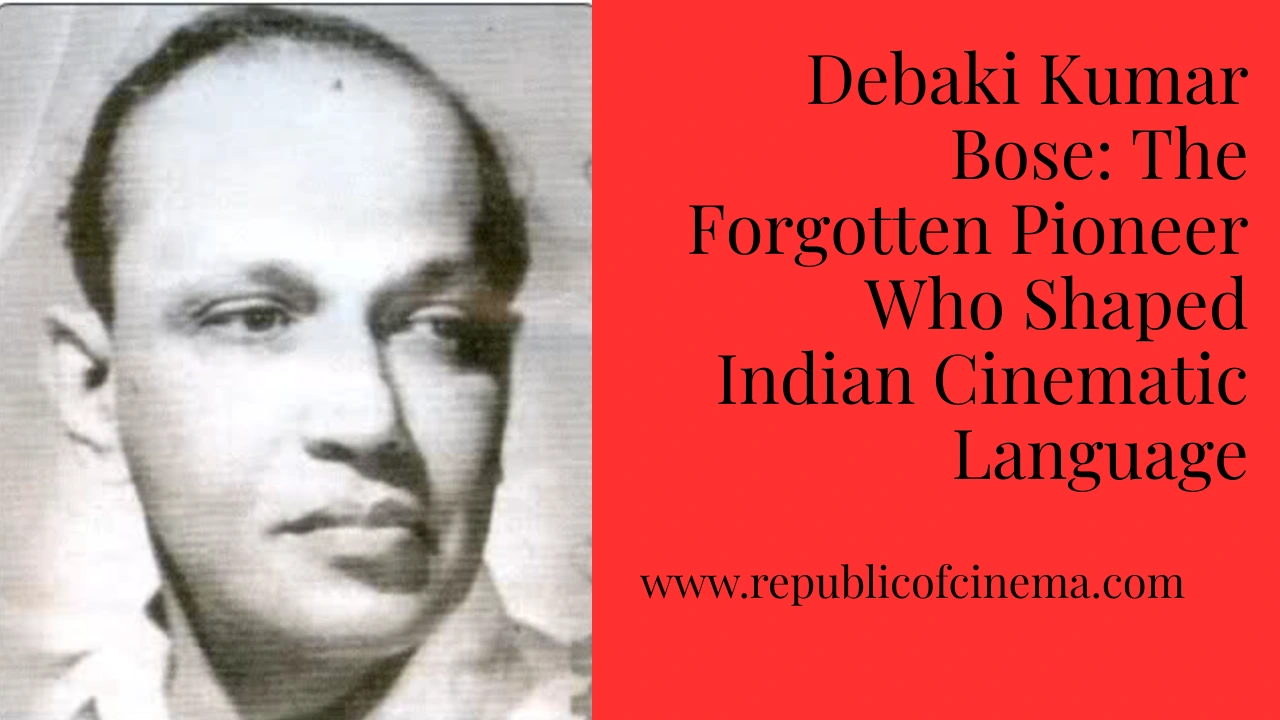
There is a scene in Chandidas, the 1932 sound film directed by Debaki Kumar Bose, in which a temple singer named Chandidas , a fifteenth-century Bengali saint-poet, a man of Brahmin birth and devotional fire , reaches across the invisible wall of caste to declare his love for Rami, a washerwoman. He does not declare it in the language of social rebellion, at least not on the surface. He declares it in the language of the divine, of the Vaishnav tradition that sees the beloved as a vessel of the sacred, the human as continuous with the holy. The scene is filmed with a stillness and an emotional precision that belongs to no genre category of early Indian cinema that one can easily name. It is not a spectacle. It is not a theatre photographed. It is something that requires a word we now associate with filmmakers who came a generation later: it is cinema.
Bose made that scene in 1932. Satyajit Ray made Pather Panchali in 1955. The twenty-three years between them contain the entire official founding mythology of Indian realist cinema. Bose is almost never in that mythology.
This is the essay's opening proposition, and it is also its central injustice: Debaki Kumar Bose is one of the most important filmmakers in the history of Indian cinema, and almost no one outside a small circle of scholars and archivists knows his name. The emotional architecture, the sonic intelligence, the understanding of Bhakti consciousness as cinematic grammar, the insistence that devotional tradition and artistic modernity were not opposites but the same inquiry pursued in different vocabularies , all of it was already present, fully formed, in Bose's films of the 1930s and 1940s. When the generation of Ray and Bimal Roy and Guru Dutt arrived and began building what the world would eventually recognize as the artistic peak of Indian cinema, they were, often unknowingly, completing work that Bose had already begun.
That he completed it first, and that the world has largely not noticed, is a fact about cinema history. It is also a fact about who gets remembered, and how, and why.
The Bengal He Was Born Into
Debaki Kumar Bose was born in 1898 in a Bengal that was, by any honest measure, one of the most intellectually alive places on earth. The Bengal Renaissance , that extraordinary convergence of literary, philosophical, political, and artistic energy that had been building since the early nineteenth century , was still cresting. Tagore was in the middle of his creative life, still writing poetry and novels and plays, still reshaping the emotional language of an entire civilization. The literary realism of Bankimchandra Chattopadhyay and the humanist compassion of Sarat Chandra had already reconfigured what Bengali fiction understood as its obligations to ordinary human experience. The theatre traditions of the region, particularly the jatra and the professional proscenium theatre of Calcutta, had developed a complex performance culture that fused classical aesthetics with contemporary social content.
Into this culture the young Bose arrived with a literary sensibility and a theatrical background. He came to cinema not as a technician but as someone already formed by the belief that art was a moral instrument, that the story was responsible to the life it depicted, that the audience was not merely an entertainment consumer but a participant in a shared act of emotional and ethical inquiry. These were not abstract positions. They were the common assumptions of the Bengali intellectual class of his generation, absorbed from Tagore and Bankim and the wider atmosphere of a culture that had been arguing, for nearly a century, about what it meant to be both modern and Indian, both universal and rooted.
This background is inseparable from what Bose made and how he made it. When he arrived at New Theatres in Calcutta in the early 1930s, he brought with him a formation that was more literary and philosophical than cinematic. He had to learn cinema , had to discover what the camera could do that the stage could not, had to understand the specific properties of the moving image as distinct from all other arts. What he brought to that education was a set of values that had been trained in Bengal's literary culture: the conviction that ordinary people's inner lives were worthy of artistic attention, that spiritual experience was inseparable from social experience, and that music was not decoration but the medium through which the deepest human truths were most honestly expressed.
New Theatres and the Idea of Indian Cinematic Seriousness
The story of New Theatres is the story of what becomes possible when an institution decides that an art form deserves to be taken seriously. Founded in Calcutta in 1930 by B.N. Sircar, the studio was not born of commercial ambition alone. Sircar wanted to make films worthy of the culture that surrounded him , films that could use the new medium of synchronized sound not merely to replicate the conventions of popular theatre or import the grammar of Hollywood, but to develop something that was authentically Indian and authentically cinematic at the same time.
What he assembled, in doing so, was a remarkable community of talent: musicians who understood both classical Indian traditions and Western orchestral practice, writers who brought literary rigour to scenarios and dialogue, and directors , among them Bose, Nitin Bose, P.C. Barua, and others , who were genuinely thinking about what Indian cinema could be rather than simply executing what it conventionally was. The atmosphere of New Theatres was, by all accounts, more like a literary atelier than a commercial studio. Arguments happened. Experiments were attempted. Failure was permitted in the service of discovery.
Bose thrived in this atmosphere because his questions were exactly its questions. How do you use the new technology of synchronized sound not merely to record dialogue but to create an entire sonic world , an environment of temple bells and rain, of devotional singing drifting through space, of silence that carries emotional weight? How do you film devotional experience without either reducing it to spectacle or making it feel like illustrated theology? How do you adapt the emotional vocabulary of Bhakti poetry , a tradition built on interiority, on the experience of separation and longing and surrender , into the necessarily external language of moving images?
These were not simple questions, and the fact that Bose was asking them in the early 1930s, when cinema in most of the world was still working out the basic mechanics of synchronized sound, tells you something about the particular intellectual environment New Theatres created.
Chandidas (1932): Devotion as Social Rebellion
The film that establishes Bose's importance is Chandidas, released in 1932, one year after India's first sound film and at a moment when Indian cinema was still feeling its way toward an aesthetic of the spoken word. Most of what was being made in Indian studios at that time was, in practice, filmed theatre , plays in front of cameras, dialogue delivered to footlights that no longer existed, the entire emotional vocabulary of the stage transplanted into a medium it did not yet fit. Bose looked at this situation and decided to do something entirely different.
Chandidas tells the story of the fifteenth-century Bengali Vaishnav saint-poet whose compositions , devotional lyrics addressed to Krishna and Radha, celebrating love as the highest form of spiritual experience , are among the foundational texts of Bengali literary culture. In Bose's film, the historical Chandidas becomes a figure of double transgression: a man who violates caste hierarchy by loving a woman of lower social position, and a man who violates institutional religion by insisting that the God experienced in emotional union with another human being is more real than the God experienced through ritual purity.
Bose filmed this without the theatrical bombast that the subject could have invited. His Chandidas is not a saint in the hagiographic sense, not a figure of miraculous aura performing spectacles of devotion for an audience of worshippers. He is a man, specific and particular, whose spiritual conviction has made him gentle, whose love has made him vulnerable, and whose gentleness and vulnerability place him in direct conflict with a social order organized around hierarchy and the management of spiritual status. The film's argument , expressed not through speeches or ideological confrontation but through the accumulated emotional weight of observed human behavior , is that institutionalized religion and genuine spiritual experience are not merely in tension but are often in active opposition.
This was radical in 1932. It would be radical in any year.
The famous declaration embedded in the film , "Sabar upar manus satya, tahar upar nai" (Above all is humanity, above that there is nothing) , is not offered as a slogan. It arrives as a conclusion that the film has earned through its emotional logic, and it arrives in the specific rhythmic cadence of devotional language, which means it sounds not like a political position but like a prayer. This is exactly right, and it reflects Bose's deepest understanding of what Bhakti traditions were: not a theology of withdrawal but a theology of radical democratic presence. The saint's love is not different in kind from the washerwoman's love. The Brahmin's spiritual experience is not superior in quality to the Dalit's. To feel is to be human, and to be human is to stand in the same relationship to the divine.
The film's sonic world was itself an argument. Bose used the new technology of synchronized sound not to fill the screen with dialogue but to create an atmosphere , devotional songs moving through air, the particular acoustic quality of a temple environment, the sound of water and birds establishing a natural world that continued indifferently around the human drama being enacted within it. This was an understanding of film sound that most of the world's cinema would not arrive at for another decade.
Seeta (1934): The Venice Moment and What It Meant
In 1934, Seeta , Bose's adaptation of the Ramayana's most intimate episode, the relationship between Rama and Sita as one of cosmic fidelity and unbearable separation , was screened at the Venice Film Festival. It won recognition as one of the outstanding films of the year. This was the first time an Indian film had achieved formal recognition at a major international festival, and the significance of that fact tends to be discussed today in nationalistic terms , as a moment of Indian cinema announcing itself to the world , rather than in the artistic terms that actually matter.
What Venice recognized in Seeta was not exoticism and not spectacle. It was craft: the specific quality of Bose's visual and sonic imagination, his understanding of the relationship between image and music, his ability to give epic material an emotional intimacy that transcended the scale of the mythology being depicted. The Ramayana is, among other things, a story about the destruction of a marriage by duty , about what it costs two people who love each other to submit to the demands of their civilization. Bose filmed it as a human tragedy with cosmological dimensions, rather than a cosmological spectacle with human ornaments.
The distinction sounds technical but it is everything. When you film human experience as ornament for a grand ideological or religious narrative, the people on screen become symbols, their suffering becomes illustration, and the emotional connection between the audience and the characters is replaced by a relationship of reverence or ideology. When you film the cosmological through the intimately human , when you make Sita's grief the entry point into the entire moral architecture of the Ramayana rather than using the Ramayana as the frame that justifies the grief , you create an entirely different kind of experience for the audience. You create what Indian aesthetics called karuna in its deepest sense: not the observation of suffering from a distance but the participation in it.
Venice saw this. The mainstream history of Indian cinema, organized around the auteurs of the 1950s, has largely forgotten to look back and see it too.
Vidyapati (1937): The Devotional and the Sensual
Vidyapati was released in 1937 and was made simultaneously in three languages , Hindi, Bengali, and Tamil , a practical requirement of studio-era distribution that Bose turned into an aesthetic opportunity by understanding that each linguistic version was a different emotional interpretation of the same material rather than a simple translation.
Vidyapati was a fourteenth and fifteenth-century Maithili poet whose compositions on the love of Radha and Krishna are among the most sensuously charged devotional texts in any Indian language. The Radha-Krishna tradition occupied a peculiar position in Indian spiritual culture: it was simultaneously the most physically and erotically charged of the devotional traditions and the one most insistently understood as metaphysical , the body's desire standing as the most honest available metaphor for the soul's desire for union with the divine. Vidyapati's poetry lived exactly in that tension, refusing to resolve it into either pure eroticism or pure metaphysics, insisting on the simultaneity of both.
Bose's film inherited and honored this tension. The visual language of Vidyapati drew explicitly on the traditions of Indian miniature painting , the Kangra and Pahari schools especially , in which the depiction of the divine lovers was inseparable from a refined sensual aesthetics, from the expressive power of color and posture and the arrangement of figures within natural landscapes. Bose understood that to film this material in the naturalistic mode of contemporary Hollywood or European cinema would be to misrepresent it fundamentally. The conventions of European realism were built on a specific ontology , the idea that what the camera recorded was a slice of observable reality , that was philosophically alien to the devotional aesthetics Vidyapati's poetry inhabited.
So he built another way of seeing. His compositions in Vidyapati are frankly painterly. They refer to a visual tradition that his audience would have recognized, creating a double level of experience in which the film is simultaneously a narrative and a meditation on a shared cultural inheritance. The devotional songs function within this framework not as interruptions to the story but as the story's deepest level , the moments when the film abandons linear narrative time and enters devotional time, the cyclic, repetitive, internally rich temporality of music and ritual, which is the only time in which certain kinds of experience can be properly held.
This understanding of cinematic time , the idea that a film does not have to move uniformly forward, that music and devotion can create zones of suspended or altered temporality within a narrative , was, in 1937, a genuinely advanced theoretical position. It is also, not coincidentally, one of the properties of Indian cinema that has most consistently puzzled Western audiences and critics who have tried to understand it through the assumptions of narrative realism.
Sound as Soul: The Sonic Revolution
To write about Debaki Kumar Bose without writing at length about his use of sound is to write about a painter without discussing color. Sound was, for Bose, not a supplement to the visual image but an equal or prior element of the cinematic experience , an understanding that was far ahead of most of his contemporaries anywhere in the world.
This was not simply a matter of musical sophistication, though his use of music was sophisticated. It was a philosophical position about what sound could do that the visual image could not. The image, however powerful, is always anchored in the visible, the present, the external. Sound can reach interior states , it can inhabit the space between what is seen and what is felt , in ways that the image cannot follow. A face in close-up can tell you what someone appears to be experiencing. The sound that accompanies that face , the specific quality of a devotional song heard at a distance, the texture of silence in a temple courtyard, the layering of a raga against the sound of rain , can tell you what the experiencing actually is.
Bose had come from a culture in which sound was understood as cosmologically primary. The Vedic and Sanskrit aesthetic traditions located the origin of existence in sound , in Om, in the primal vibration from which all form emerged. The Vaishnav traditions in which Chandidas and Vidyapati were embedded understood music as the most direct pathway to spiritual experience, the vehicle through which the devotee's ordinary consciousness could be lifted toward the experience of the divine. The kirtan and bhajan traditions of Bengali devotional culture were not performance traditions in the Western sense , they were participatory, transformative practices in which the singer and the listener were both engaged in an act whose purpose was internal rather than external.
When Bose brought this understanding to cinema, he was not importing a religious practice into a secular medium. He was recognizing that cinema, as a collective experience in darkness, shared certain structural properties with devotional performance , that the suspension of ordinary consciousness, the heightened emotional receptivity, the participation in a shared symbolic world , were available to cinema in a form that no other modern art could quite replicate. He was, in this sense, one of the first filmmakers to understand what Walter Benjamin was beginning to theorize at roughly the same period: that cinema had changed not just the content but the very structure of collective experience.
His naturalistic use of ambient sound was an extension of this insight rather than a separate phenomenon. When he recorded the actual acoustic environment of the locations his films inhabited , the specific resonance of a temple courtyard, the ambient sounds of a riverside, the texture of a crowd at devotional ceremony , he was not pursuing documentary authenticity in the manner of later realist movements. He was building a sonic world that the audience could inhabit rather than observe, that would place the viewer inside the emotional and spiritual environment of the story rather than in front of it.
Nartaki (1940): Between the Sacred and the Sensual
Nartaki (1940) is the film in which Bose most explicitly confronted the tension that runs beneath all of his devotional films: the tension between sensual beauty and spiritual transcendence, between the body as divine vehicle and the body as worldly temptation, between the classical Indian understanding of art as a path to the sacred and the more puritanical strains within Indian culture that regarded artistic performance , particularly dance , with suspicion.
The film's subject is a classical dancer, and its central conflict turns on whether the dancer's art is a form of worship or a form of corruption. This was not an abstract debate in the India of 1940. The devadasi system , the tradition of women dedicated to temple service as ritual performers , had been the subject of intense social reform efforts and moral condemnation throughout the preceding decades. The women who inhabited that system were, depending on who you asked, either guardians of a sacred artistic tradition or victims of institutionalized exploitation. Both things were true simultaneously, and Bose was honest enough as a filmmaker to know that both things were true simultaneously.
Nartaki does not resolve this tension into a simple moral position. It holds it , gives it a form in which the beauty and the tragedy coexist without either erasing the other. The dancer's art is shown as genuinely transcendent: the choreography and the performance aesthetics draw on classical traditions of a kind that had not previously appeared in Indian cinema with this degree of formal fidelity. And the structures of power that surround the dancer are shown as genuinely oppressive: the film does not aestheticize exploitation under the cover of spiritual language.
This balance , between the honest acknowledgment of institutional harm and the genuine appreciation of what was beautiful and spiritually serious in the tradition being criticized , required a moral intelligence that is difficult to achieve and even more difficult to film. Bose achieved it. And in doing so, he created a template for how Indian cinema could approach the intersection of spirituality, gender, and social power that later filmmakers , Satyajit Ray in Devi, Mrinal Sen in his examinations of female experience under patriarchal tradition , would return to repeatedly.
Bhagaban Shri Krishna Chaitanya (1953): The Mystical Late Film
By 1953, when Bose made Bhagaban Shri Krishna Chaitanya , his film on the sixteenth-century Bengali saint who founded the Gaudiya Vaishnav tradition and who remains, for many Bengalis, the most historically proximate embodiment of Bhakti consciousness , he was working in a changed cinematic landscape. Satyajit Ray was preparing Pather Panchali. Bimal Roy had just released Do Bigha Zamin. A new generation was arriving, shaped by Italian Neorealism and French criticism and the aftermath of partition and independence, asking new questions of Indian cinema that had nothing to do with devotional tradition.
Bose understood this, and Bhagaban Shri Krishna Chaitanya is a film that knows its own position in the historical moment , that carries within its frames a consciousness of what was ending as well as what was being celebrated. Chaitanya himself was a figure of total surrender, of the complete dissolution of individual ego into devotional love , a saint so consumed by the experience of divine union that he would fall into ecstatic states that contemporary observers described as simultaneous madness and enlightenment. Bose filmed this not with the narrative distance of hagiography but with the kind of interior attention his work had always brought to devotional experience.
The film's devotional music , drawn from the kirtans and bhajans of the Chaitanya tradition, which remain living performance forms in Bengal today , functions as the primary vehicle of meaning rather than as accompaniment to visual narrative. This was a mature version of the sonic philosophy Bose had been developing since Chandidas twenty years earlier: the idea that music was not illustration but argument, not decoration but the film's deepest level of emotional and spiritual communication.
There is something elegiac about the film, in retrospect. It was made by a man at the end of a long career, by a filmmaker who had spent decades insisting that Indian cinema could be simultaneously popular and philosophically serious, that Bhakti traditions were not an embarrassment to be transcended but a resource to be honored and explored. And it was made at the exact moment when Indian cinema was, under the pressure of new international models and new national anxieties, beginning to look elsewhere for its aesthetic foundations.
The Question of Influence
When Satyajit Ray began making films in the mid-1950s, he acknowledged his debt to Renoir and De Sica, to the Italian Neorealists, to the European art cinema tradition. He was honest and articulate about his influences, and those acknowledgments shaped how his films were understood internationally: as Indian cinema finally arriving at a cinematic language that the world could recognize and honor.
What tends to be underacknowledged , by Ray himself, by international critics, and by much of the subsequent scholarship on Indian cinema , is the extent to which Bose and the New Theatres generation had already been asking Ray's questions, in Bengali, a generation earlier. The naturalistic performance tradition that Ray brought to Pather Panchali , the attention to the specific textures of ordinary life, the refusal of theatrical grandeur, the willingness to let silence and environment carry emotional weight , had precedents in Bose's work that the mythology of Indian cinema has obscured.
This is not a criticism of Ray. It is a criticism of how film history is written , of the tendency to organize artistic genealogies around the figures who achieved international recognition, and to treat those figures as originary rather than as moments in a longer tradition. Ray was a great filmmaker. He was also a great filmmaker working within a Bengali cultural context that Bose had helped to form.
The debt to Bose is even more visible, and even less often discussed, in the work of Ritwik Ghatak. Ghatak's cinema , its use of folk and devotional sound as a kind of civilizational memory, its understanding of partition as a spiritual wound as much as a political one, its relationship to Bengali mythic and literary archetypes , is directly descended from the New Theatres tradition that Bose helped to define. The way Ghatak uses music in films like Meghe Dhaka Tara and Subarnarekha , as eruption rather than illustration, as the sound of a culture's grief finding its way to the surface through the body of a film , is a development of exactly the sonic philosophy that Bose had been practicing since 1932.
Guru Dutt's relationship to this tradition is more indirect but no less real. The quality in Dutt's films that most distinguishes them from other Hindi commercial cinema of the period , the sense that his protagonists inhabit a devotional emotional space even when the narrative is entirely secular, that their suffering has a spiritual dimension that transforms it into something closer to viraha, the Vaishnav tradition's concept of longing-in-separation as the highest form of devotional experience , is traceable, through the complex pathways of cultural transmission, to the Bhakti aesthetic that Bose helped bring into the mainstream of Indian cinema.
Why He Was Forgotten
The mechanisms by which a figure as important as Debaki Kumar Bose can recede from mainstream film history are not accidental. They are the products of specific forces that operate in specific ways, and understanding them is part of understanding Indian cinema's relationship to its own past.
The first force is archival. India has lost a catastrophically large proportion of its early film heritage. The physical prints of many of Bose's films either no longer exist or survive in damaged, incomplete, or technically degraded forms that make the films difficult to screen and therefore difficult to study. When films cannot be seen, their directors cannot be fairly evaluated. The National Film Archive of India has done important preservation work, but the resources available for archival work have never been commensurate with the scale of the problem, and films continue to be lost to neglect, humidity, and institutional indifference.
The second force is critical. The international framework through which Indian cinema achieved global recognition in the 1950s and 1960s , the framework built around Ray's relationship to European art cinema, around the Venice and Cannes and Berlin responses to films that could be understood through the lens of Italian Neorealism and the French New Wave , systematically undervalued work that could not be understood through those lenses. Bose's cinema was not anti-realist in the European sense; it was devotionally realist in the Indian sense, which means it operated according to aesthetic principles that the dominant international critical vocabulary did not have adequate categories to describe. What could not be described was not reviewed. What was not reviewed was gradually forgotten.
The third force is national. Post-independence India was, understandably and in many ways necessarily, oriented toward the future , toward the construction of a modern secular national identity that would distinguish the new republic from both the colonial past and the communal violence of partition. In this context, the devotional and spiritual dimensions of early Indian cinema could appear not as a resource to be inherited but as a cultural inheritance to be transcended. The prestige of the new national cinema , of Ray and Bimal Roy and Ritwik Ghatak , was partly built on the perception that it had left behind the mythological and devotional traditions of earlier filmmaking. That the leaving behind was more complicated than this narrative suggested, that figures like Bose were already working across the apparent divide between tradition and modernity, was an inconvenient complication of a useful story.
These forces do not make Bose's marginalization inevitable. They make it explicable, which is different. And explicability is the first step toward repair.
The Bhakti Aesthetic and What Cinema Learned From It
It is worth pausing, in an essay on Bose, to think more carefully about what exactly Bhakti traditions brought to Indian cinema , not in the obvious sense of devotional subject matter, but in the deeper sense of emotional structure and understanding of the audience.
Bhakti was, among other things, a revolution in the theory of spectatorship. The dominant understanding of religious and artistic experience in the Brahminical tradition had emphasized detachment , the ability of the contemplative individual to observe experience without being absorbed by it, to maintain the perspective of the witness rather than the participant. Bhakti inverted this hierarchy. In the devotional traditions that Kabir and Mirabai and Chaitanya embodied, the highest spiritual experience was precisely one of total absorption , of the dissolution of the boundary between the devotee and the object of devotion. The goal was not to stand apart and observe the divine but to be overwhelmed by it, to lose the individual self in the collective experience of surrender.
This understanding of ideal spectatorship entered Indian cinema through the cultural transmission of Bhakti aesthetics, and it shaped Indian film viewing in ways that persist today. The Indian film audience has historically been willing to be overwhelmed, to weep openly, to participate physically in music sequences, to respond collectively to emotional moments in ways that Western audiences, trained in a tradition of aesthetic detachment inherited from Kantian aesthetic theory, would regard as undisciplined. This is not naivety. It is a different theory of what the relationship between an audience and an art form should be , a theory in which the purpose of the experience is emotional transformation rather than aesthetic contemplation.
Bose understood this. His films do not invite detached appreciation. They invite emotional participation. The devotional music in Chandidas and Vidyapati does not create a mood for the audience to appreciate from a distance. It creates an experience for the audience to enter. The silence in his films , the specific quality of silence in a temple courtyard or after a devotional song , is not the European modernist silence of alienation and absence. It is the devotional silence of presence, of the interior fullness that comes after sound has opened a space within you.
This is a distinction that requires cinema to be made differently, and received differently, and ultimately judged differently. It is one reason why Bose's films, when viewed through the frameworks of European film criticism, can appear to lack the qualities , narrative economy, psychological realism, formal self-consciousness , that European critical tradition regards as marks of cinematic achievement. They are not lacking those qualities. They are pursuing different ones, in service of a different theory of what cinema is for.
The Case for Reclamation
To write about Debaki Kumar Bose today is inevitably to write a case for reclamation , to argue that the history of Indian cinema, as it is currently told, is incomplete in ways that matter, and that the incompleteness is not simply a problem of historical accuracy but a problem of self-understanding.
Indian cinema in 2025 is the world's largest by volume of production and one of its most culturally influential by global reach. Its most commercially successful forms , from Bollywood to the South Indian mass cinema that has, in recent years, attracted audiences far beyond the subcontinent , are built on aesthetic structures that have deep roots in the devotional and literary traditions that Bose was working within and through in the 1930s. The musical number as emotional expression rather than narrative interruption, the willingness to use grandeur in the service of feeling rather than spectacle, the understanding that the audience comes to a film as participant in a shared emotional experience rather than as consumer of a finished product , these properties of Indian popular cinema are not accidents or irrationalities but the expression of a coherent aesthetic philosophy with a long history.
Bose is part of that history. Understanding him is part of understanding what Indian cinema is and where it comes from. And understanding where it comes from is, always, the beginning of understanding where it might go.
A cinema that does not know its own history is a cinema that keeps reinventing the same wheels, that mistakes rediscovery for innovation, that loses access to the full range of its own inheritance. Bose's films , those that survive, those that can still be screened , offer Indian cinema a mirror in which it can see a version of itself that is richer, stranger, and more philosophically ambitious than the mainstream history of the medium typically acknowledges.
They offer the rest of the world something too: evidence that the cinematic language of emotional and spiritual realism that India developed in the early decades of the medium was not a provincial departure from some universal norm but an alternative and entirely serious engagement with the deepest questions about what film was for. What does an image do? What does sound do to the mind in the dark? What is the relationship between the individual viewer and the collective experience of cinema? What can a story about a saint-poet of the fifteenth century tell a modern audience about the life they are actually living?
Bose had answers to these questions. They are answers worth hearing, a century after they were first given.
Filmography
| Film | Year | Language | Themes | Historical Significance |
| Chandidas | 1932 | Bengali | Caste, Bhakti, love as social rebellion | Pioneering use of devotional music as cinematic grammar; foundational early talkie |
| Seeta | 1934 | Hindi | Ramayana; conjugal fidelity; cosmic separation | First Indian film recognized at Venice Film Festival |
| Vidyapati | 1937 | Hindi/Bengali/Tamil | Vaishnav devotional poetry; the sensual and the sacred | Multilingual production; painterly visual aesthetic drawn from Indian miniature traditions |
| Nartaki | 1940 | Hindi | Classical dance; the sacred and the exploited feminine | Early examination of devadasi system; tension between tradition and reform |
| Bhagaban Shri Krishna Chaitanya | 1953 | Bengali | Gaudiya Vaishnavism; total surrender; mystic experience | Late summation of Bose's devotional aesthetic; kirtan as primary cinematic language |
Conclusion: The Grammar Before the Auteurs
There is a way of writing film history that is, at its core, a history of recognitions , of which films were seen internationally, which directors were celebrated at festivals, which movements acquired critical vocabularies sufficient to explain them to audiences outside their cultures of origin. This history has its uses, but it also has its systematic distortions. It mistakes visibility for significance. It treats the international critical framework as a neutral measure of cinematic achievement when it is, in fact, a historically specific set of preferences that favors certain kinds of realism, certain kinds of narrative economy, certain aesthetic conventions over others.
Debaki Kumar Bose is a casualty of this distortion. He worked inside a devotional aesthetic tradition that the dominant international framework did not, in the 1930s or the 1950s or the decades since, possess adequate categories to describe. His films were recognized, when they were recognized at all, as curiosities or as evidence of the spirituality of Indian culture rather than as rigorous cinematic achievements in their own right. And so they were not written about seriously, not taught seriously, not preserved seriously, and not , with the notable exception of that single Venice recognition in 1934 , honored at the international level that their quality warranted.
What Bose actually did was help invent a cinematic language. Not the only Indian cinematic language, and not a language that stands in simple opposition to the realist tradition that later received more attention. A language rooted in the understanding that cinema could think devotionally, that the relationship between audience and screen could be structured as participation rather than observation, that sound could carry meaning the image could not, that silence could be full rather than empty, that the rhythms of devotional performance could become the rhythms of cinematic time.
This language did not disappear with Bose. It went underground, absorbed into the practices of filmmakers who did not always know what they had inherited, expressed in the music sequences of popular cinema that international critics have consistently undervalued, alive in the best regional cinemas that have never received the global attention they deserve. It is there in Ghatak's folk-memory soundscapes and in Guru Dutt's spiritual melancholy and in the emotional architecture of Indian film music at its most serious.
It was there before all of them, in a Calcutta studio in 1932, when a filmmaker named Debaki Kumar Bose pointed his camera at a saint-poet reaching across the wall of caste toward a woman he loved, and decided to film the scene not as spectacle, not as illustration, but as the thing it was: a human being encountering the divine in another human being, which is both the oldest story in devotional tradition and, in Bose's hands, the most modern thing that Indian cinema had yet attempted.
The grammar was already there. We are still learning to read it.
Notes on Archival Preservation
Several of Bose's films survive in incomplete or technically damaged form. Chandidas exists in multiple versions of varying quality, and restoration work remains incomplete. Seeta survives but deserves the full restoration treatment that its historical significance demands. The National Film Archive of India holds materials related to Bose's work that merit systematic scholarly attention. Institutions working on early Indian cinema preservation , including the Film Heritage Foundation under Shivendra Singh Dungarpur , have identified Bose's filmography as a priority, but resources remain inadequate to the scale of the preservation need.
Further Reading
Rajadhyaksha, Ashish and Paul Willemen. Encyclopaedia of Indian Cinema. BFI and Oxford University Press, 1994.
Dasgupta, Chidananda. The Painted Face: Studies in India's Popular Cinema. Roli Books, 1991.
Gooptu, Sharmistha. Bengali Cinema: An Other Nation. Routledge, 2011.
Barnouw, Erik and Krishnaswamy, S. Indian Film. Columbia University Press, 1963. Second edition, Oxford University Press, 1980.
Vasudevan, Ravi, ed. Making Meaning in Indian Cinema. Oxford University Press, 2000.
Bhaumik, Kaushik. "The Emergence of the Bombay Film Industry, 1913–1936." DPhil thesis, University of Oxford, 2001.
Chatterjee, Partha. The Nation and Its Fragments: Colonial and Postcolonial Histories. Princeton University Press, 1993.
Tagore, Rabindranath. My Life in My Words. Edited by Uma Das Gupta. Penguin, 2006.
Republic of Cinema publishes long essays on cinema history, theory, and filmmakers for readers who believe film is one of the most powerful tools we have for understanding the world we live in.
💬 Discussion
0 comments