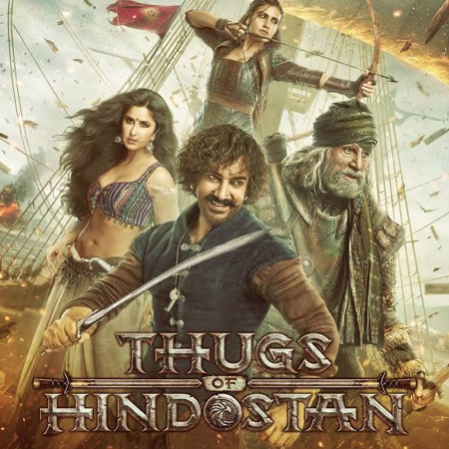
Seven years on, with the marketing noise gone, the opening weekend shock exhausted, and the discourse about what went wrong reduced to a punchline, what remains on screen is something more instructive than a simple failure — it is a complete record of what happens when an industry confuses the scale of a production with the ambition of a vision.
Begin with what Thugs of Hindostan actually had, because the autopsy is only instructive against the full scale of what was available and unused.
It had Amitabh Bachchan and Aamir Khan sharing a screen for the first time in their careers. Two actors whose combined filmography constitutes the most significant body of mainstream Hindi cinema produced in the last fifty years. Two actors for whom the audience had accumulated, over decades, a specific quality of trust and anticipation that no amount of marketing can manufacture and that studios spend entire careers trying to build. Their presence in the same frame was, before a single shot was composed, a dramatic fact.
It had a subject — the East India Company's colonial extraction and the armed resistance it provoked — that is among the most morally urgent and cinematically rich territories available to Indian popular cinema. A story about Indians fighting for their land against an occupying commercial empire, set in 1795, with the full visual and dramatic resources of the period available to a director with the budget to use them. The story was there before anyone wrote a word of screenplay.
It had ₹270 crore, which is enough money to make almost any film that has been properly conceived.
What it did not have — and what the autopsy reveals as the single decisive absence beneath every specific failure — was anyone in the production who had asked the most basic question a filmmaker must ask before a rupee is spent: what is this film actually about?
Not what happens in it. What it is about. What human truth it is a vehicle for. What it believes about the people in it and the world they inhabit. The question that separates a film with a story from a film that is merely a series of events organised around expensive production design.
Nobody asked this question. The evidence is on screen in every scene.
The Aamir Khan problem — and what it reveals
The most discussed element of Thugs of Hindostan's failure was Aamir Khan's performance as Azaad — or rather, Firangi, the film's mercenary protagonist. It was compared immediately and devastatingly to Jack Sparrow. The comparison was accurate. It was also, in the context of the autopsy, the wrong thing to focus on.
The Jack Sparrow problem was not that Khan imitated Johnny Depp's performance from Pirates of the Caribbean. It was that the production needed a character type — the roguish, unpredictable, comedically unreliable trickster whose eventual moral awakening provides the film's emotional arc — and had no original conception of what that character type should look like in a 1795 Indian context, in the body of this specific actor, in this specific story. In the absence of an original conception, the available reference filled the vacuum.
Khan's specific quality as a screen actor — the quality that makes Lagaan, Taare Zameen Par, and Dangal work — is his capacity for complete psychological inhabitation. He does not perform characters. He becomes them, which requires the character to be fully conceived before he can fully inhabit them. Firangi is not fully conceived. He is assembled from borrowed parts. Khan, faced with a character who is a collection of gestures rather than a person, produces a performance of gestures. The gestures are technically accomplished and completely unconvincing because there is nobody behind them.
This is not a failure of talent. It is a failure of the screenplay to provide the specific human truth that Khan's specific talent requires.
The Amitabh Bachchan problem — the more serious failure
The Aamir Khan problem was widely discussed. The Amitabh Bachchan problem was not, and it is the more serious failure of the two.
Bachchan plays Azaad, the legendary freedom fighter whose mythological status among the local population constitutes the film's moral centre. He is the figure around whom the resistance organises, the figure whose sacrifice gives the story its weight, the figure who should be the film's emotional and dramatic foundation.
Vijay Krishna Acharya gives him almost nothing to do.
Across a film whose runtime approaches two and a half hours, Bachchan is called upon to stand on high places looking resolute, to deliver declaratory speeches about freedom that the screenplay has not earned through any preceding dramatic development, and to be betrayed by a man he trusts in a plot development that carries no emotional weight because the film has not built the specific human relationship between Azaad and Firangi that the betrayal would need to wound.
The specific quality of Bachchan's screen presence in his mature work — in films like Pink, Piku, and Black — is the presence of a man carrying a specific weight, a specific history, a specific understanding of loss and persistence that the camera finds in his face without requiring him to perform it. This quality is available to any director who creates the conditions for it — who gives him the material to inhabit, the space to be still, the scenes that allow the camera to find what is actually there.
Acharya does not create these conditions. He uses Bachchan as a monument — as a visual signifier of gravitas and significance — rather than as an actor with a specific human capacity that the film should be designed to use. The result is the most expensive waste of Amitabh Bachchan's talent in his career, and the talent being wasted is among the most significant in the history of Indian cinema.
The screenplay — the source of everything
Vijay Krishna Acharya wrote the screenplay. He also directed the film. This combination — the same person responsible for both the foundation and the construction — means that the foundation's problems were invisible during production. Nobody was in a position to say: the story does not know what it is about.
The plot of Thugs of Hindostan is mechanically functional. Events occur in a logical sequence. Characters have stated motivations. The East India Company is the villain. Azaad is the hero. Firangi is the comic mercenary who will eventually choose the right side. The three-act structure is technically present.
What the screenplay does not have is a single scene in which a character says or does something that is specifically, irreducibly true to that character rather than to the function they serve in the plot. Azaad speaks about freedom the way a character in a screenplay about freedom speaks about freedom — in the language of a theme rather than in the language of a person. Firangi is selfish and comic in the ways that selfish comic characters are selfish and comic in the films that Acharya had seen before making this one.
The colonial period setting — which should be the screenplay's greatest resource, because 1795 India under East India Company extraction is a world of such specific and vivid human drama that the material should overflow the film — is used entirely as backdrop. The specific texture of colonial oppression — the particular violence it does to particular people in particular places — is never rendered in specific human terms. The Company is evil in the abstract. Its victims suffer in the abstract. The freedom that Azaad fights for is freedom in the abstract.
A film about colonialism that has nothing specific to say about colonialism is a film that has used its subject as a setting rather than as a subject.
The ₹270 crore question
The production design of Thugs of Hindostan is the film's most technically accomplished element and its most revealing symptom. The period detail is extensive, the scale is genuine, the visual ambition is real. There are sequences — the ship battle, certain coastal vistas, the market scenes — that demonstrate exactly what the budget could achieve when directed toward a specific visual purpose.
The problem is that visual spectacle without human stakes is entertainment design, not cinema. The ship battle is visually impressive and emotionally inert because the film has not built the specific human relationships that would make the outcome of the battle matter to the viewer. The stakes are stated — freedom, betrayal, redemption — but not felt, because feeling requires the specific human truth that the screenplay did not provide and that ₹270 crore cannot manufacture.
The budget was not the problem. The budget was the most visible expression of the problem — the production's complete confidence that scale and spectacle were sufficient substitutes for the creative work that makes scale and spectacle meaningful.
What the autopsy finds
Thugs of Hindostan is not a film that failed because it was too ambitious. It is a film that failed because it was not ambitious enough — not at the level that matters. It was ambitious about scale, about cast, about production design, about the opening weekend it was targeting. It was completely unambitious about the specific human truth it was trying to tell, because nobody involved in making it appears to have identified what that truth was before the cameras started rolling.
The two biggest stars in Hindi cinema were present and available. The subject matter was rich enough to sustain a dozen great films. The money was there. The audience was ready — ₹52 crore on opening day is an audience that has shown up, that has brought its trust and its anticipation and its willingness to be moved.
What they were given was a film that did not know what it wanted to say to them. That is not a production failure. It is a creative failure at the most fundamental level — the failure to answer, before a single frame was shot, the question that every film must answer: what is this about, and why does it matter? Thugs of Hindostan never answered that question. Everything that followed was the consequence.
Rating: 2.5 / 10 By Republic of Cinema · Autopsy · Republic of Cinema
💬 Discussion
0 comments