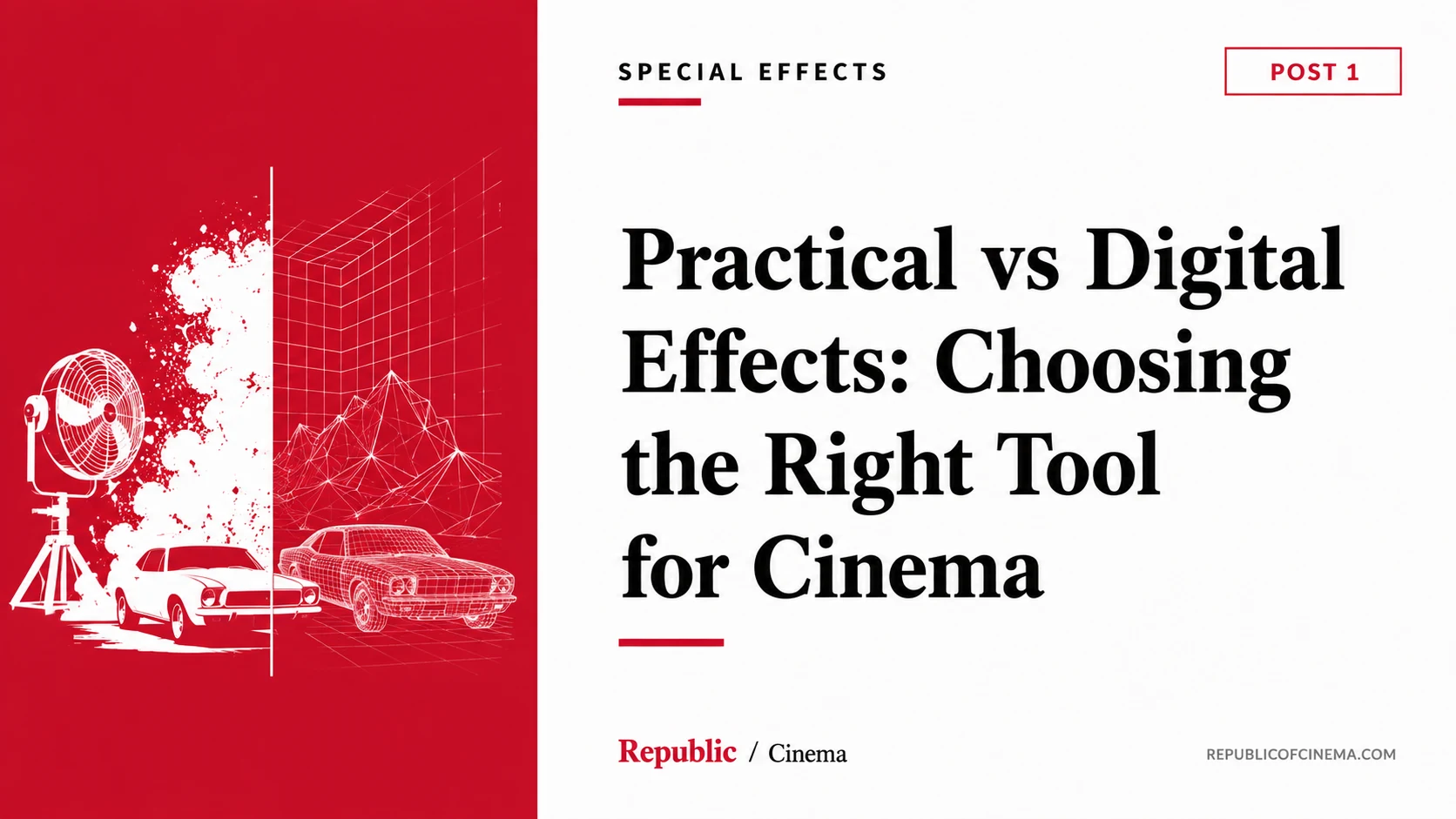
A burning building can be a real fire, carefully controlled, with a licensed pyrotechnician standing six feet away with a hand on the kill switch. Or it can be three layers of stock footage and a compositing pass, assembled months after everyone went home safely. Both can end up looking identical on screen. One of them costs vastly more, carries vastly more risk, and demands vastly more planning. The other costs vastly less and risks nobody's safety at all. So why would any production ever choose the harder, more dangerous, more expensive option?
This is the question this entire department exists to answer honestly, because the honest answer isn't "tradition" or "because that's how it used to be done." The honest answer is that a practical effect and a digital one are not interchangeable tools that happen to produce the same picture. They are different creative decisions, with different relationships to the actor, the set, and the audience, and a filmmaker who treats the choice as purely a budget line has already misunderstood what's actually at stake.
Start with what "practical" actually means as a category, because the term covers more ground than beginners usually assume, and most of that ground is far less dangerous than the word "special effects" suggests. Deborah Patz's account of what falls under this department is useful precisely because of how broad it is: special effects "can range from the use of dry ice, steam, or smoke as atmosphere, to the creation of a waterfall, snowfall, rainfall, wind, blazing fire, or explosions on set." Most of that list — dry ice, smoke, manufactured rain, manufactured snow — carries genuinely modest risk and can, on a small production, even be managed by the props department. It's only "as the complications increase," Patz notes, that you need "a reliable, experienced supplier: a special effects company." The danger in this department isn't evenly distributed across the whole category. It concentrates, almost entirely, in two specific areas — fire and explosives, and anything involving live ammunition — and understanding that concentration is the first step toward understanding why this department's safety culture looks the way it does.
Bryan Stoller states the rule for that concentrated danger as plainly as it can be stated: "Anything pyro absolutely must be handled by a licensed pyrotechnician. These are people with a federal license who have passed extensive testing in the use of explosives." Blain Brown's account adds the parallel rule for firearms: "All guns are handled by a prop specialist called an armorer." Neither of these is a suggestion. They're the bright line this entire department is built around — a line so firm that Stoller's advice to beginning filmmakers isn't "be careful with pyro," it's closer to "don't touch pyro, ever, under any circumstances, full stop." The reason that line exists isn't bureaucratic caution. Fire and explosives and firearms are the only categories in this department where a mistake doesn't just ruin a shot. It can kill someone. Every other safety protocol in this department exists downstream of that one fact.
What does responsible safety planning on an effects-heavy set actually look like in practice, beyond the headline rule about who's licensed to do what? Patz's account of the production manager's relationship with the special effects supervisor is worth reading closely, because it shows safety functioning as a structural relationship, not a checklist completed once and forgotten. "The SPFX Supervisor is the key person for design and preparation of the shot," she writes, and crucially, "this person is also the key safety person on the day." The same individual responsible for making an effect look right is the same individual responsible for keeping everyone alive while it happens — which means safety isn't a separate department checking the effects department's work after the fact. It's built into the same chain of authority and accountability that designs the effect in the first place.
This is also why Patz is insistent that "there is no such thing as a 'spur of the moment' special shot," and why she warns explicitly against any supplier who claims otherwise: "If the supplier thinks he can promise you this, find another supplier." Effects suppliers need real prep time, she explains, specifically "to test their explosions so they know ahead of time how big the blast will be, and how much smoke it might generate at the location chosen." That testing isn't a luxury squeezed in if the schedule allows. It's the entire mechanism by which an unpredictable, genuinely dangerous physical event gets converted into something predictable enough to put actors and crew safely next to. Blain Brown's practical checklist for a working set reinforces the same culture from ground level — know where the fire extinguisher is, know where the nearest hospital is, never get on or off a crane until the key grip says so, call out "hot points" when carrying anything that could injure someone moving past. None of this is exciting to read. That's exactly the point. A genuinely well-run effects set is, by design, almost boring in how thoroughly every danger has been anticipated and planned around in advance, because the alternative to boring planning is an exciting accident.
Now turn to the actual creative question this post opened with, because safety explains why practical effects demand discipline, but it doesn't yet explain why a filmmaker would choose the harder path at all when a digital alternative exists. The clearest argument against treating this as a pure budget calculation comes, perhaps surprisingly, from a warning about the opposite mistake — assuming digital is automatically the cheaper, easier choice. Patz tells a story worth remembering in full: a production lets a trained bird keep its tether on during a shot to save five minutes of removal time on set, planning to erase the tether digitally afterward. "You save the five minutes of shooting," she writes, "but find that to remove the tether in CGI, the cost equals that of one of your fancy effects; so you have to remove a fancy effect from the script to cover the cost of the tether removal — leaving you with a CGI effect that is in effect, invisible." Her conclusion is blunt: "'Fixing it in post' is expensive. Avoid it." This is the practical proof that the practical-versus-digital decision is never simply "which costs less." Sometimes the cheap-seeming shortcut on set becomes the expensive mistake in the edit bay, and the only way to know which is which is to think the decision through in advance, with the same seriousness this department brings to a pyrotechnic test.
The deeper creative argument for choosing a practical effect has nothing to do with cost at all, and everything to do with what happens to a performance when the thing an actor is reacting to is actually, physically present. An actor reacting to real fire six feet away, real water crashing toward them, a real mechanical rig genuinely moving beneath their feet, is reacting to something. An actor reacting to a green screen and a verbal description of what will be added later is performing an act of imagination under pressure, which some actors do brilliantly and others find almost impossible to do convincingly. This isn't a minor technical footnote. It connects directly to everything this curriculum's Acting & Performance department has already established about revelation versus reproduction — an actor's fear, recoil, or wonder in response to something genuinely happening in front of them carries a different quality than the same actor performing fear, recoil, or wonder in response to nothing, trusting that the nothing will become something months later. Neither approach is automatically superior. But the choice is a creative one, made in service of the performance a director needs, not simply a cost comparison run by a line producer.
No one proved the creative power of doing it by hand, in camera, more completely or for longer than Ray Harryhausen, and his career is worth understanding in some depth because it represents practical effects pushed to a level of artistry that has never been fully superseded, only supplemented, by digital tools.
Harryhausen worked in stop-motion model animation — building small, fully articulated creatures, often a combination of metal armature, foam latex, and careful sculpting, and then animating them frame by frame, moving each model a fraction of an inch, exposing a single frame of film, moving it again, exposing another frame, across thousands of individual adjustments to produce even a few seconds of finished movement. This is, by any measure, one of the most painstaking processes in the entire history of visual effects, and Harryhausen's signature achievement — the skeleton fight in Jason and the Argonauts, where Jason and his companions duel seven stop-motion skeleton warriors animated entirely by hand — required these creature performances to be choreographed with the same care this curriculum's Stunts & Action department has already established for live combat: each skeleton needed a legible, distinct quality of movement, timed against the live actors' very real swordplay, frame by frame, with absolutely no room for digital correction afterward if a movement read as unconvincing. What makes the sequence remarkable isn't merely its technical difficulty. It's that the skeletons feel like they're actually fighting — aggressive, reactive, occasionally clumsy in ways that read as menacing rather than mechanical — because Harryhausen was animating performance, not just motion, one painstaking frame at a time, decades before any digital tool existed that could have done the work faster.
This is the case study worth holding in mind whenever the practical-versus-digital question feels purely technical. Harryhausen's creatures don't look real in the way a modern digital creature can look real — the stop-motion texture is visible if you look for it, the movement has a particular, slightly stuttering quality unique to the technique. And yet generations of filmmakers, working with vastly superior digital tools available to them, have cited Harryhausen's work as more frightening, more alive, more dramatically convincing than plenty of technically smoother CGI that followed. The lesson isn't that practical effects are simply "better." The lesson is that a technique chosen and mastered with total command of its specific creative possibilities can outlast techniques that are objectively more advanced but less deeply understood by the people using them.
Now travel to a tradition that proves the identical principle from the opposite end of the world and an entirely different genre register: early Indian mythological cinema, where practical, in-camera effects weren't an artistic indulgence layered on top of the genre. They were the genre's entire reason for existing as cinema rather than as theatre.
From its earliest decades, Indian mythological filmmaking demanded effects that theatrical staging could never deliver convincingly — gods materializing and vanishing, demons transforming, divine weapons appearing from nowhere, multi-armed figures performing feats no human body could perform unassisted. None of this could wait for a digital toolset that didn't exist yet. It had to be solved, immediately, with the tools cinema's earliest technicians actually had on hand: stop-motion-adjacent substitution tricks, where an object or figure is removed or replaced between exposures so a god appears to materialize out of thin air; double exposure, layering two separately filmed images onto the same strip of film to produce ghostly transparency or simultaneous divine and mortal presence in a single frame; carefully managed in-camera matte work, where part of a frame is masked during one exposure and the remainder filled in during a second pass, allowing a god's full, larger-than-human form to share the frame with ordinary mortals at a completely different scale. This is the same fundamental technique Stoller describes for forced perspective and matte work in a contemporary, low-budget context — the camera not simply recording what's physically present, but assembling, through careful planning and multiple passes, an image that never existed in front of it as a single, continuous reality.
What makes this tradition worth studying as seriously as Harryhausen's is that the constraint wasn't a stylistic choice — it was the only option available, and yet it produced a visual grammar still recognizable in mythological and devotional filmmaking today, decades after digital tools made every one of these tricks technically unnecessary. A god's transformation, executed through patient, exact in-camera technique, carries a different visual texture than the same transformation rendered through contemporary compositing — and audiences raised on this genre have, for generations, read that specific texture as part of the genre's own visual identity, the same way Harryhausen's stop-motion texture became inseparable from the particular menace of his creatures. The effect wasn't simply standing in for something a more advanced technology would eventually do better. It was building a visual language unique to the constraint that produced it.
This is, finally, the test this post needs to leave you with, because it's the only test sturdy enough to govern a decision this consequential, in either direction: is this effect serving the story, or is it competing with it? A practical effect competes with its story when the audience's attention shifts from what's happening to how it was achieved — when admiration for the craft displaces feeling for the character experiencing it. The same failure can happen with a digital effect every bit as easily; spectacle for its own sake doesn't care which technique produced it. But a practical effect serves its story exactly when Harryhausen's skeletons serve theirs, or when an early mythological transformation serves its genre's devotional purpose: when the audience isn't admiring the trick at all, because they're too absorbed in what the trick made them feel to notice it was a trick in the first place. That absorption is never guaranteed by choosing practical over digital, or digital over practical. It's earned, every time, by the same discipline this entire curriculum keeps returning to — knowing exactly what the story needs this moment to mean, and choosing, deliberately, the technique most capable of delivering that meaning without asking the audience to admire the delivery.
The modules ahead in this department will take apart the practical craft this post has only sketched the philosophy of — how a specific practical effect actually gets planned and budgeted from script to shoot day, what a pyrotechnics test genuinely involves, how miniatures and forced perspective get built and shot to read convincingly at full scale, and how specific practical-effects traditions across world and Indian cinema have shaped the visual grammar audiences still recognize today. None of that craft will matter, though, without the foundation this post has tried to establish first: a practical effect is never simply the harder, more expensive way to do something a computer could do instead. Done right, it's a different creative choice entirely, with its own specific power, its own specific risk, and its own specific responsibility to the people standing closest to it when it happens.
💬 Discussion
0 comments