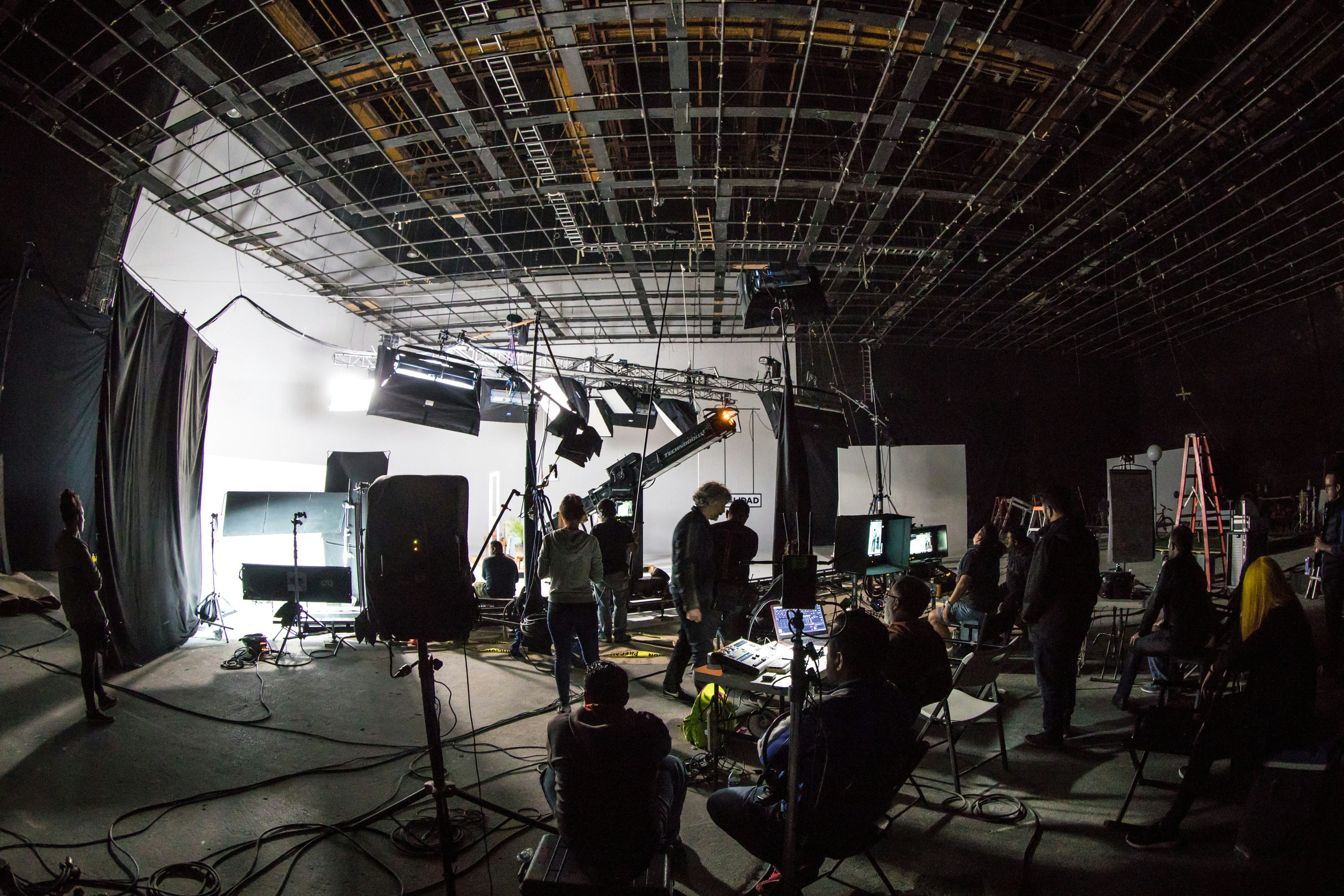
Ask a visitor on a film set who's in charge, and they'll point to the director. They're not wrong, exactly. But they're answering a different question than the one that actually matters for getting through the day.
The director is in charge of what the film means. Every choice about performance, camera, and theme runs through that single authority, and the rest of this curriculum has spent its founding posts establishing exactly how much weight that authority carries. But ask a different question — not "who decides what this film is about" but "who makes sure two hundred people, a hundred thousand dollars of equipment, and a schedule with no slack in it actually produce something today" — and the answer changes completely. That's the assistant director's job. And almost nobody outside the industry knows it exists.
Blain Brown states the division as cleanly as it can be stated: "The director is in control artistically, of course, but as far as just keeping things running, the AD is in charge." Two separate forms of authority, operating simultaneously, neither one subordinate to the other in its own domain. A director who tries to run the schedule themselves will burn out within a week and make a worse film in the process, because every minute spent managing logistics is a minute not spent watching a performance closely enough to notice what Lumet noticed in William Holden's eyes. An AD who tries to direct the actors has already failed at their actual job, which has nothing to do with performance and everything to do with making sure the conditions for performance exist on time, in budget, without anyone getting hurt.
Start with what the title actually contains, because "assistant director" is one of the most misleading job names in the entire industry. Brown's correction is direct: the AD does not assist in directing the movie. The AD is "an assistant to the director" — and the distance between those two phrases is the entire job description. The 1st AD's responsibilities, carried over from pre-production into the shoot itself, begin with the document this curriculum's Planning & Scheduling post already introduced: lining the script, building the schedule, running the stripboard. But once cameras roll, the job becomes something closer to a live performance of logistics — keeping a hundred moving parts synchronized in real time, hour after hour, day after day, for the entire length of a production.
Here is the test that separates a working understanding of this job from a textbook one: the 1st AD never leaves the set. Brown is explicit about this — "the AD never leaves the set; if they do have to be away for a few minutes, they get a Second AD to take over for them." Think about what that constraint actually demands. A shoot day might run twelve hours, fourteen on a hard day. For every one of those hours, someone has to be tracking where the production stands against the schedule, what's coming next, what just went wrong, and what's about to go wrong if nobody intervenes in the next ninety seconds. That's not a desk job. That's closer to air traffic control, except the planes are actors, lights, extras, animals, weather, and a director's evolving creative instincts, and a mistake doesn't crash a plane — it costs an hour of a budget that doesn't have an hour to spare.
This is exactly why the job splits the way it does. The 2nd AD exists to handle everything the 1st AD's constant on-set presence makes physically impossible to handle personally — building tomorrow's call sheet, confirming cast and crew calls, managing the mountain of paperwork a union shoot generates. The Filmmaker's Handbook draws the same line: the 1st AD "is responsible for keeping the shoot on schedule and maintains order on the set," while the 2nd AD "manages call sheets... and makes sure that needed actors are present." On larger productions there's a 2nd 2nd AD as well, whose job, per Brown, is "most often... involved in helping run the set, especially a larger set with lots of extras or action" — managing background performers, running lockups, doing whatever the AD team needs done that the 1st and 2nd genuinely cannot do themselves because they're already doing something else.
None of this is bureaucracy stacked on top of creativity. It's the precondition for creativity having anywhere to happen at all. Bryan Stoller's For Dummies guide states the limit of the AD's authority in one crisp sentence worth memorizing exactly as written: "The director — never the assistant director — calls 'action' and 'cut.'" Everything up to that word belongs to the AD's department. The word itself, and everything that follows from it, belongs entirely to the director. That boundary isn't arbitrary etiquette. It's the line between management and art, drawn as precisely as a production can draw it.
Now go inside an actual shoot day, because the structure here is so consistent across productions that Deborah Patz describes it as a near-mechanical cycle: "The set's shoot day is basically structured into four phases that repeat over and over again: blocking, lighting, rehearsal, and shooting — all orchestrated by the Assistant Directors." Four phases, repeating dozens of times across a single day, each one handing off to the next through a sequence of calls that anyone who's spent real time on a working set will recognize instantly.
Blocking comes first: the director walks the actors through the scene, while the camera department notes positions and a camera assistant marks the floor for focus. Once blocking is set, the actors and director step away — Brown notes they'll often go straight to makeup and wardrobe — and the set becomes, in the precise language used on professional sets, the property of "lighting and camera." Stand-ins, sometimes called "second team," take the actors' places so the DP, gaffer, and key grip can build the lighting without burning the real cast's energy standing under hot lights for an hour while cable gets run. Patz notes the AD calls out a time estimate to the rest of the crew during this phase — "We're 45 away" — so every department can pace its own preparation against the same clock. Only when lighting is actually ready does the AD call for "first team," bringing the real actors back for the rehearsal that locks the scene in before the take itself. Then, finally, shooting: a precise verbal sequence — lock it up, roll sound, sound speed, roll camera, camera speed — that hands control, syllable by syllable, from the AD's department to the director, who alone says the word that starts the scene and the word that ends it.
This is also where the most evocative detail in all of Sidney Lumet's account of his own sets belongs, because it shows exactly what disciplined process looks like from inside, on a film that actually got made under it. "Bells!" Lumet writes. "A sharp bell that would frighten a fireman sounds three times on the stage and just outside." That's the signal — audible to everyone, impossible to miss, a sound built specifically so that nobody on a noisy, crowded soundstage has an excuse to claim they didn't know a take was about to roll. And immediately after it, Lumet gives an instruction to his actors that tells you everything about what disciplined process is actually protecting: "Don't work," he tells them at the first rehearsal. "Just make the moves and use the volume you'll be using, for sound." He doesn't want them to waste emotion on a rehearsal that exists purely to fix technical problems. "They are in for a long day, and I want them to save their emotions for the take."
That single instruction is the entire argument of this post compressed into one sentence. The structure — the bells, the stand-ins, the blocking rehearsal, the lighting pass — exists so that the thing this curriculum's Acting & Performance post described as genuinely precious and genuinely fragile, an actor's willingness to reveal something real, doesn't get burned away on logistics. Lumet's set runs on rigid, repeated, almost ritualized process specifically so that when the moment for revelation finally arrives, the actor still has something left to give.
Look at what that handoff between stand-in and actor actually demands, because it's more intricate than it sounds. "Up until now, all lighting was done on the 'second team' (the stand-ins)," Lumet writes. "Now, with the 'first team' (the actors themselves), there are corrections to be made. This is normal, and none of the actors mind." Why corrections? Because an actor moves at a different pace than a stand-in, which means a camera move calibrated against the stand-in's timing has to shift to match the real performer. Because physical differences matter in ways a stand-in can't replicate — Lumet's own example is blunt and specific: "Sean Connery is six feet four. Dustin Hoffman isn't. Trying to get them in a tight two-shot presents some problems." His solution has a name on his sets, half technical jargon and half private joke: "Sean, give me a Groucho," meaning lower your body before you sit so the frame doesn't have to chase your height; "a slight banana on that cross," meaning arc your path slightly so the camera doesn't catch the edge of the set. None of this is decoration. It's the connective tissue between a director's creative intention and a camera operator's physical ability to execute it, worked out in a shared vocabulary developed through repetition, take after take, picture after picture.
This is the page turn's whole purpose, and it's worth being precise about what that meeting actually does, because students often imagine it as a formality. Brown describes it directly: "Similar to the table read, the page turn is for the crew, not for the actors. Led by the Assistant Director (the director sits in), all the department heads — cinematographer, gaffer, grip, production designer, props, makeup, wardrobe, stunts, mechanical effects... and others — go through the script page by page and make sure the specific requirements of each scene are under control." Notice what this accomplishes that no other meeting can: it's the one moment before the shoot when every department head looks at the same page of the same script at the same time, in the same room, and surfaces whatever questions only become obvious when you're staring at a scene from your own department's specific angle. The props department might realize a line implies an object nobody's sourced. The stunt coordinator might flag a piece of choreography the script glosses over in one sentence but that needs three days of rehearsal. Brown adds the other half of the page turn's value, easy to overlook: "This is also a great opportunity for the director to communicate to them the vision and style they have in mind for the film." It isn't only a checklist. It's the moment a director's answer to "what is this film about" — this curriculum's founding question — gets transmitted to every department head who will spend the coming weeks translating that answer into light, fabric, props, and rigging.
This entire apparatus — bells, stand-ins, page turns, the precise call-and-response of lock it up and roll camera — scales up dramatically once you leave a single unit working a single set and step onto the kind of production India's largest films routinely demand. Multi-unit shoots, simultaneous Hindi and regional-language versions of the same film, action and stunt units running in parallel with the principal dialogue unit, sometimes across different cities or even different countries in the same production window — none of this is survivable without exactly the invisible structure this post has been describing, multiplied across crews who may never be in the same room as each other. When a second unit is shooting an action sequence in one location while the principal unit works dialogue scenes elsewhere, the only thing keeping both units pointed at the same eventual film is the AD department's paperwork — the stripboard, the call sheets, the schedule — functioning as the connective record between people who are, for weeks at a time, making the film in parallel rather than in sequence. A production of this scale isn't held together by a single director's presence on every set, because no single director can be on every set. It's held together by the AD department's discipline being rigorous enough that the film comes back together coherently when all the footage finally lands in the same edit room.
This is the deeper truth worth sitting with as you finish this post: discipline, in this department, isn't the opposite of creative freedom. It's the thing that makes creative freedom affordable. A director who trusts that the schedule is being tracked, that the call sheet is accurate, that the lighting estimate is honest, that the stand-ins are doing their job so the actors arrive fresh — that director gets to spend their entire reserve of attention on the one thing only they can do, which is recognize the moment an actor's eyes finally hold steady, or notice that a scene everyone agreed was working is somehow, mysteriously, flat. Take that structure away, and the director doesn't gain freedom. They lose the bandwidth that freedom actually requires, buried instead under a hundred logistical questions that someone else was supposed to be answering. The bells ringing three times on Lumet's set weren't a constraint on his art. They were the reason he had any art left in him by the fourth take.
The modules ahead in this department will take apart everything this post has only sketched in outline — how a call sheet is actually built and read, what a tech scout demands from an AD compared to a DP, how lockups and crowd control actually function on a real location, what the radio discipline of a working set sounds like in practice, and how the rhythm of blocking, lighting, rehearsal, and shooting changes shape depending on scale, from a two-person crew shooting in a borrowed apartment to a multi-unit production spanning continents. None of that detail will make sense without the foundation this post has tried to lay first: the person calling "action" is not the only person running the set. They're simply the only one whose authority begins exactly where everyone else's carefully, deliberately, and invisibly ends.
💬 Discussion
0 comments