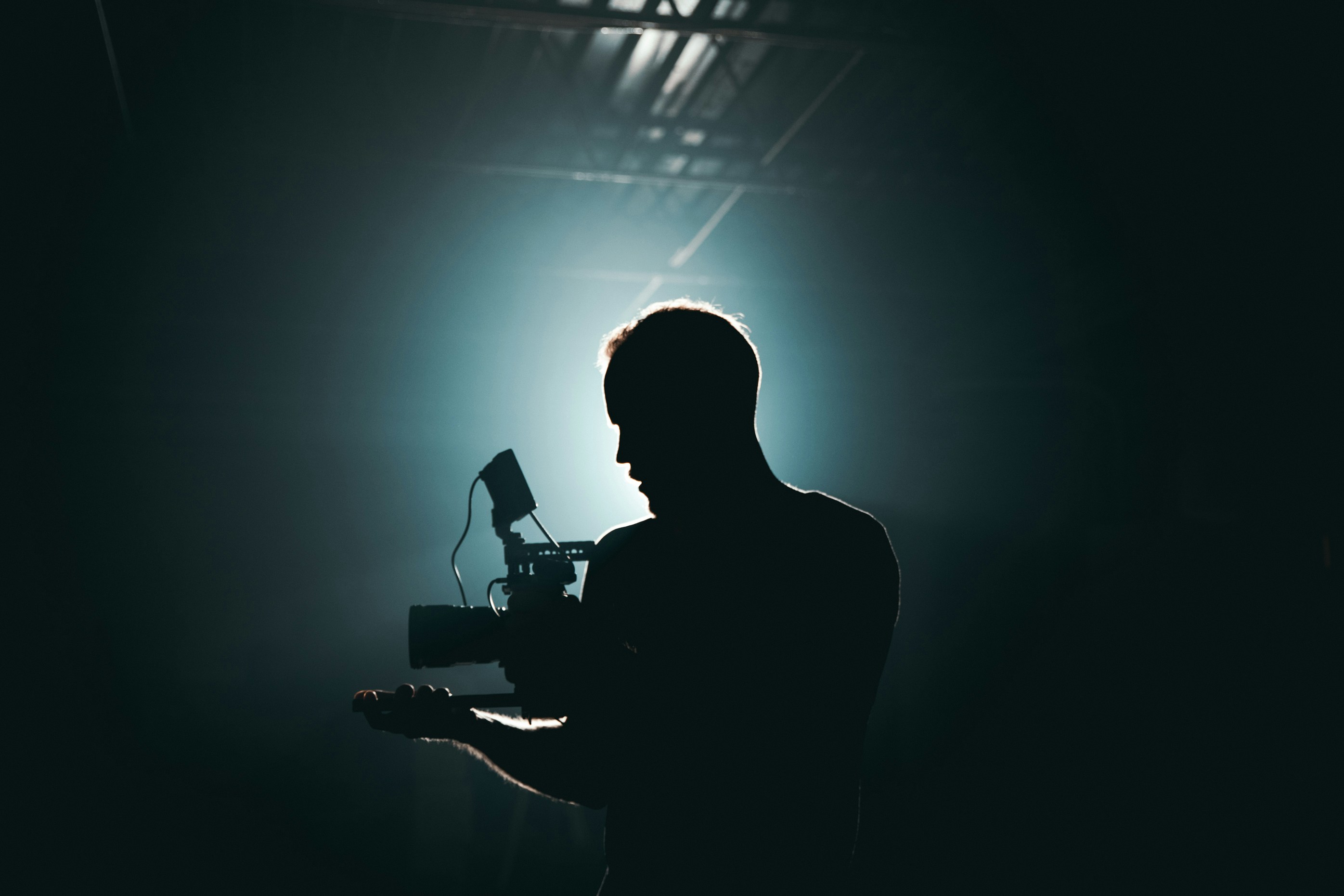
Point a camera at a room. Any room. Choose a lens, set the exposure, decide where the key light falls. Now stop and notice something: you have already made an argument about that room before a single character has walked into it. You haven't recorded the room. You've interpreted it.
This is the idea this entire department exists to teach you, slowly and from every angle, until it becomes instinct. A camera looks neutral. It has no opinions, no feelings, no agenda — it's a mechanism, glass and a sensor and some electronics, doing exactly what physics tells it to do. And that neutrality is the most persistent illusion in filmmaking. Every choice a cinematographer makes — which lens, how much light, what exposure, where the camera sits and how it moves — is already a point of view. The image was never a recording of what was there. It was always a translation of what the filmmakers wanted you to feel about what was there.
Sidney Lumet puts this as plainly as anyone ever has, and it's worth sitting with his exact words before going further. "Good camera work is not pretty pictures," he writes. "It should augment and reveal the theme as fully as the actors and directors do." Read that twice. He isn't saying camera work should look beautiful — plenty of beautiful images carry no meaning at all, and Lumet has little patience for them. He's saying the camera's job is to reveal, the same job an actor's performance has, the same job a script has. The image isn't decoration applied to the story. The image is one of the places the story actually happens.
Lumet's proof of this is Sven Nykvist's work with Ingmar Bergman, and the example he chooses is almost embarrassingly simple once you see it: "The light Sven Nykvist has created for so many of Ingmar Bergman's movies is directly connected to what those movies are about. The light in Winter Light is totally different than the light in Fanny and Alexander. The difference in lighting is related to the difference in the themes of the movies. That's the true beauty in movie photography." Two films, two completely different theological and emotional climates, two distinct ways of lighting a face — Winter Light, austere, a film about a pastor's collapsing faith, photographed in the gray, withholding light of a Swedish winter that gives nothing back; Fanny and Alexander, warm, golden, a film of childhood memory and abundance, photographed in light that seems to glow from somewhere inside the rooms themselves. Nykvist didn't pick a "style" and apply it to both films. He asked, each time, what these films were about, and let that answer dictate how light should behave.
This is the principle every decision in this department will trace back to. Not "what looks good," but "what does the theme require." Lumet's word for it, again: light should augment and reveal the theme. If it isn't doing that, it's decoration, and decoration is the cinematographer's most dangerous habit, because it's so easy to mistake for skill.
Now go granular, because abstraction is easy to agree with and hard to actually use. Let's talk about lenses, because lens choice is where this principle becomes mechanical and precise rather than poetic.
Lumet describes lenses as having "different feelings about them. Different lenses will tell a story differently." This is not metaphorical generosity on his part — it's an exact technical claim, and Blain Brown's account of focal length confirms it from the opposite direction, the engineering side. A wide-angle lens expands space: put two actors in front of one and they'll read as standing several feet apart, even if they're standing close. A long lens compresses that same space: the identical actors, the identical distance between them, suddenly look as though they're standing inches apart. Brown is explicit that this isn't an incidental side effect — it's "an enormously important storytelling tool," and understanding it is core, not optional, knowledge for both directors and cinematographers.
Watch what Lumet does with this fact on Murder on the Orient Express. Several scenes in the film get revisited near the end, recounted by Poirot as he assembles the solution to the murder. Lumet shot each of those scenes twice — once with the normal range of lenses used throughout the rest of the film (50mm, 75mm, 100mm), and a second time with a much wider lens, 21mm. The first time we see a given scene, it plays as ordinary narrative. The second time, recalled as evidence in the solving of the crime, the wide lens distorts it just enough to feel "melodramatic, fitting in with the drama of a solution to a murder," as Lumet puts it. Nothing in the blocking changed. Nothing in the performances changed. The lens alone reframed the same information into a different emotional register. That's not a technical trick. That's the lens functioning as an argument about how we should now understand what we're looking at.
This is also where exposure enters the same conversation, and it's worth being precise about what exposure actually controls, because the term gets treated as a purely technical hurdle — get it "right" and move on — when it's just as expressive a choice as lens or light. The Filmmaker's Handbook puts the core idea simply: there is no single correct exposure for a scene. A shot is properly exposed when the important elements — usually, but not always, a face — carry the detail you need them to carry, and everything else is free to fall lighter or darker than that as the story requires. Exposure isn't a meter reading you chase until it matches a number. It's a decision about what the audience is allowed to see clearly and what they're allowed to lose into shadow or light. Lumet's own description of his choices on Prince of the City shows exactly this principle at work over the length of an entire film: across three acts, he and his cinematographer deliberately shifted the balance between foreground and background light — bright background early, balanced through the middle, and by the film's last third, "we cut the light off the background. Only the foreground, occupied by the actors, was lit." The world physically narrows around the character as his options narrow. That's an exposure decision telling the story as directly as a line of dialogue could.
Now take all of this — light, lens, exposure — and go looking for where a director and a director of photography actually meet, because none of these decisions get made by the DP alone, and none of them get made by the director alone either. Lumet is unambiguous about what this relationship is supposed to look like: "During shooting, most directors' closest relationship is with the cameraman... As much as anyone, the photographer can harm or gloriously fulfill my purpose in doing the picture in the first place." Notice the word he doesn't use: execution. He doesn't describe the DP as someone who carries out the director's visual instructions. He describes a relationship close enough, consequential enough, to determine whether the entire purpose of the film survives or doesn't.
That collaboration runs in both directions. The director arrives with the theme — the riverbed this curriculum's founding post described, the answer to "what is this film about." The cinematographer's job is not to illustrate that theme literally, but to find its visual equivalent: what kind of light tells the truth of this story, what kind of lens distance, what kind of movement. Sometimes, as on Daniel, that equivalent emerges only after long discussion — Lumet describes how the visual solution to that film's fractured timeline, separating the parents' world from the children's through color filtration on the lens itself, only "presented itself" after extended conversation among director, cameraman, production designer, and editor. The director didn't dictate the answer. The collaboration found it.
Now carry this same principle to two Indian cinematographers whose work, in radically different registers, proves exactly what Lumet and Brown are describing — and proves it under far harder constraints than either of those Hollywood examples enjoyed.
Subrata Mitra was barely in his twenties, with no formal training as a cinematographer, when Satyajit Ray brought him onto Pather Panchali in the early 1950s. The production had almost no money and almost no equipment — nothing like the lighting packages a studio crew would have carried. And the film needed to be shot largely inside small, real Bengali village interiors, the kind of low-ceilinged rooms where there is simply nowhere to hang a conventional lighting rig without it being seen, and nowhere to bounce a hard key light without it looking exactly like what it was: a film crew's lighting setup imposed on someone's actual home.
Mitra's solution became one of the most influential technical innovations in the history of cinematography, and it began as a pure problem of necessity. He built large white cloth screens — bounce surfaces — and positioned them to reflect sunlight up into a room through the doorways and windows that were already there, rather than introducing hard studio light from fixtures the rooms couldn't accommodate. The light that resulted was soft, even, directionless in the way real daylight inside a real room actually is — closer to what the Filmmaker's Handbook describes as the natural softness of window light, "bouncing from all directions from outside the window," except achieved entirely without electricity, on a production that often didn't have access to it. What started as Mitra solving a problem — how do I light an interior I can't put fixtures in — became something else entirely: a visual language for what Pather Panchali needed to be. The film's poverty needed to look like poverty, not like poverty dressed up by a film crew's equipment. The light needed to feel like it belonged to the house, not to the production. Mitra's bounce technique gave Ray a visual world that matched, frame for frame, what the film was about: a rural Bengali childhood observed with total fidelity, never staged into something prettier or more dramatic than the life actually was. The technical solution and the thematic requirement turned out to be the same thing, discovered at the same moment, the way Lumet describes Nykvist's light for Bergman being inseparable from what those films meant.
Now go to the opposite end of the tonal spectrum, to V.K. Murthy's work for Guru Dutt on Pyaasa and Kaagaz Ke Phool— films about the same wound Guru Dutt explored as both director and, as the Producing & Film Finance department in this curriculum has already covered, as his own producer: the artist who creates something true and is met by a world that has no use for it.
Where Mitra's Pather Panchali light is soft, even, and unstaged, Murthy's light for Guru Dutt is hard, sculptural, and unapologetically theatrical — deep shadow, sharp shafts of light cutting through darkness, faces half-lit and half-lost. This isn't an aesthetic preference floating free of meaning. It's the visual equivalent of what these films are about. Pyaasa's poet protagonist is a man the world refuses to see clearly — society's version of him and the truth of him never align — and Murthy's high-contrast photography enacts that exact split on the screen: faces caught between visibility and erasure, light that reveals half a person and lets the rest fall away into shadow. Kaagaz Ke Phool, famously among the first Indian films shot in CinemaScope, pushes this even further. Its most celebrated image — a beam of studio light falling through the air of an empty soundstage, dust suspended and visible in the column of light, a director and a star meeting inside that single shaft — uses light as the literal subject of a film about a filmmaker's fading relevance to the industry that made him. The light isn't illuminating the scene. The light is the scene's argument: a fragile, narrowing column of meaning surrounded by encroaching dark, exactly mirroring what was happening to the character, and, the curriculum's earlier post on producing already noted, to Guru Dutt himself.
Mitra and Murthy never worked together, shaped two entirely different visual languages, and were solving two entirely different problems — one a problem of poverty and necessity, the other a problem of theatrical despair. But both of them prove the same foundational claim this post opened with. Neither director picked a "style" first and applied it afterward. Both found, through close collaboration with their directors, a way of handling light, lens, and exposure that made the visual experience of watching the film inseparable from what the film was trying to say. That inseparability — not technical polish, not pretty pictures — is what Lumet means when he calls good camera work invisible work that augments and reveals. You're not meant to notice Mitra's bounce boards or Murthy's hard key as technique while you're watching. You're meant to feel, without quite knowing why, that the light in that house is honest, or that the light around that fading filmmaker is running out.
This is also, finally, why all of this happens before a single line of dialogue is spoken. The audience reads a frame's light, lens distance, and exposure in the first half-second of any shot — long before anyone speaks, often before they've consciously registered what the shot even contains. A face lit hard from below with deep shadow tells the audience something is wrong before the character says a word. A wide lens that makes a room feel cavernous and empty tells the audience this person is isolated before the scene gives any narrative reason for isolation. This is not subtext layered under dialogue. It's the first text the audience receives, arriving through the eye milliseconds before the ear gets anything at all. A cinematographer who understands this isn't decorating a scene. They're delivering part of the story's meaning through a channel dialogue can't reach as fast or as directly.
The rest of this department will take these tools apart in detail — how to read and control light technically, how lens choice interacts with blocking and camera movement, how exposure and contrast get shaped from the set all the way through to the color grade, and how specific cinematographers across world and Indian cinema have built entire visual languages out of the same handful of fundamentals covered here. None of that technical detail will mean anything on its own. It only means something once you've internalized what this post is asking you to carry forward: every choice you make behind a camera is already an interpretation. The only real decision is whether you make that interpretation on purpose.
💬 Discussion
0 comments